
991228 travellers read
Cross Ponte Sisto from Rome’s historic centre and you reach Piazza Trilussa on the Trastevere side of the river.
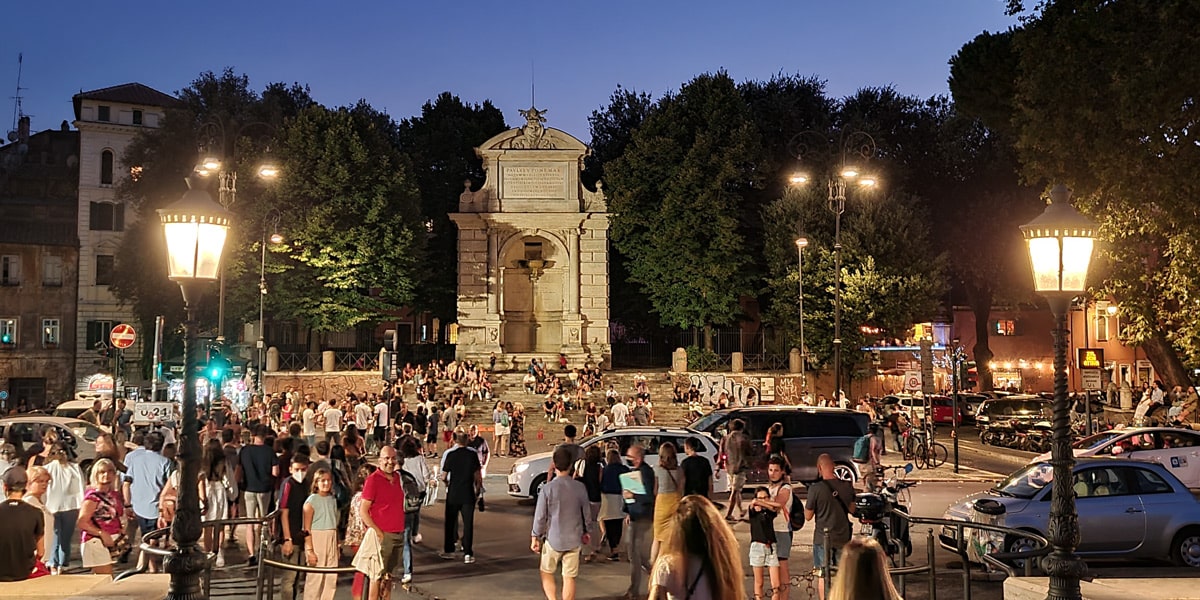
By day, the monumental fountain and broad flight of steps dominate the view. After dark, people gather on those steps with drinks while street musicians perform below. The square takes its name from a Roman dialect poet, but its fountain is older and has crossed the Tiber once already.
Piazza Trilussa sits where Ponte Sisto meets the Trastevere bank of the Tiber. The bridge is reserved for pedestrians, so many evening walks from Campo de’ Fiori, Palazzo Farnese, and the Campo Marzio quarter pass through this square. It acts as a natural threshold between the historic centre and the lanes of Trastevere.
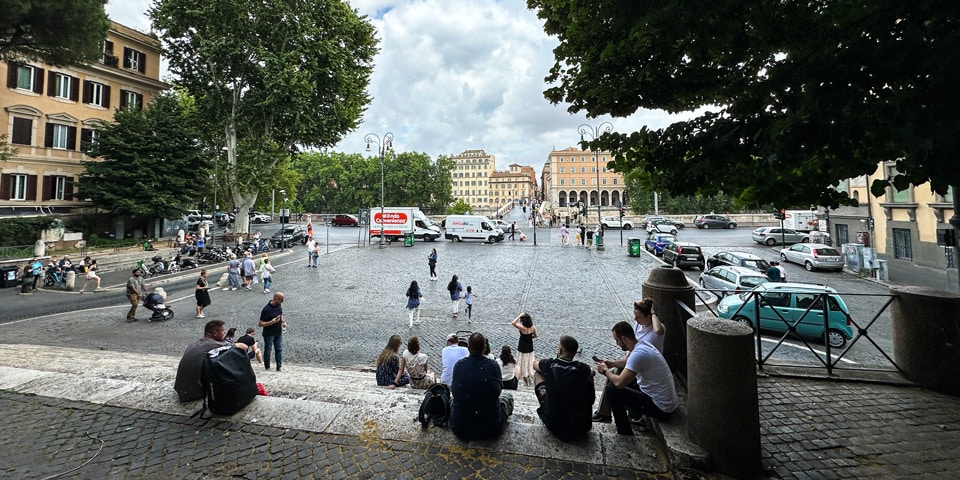
The wide steps below the fountain serve as public seating. On warm evenings, people arrive with a bottle and a paper cup, while street musicians set up at the foot of the stairs. Arrive before sunset for more choice of where to sit. Later in the evening, expect a louder and denser crowd.
The square is named for Carlo Alberto Salustri (1871–1950), a Roman poet who wrote under the pen name Trilussa. The name is an anagram of his surname, Salustri. That wordplay suits a writer known for approaching public life from an unexpected angle.
Trilussa wrote in romanesco, the dialect of Rome, rather than literary Italian. He used sonnets and fables to mock corrupt politicians, pompous officials, fanatics, and the self-satisfied middle class. His direct language made the criticism easy to remember and repeat.
One of his best-known poems, “La Statistica,” explains the deceptive comfort of an average through a chicken. If one person eats two chickens and another eats none, the official average still assigns one to each of them. The image became so familiar that Italy’s national statistics institute has used “Trilussa’s chicken” when explaining how a mean can conceal inequality.
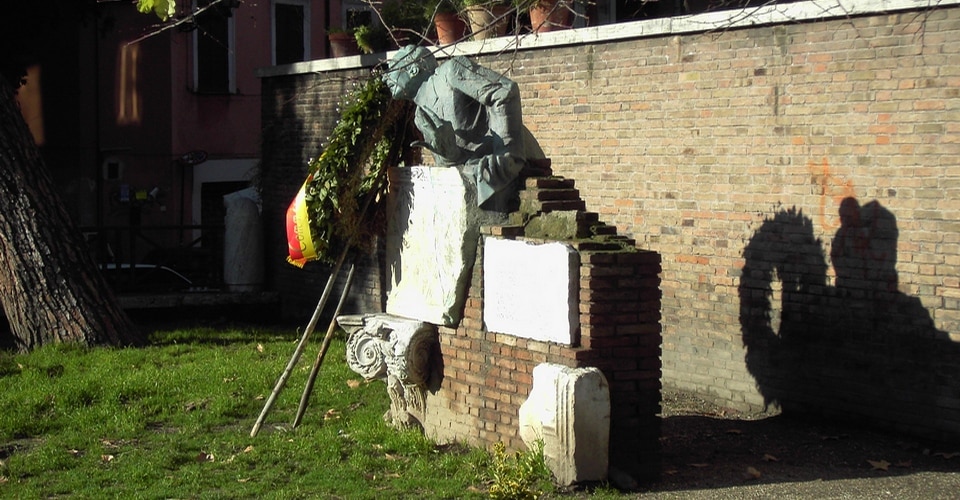
The bronze monument stands on the right side of the square when you face the fountain. Sculptor Lorenzo Ferri made it, and it was unveiled in 1954, four years after Trilussa’s death. The poet reclines against a fragment of ancient column as if pausing in thought. Some of his friends criticised the informal pose and complained that they could not recognise him.
Beside the statue, a marble slab carries his poem “All’Ombra” (In the Shade). Its speaker rests in the shade, greets a pig and a donkey by name, and enjoys being able to speak honestly without going to prison. The scene condenses Trilussa’s political humour into a few plain-spoken lines.
The monumental fountain above the steps is the Fontanone di Ponte Sisto. It is the smaller counterpart of the Fontanone dell’Acqua Paola on Janiculum Hill. The upper Latin inscription explains the connection. It records that Pope Paul V extended water brought to the summit of the Janiculum to this side of the Tiber for the use of the city. The inscription is dated 1613, the eighth year of his pontificate.
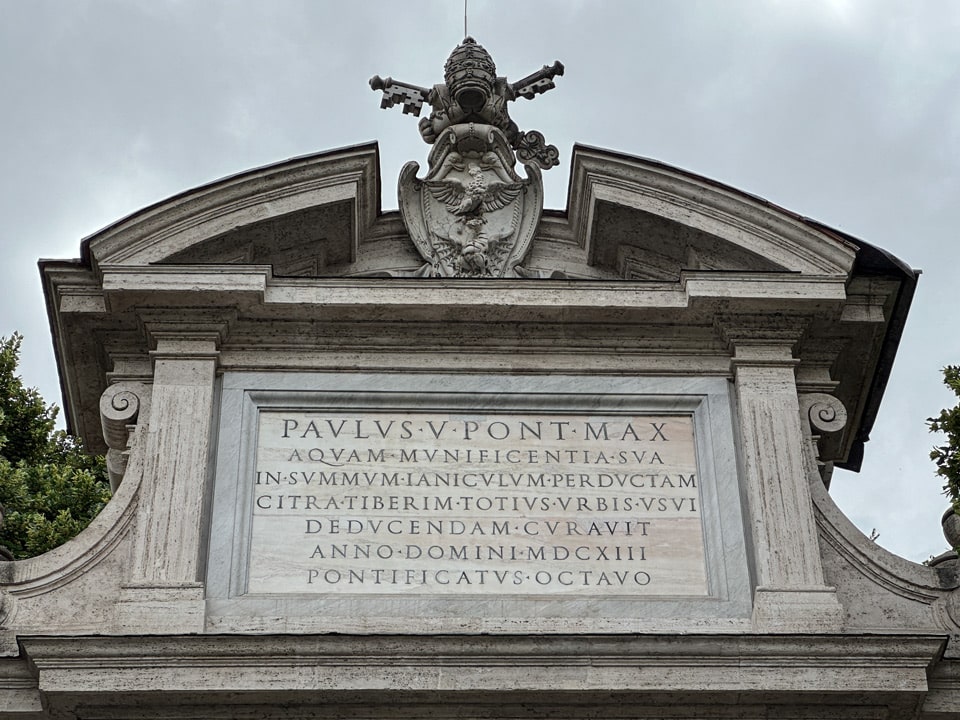
Paul V, born Camillo Borghese, restored the Acqua Paola aqueduct to supply Trastevere, Borgo, and districts across the river. This fountain became its second monumental public outlet. Architects Giovanni Vasanzio, the Dutch-born Jan van Santen, and Giovanni Fontana designed it. The pilasters display the dragons and eagles of the Borghese coat of arms, and water pours from the dragons’ mouths.
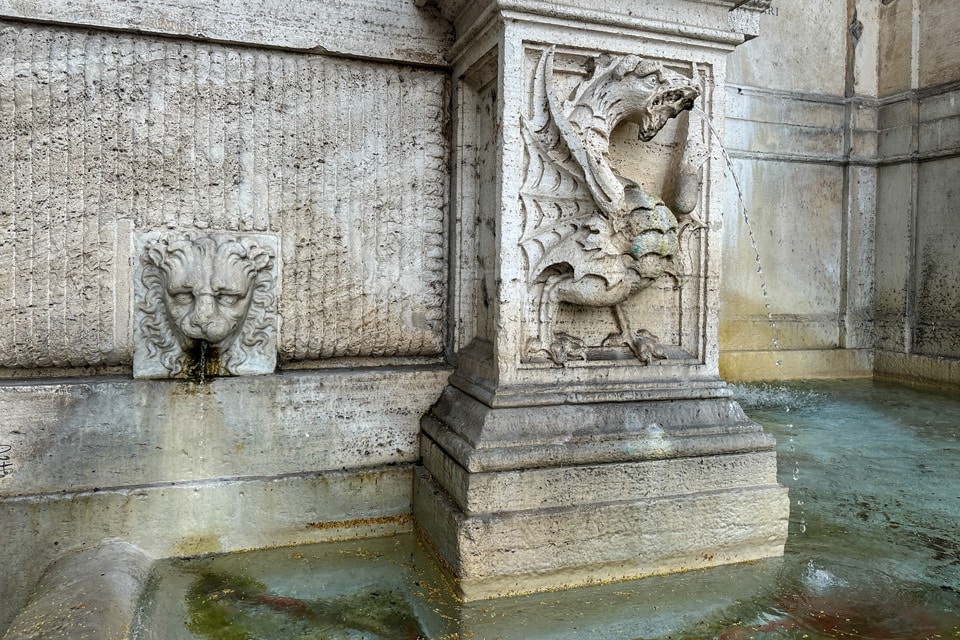
The fountain originally stood on the opposite bank of the river, at the head of Via Giulia, where it served the hospice of the Cento Preti. Rome removed it during the late 19th-century construction of the embankment walls along the Tiber. The structure went into storage, and many of its pieces were lost or dispersed among municipal warehouses.
In 1898, architect Angelo Vescovali reassembled the surviving elements in Piazza Trilussa. He raised the fountain above a new flight of steps and aligned it with Ponte Sisto. From its new position, it faces across the river and towards the larger Acqua Paola fountain on the Janiculum.
A second Latin inscription appears lower inside the niche. It records that the city moved the Acqua Paola nymphaeum from the head of Via Giulia to make room for the new embankment, then erected and restored it here.
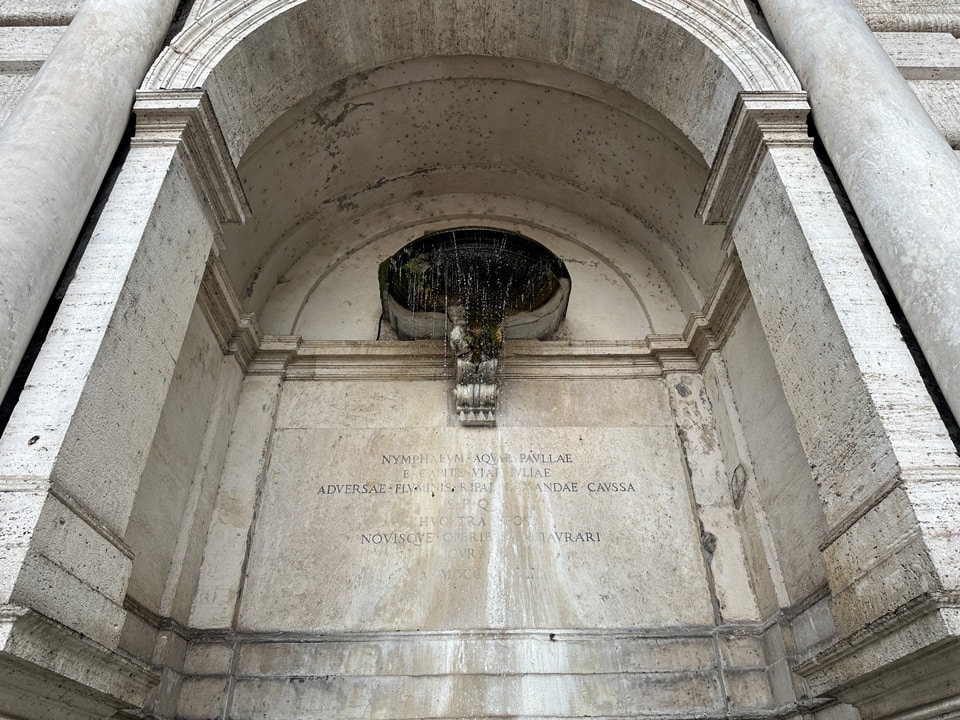
The present fountain combines the surviving elements of the 1613 Borghese monument with Vescovali’s 1898 reconstruction. Its location and alignment belong to the later project.
Piazza Trilussa works best as the start or end of a wider evening in Trastevere. The square itself has no restaurants on it to speak of, but it opens directly into the tangle of lanes that hold the neighbourhood’s best trattorias, bars, and gelaterias.
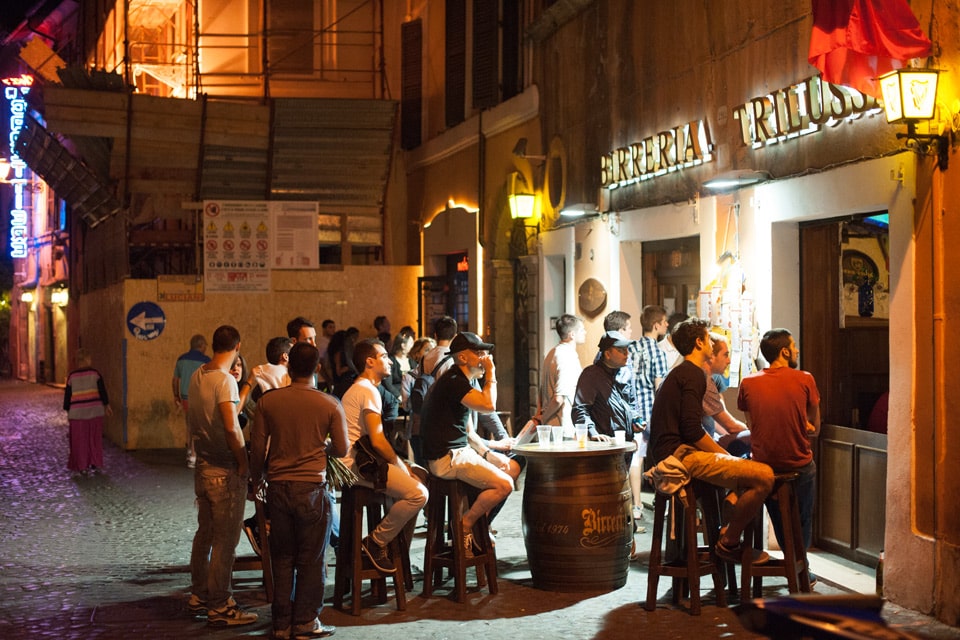
Down one of the cobbled lanes beside the square is Birreria Trilussa, a beer pub operating since 1974. On warm evenings, customers gather outside around barrel tables. It works as a convenient first or last stop during an evening walk through the neighbourhood.
The Basilica of Santa Maria in Trastevere and its medieval mosaics are about a five-minute walk away. Villa Farnesina and Palazzo Corsini are also nearby. For a simple evening route, cross Ponte Sisto before sunset, spend some time on the fountain steps, and continue towards Santa Maria in Trastevere for dinner.
RomeItaly.guide © 2026. Created with love by Roman experts and guides.