
991242 travellers read
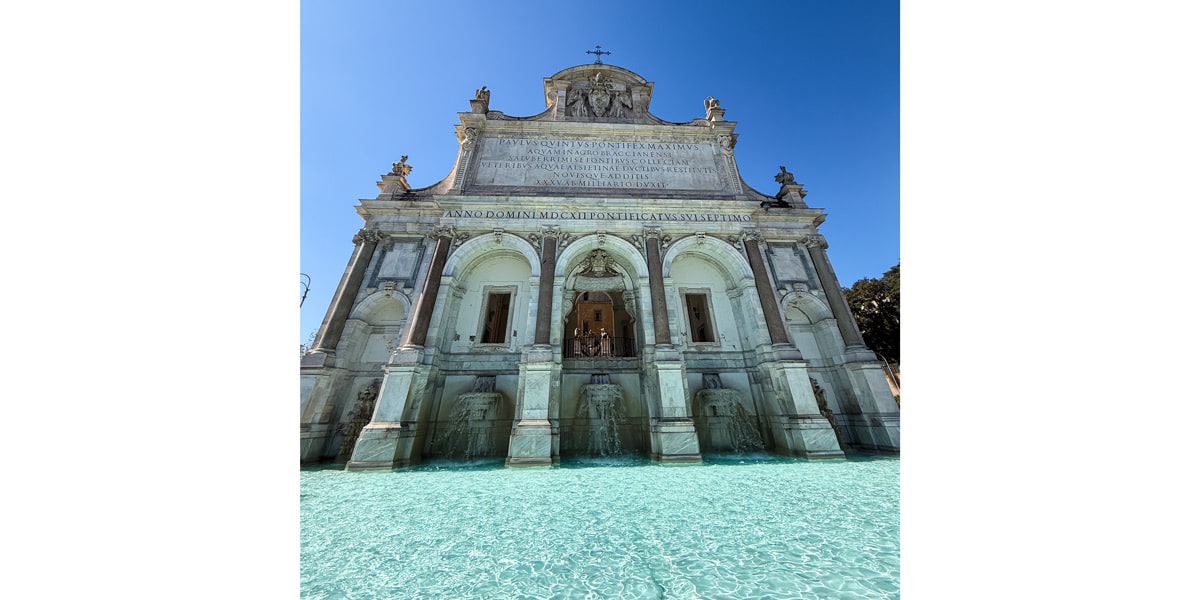
At the top of the Janiculum, five arches release water into a basin broad enough to resemble a reflecting pool. Romans call the fountain Il Fontanone, the Big Fountain. Its official name, Fontana dell’Acqua Paola, records the pope who brought a reliable water supply back to this side of Rome.
The scale makes sense once you know its purpose. This was the monumental termination, or mostra, of an aqueduct. It announced the arrival of water to the neighbourhoods beyond the Tiber and turned a major engineering project into papal architecture.
The fountain is also a useful starting point for reading the Janiculum. Its marble came from ancient monuments, its inscription names the wrong Roman aqueduct, and its side arches preserve records from Rome’s water administration. The panorama across the city begins directly behind you.
Pope Paul V Borghese commissioned the fountain after work began in 1608 to revive the ancient water route serving Trastevere and the Janiculum. Giovanni Fontana and Flaminio Ponzio designed the terminal display, built between 1610 and 1614.
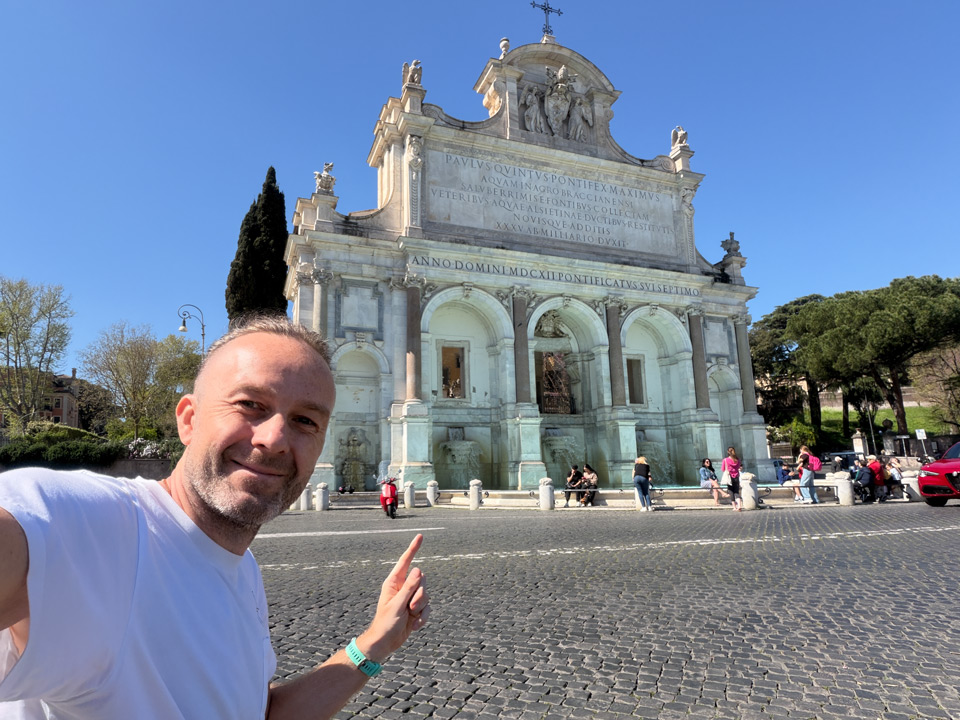
They borrowed the language of a Roman triumphal arch. Five openings divide the façade, with three taller arches in the centre and two smaller ones at the sides. Six granite columns frame them. An attic carrying the dedication rises above the water, followed by the Borghese arms and a cross.
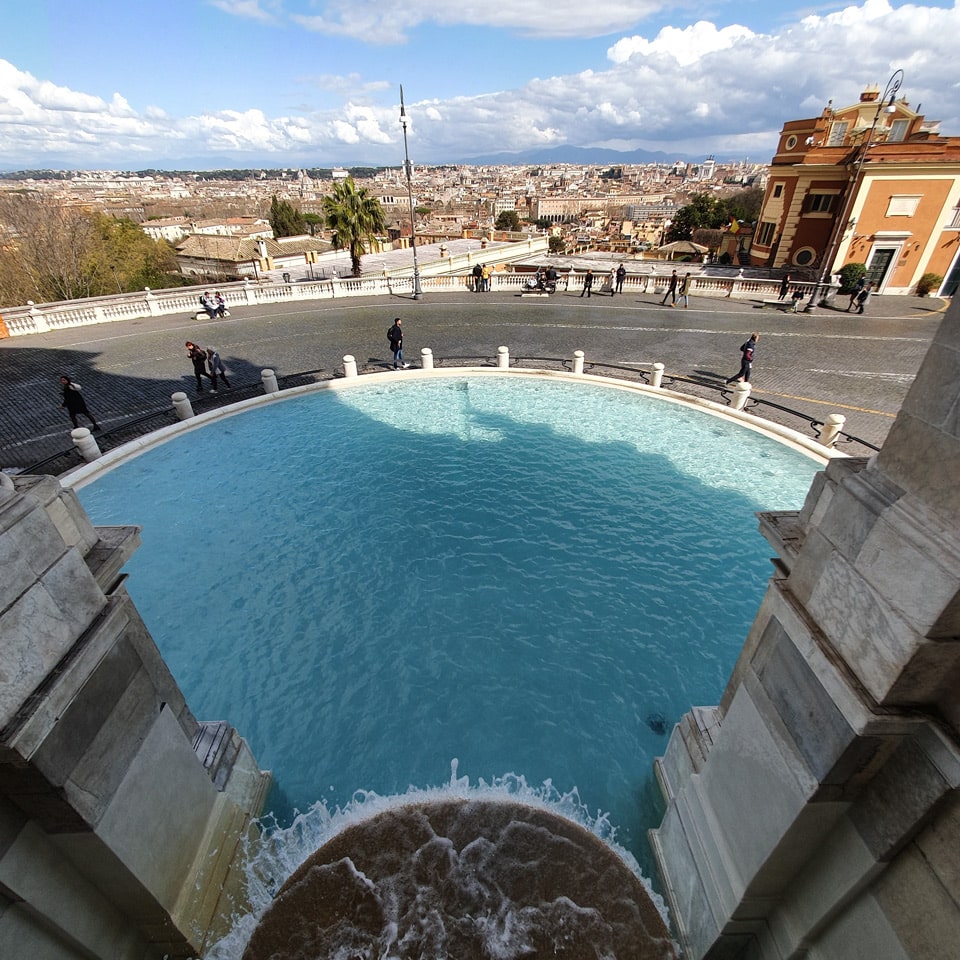
The present basin belongs to a later phase. Water originally fell into five separate receptacles beneath the arches. Between 1690 and 1693, Carlo Fontana replaced them with the sweeping semicircular pool seen today. His intervention gave the monument a stronger theatrical effect and created the curved foreground that defines most modern views of the fountain.
The façade suffered damage during the French assault on the Roman Republic in 1849. Later restorations repaired the structure, but its basic seventeenth-century composition survives.
The name Acqua Paola means the water of Paul. The pope’s engineers recovered much of the route of the Aqua Traiana, built for Emperor Trajan in AD 109. The ancient system had gathered spring water around Lake Bracciano and carried it towards the western side of Rome.
By Paul V’s reign, the districts across the Tiber needed a stronger supply. The reconstructed line combined ancient channels with new construction over a route of roughly 57 kilometres. Water reached the Janiculum in 1612 and later served public fountains, mills, gardens, and branches across Trastevere and the Vatican area.
Taxes on meat and wine helped finance the expensive project. The familiar Roman saying valere quanto l’Acqua Paola, meaning to be worth as little as Acqua Paola, has a different origin. The water initially came from springs. Its reputation deteriorated after lake water was added to the system later in the seventeenth century, reducing its quality.
The fountain therefore preserves two versions of Paul V’s project. The façade celebrates abundant and wholesome water. Roman speech remembers the period when that water no longer tasted so wholesome.
The inscription above the arches can be read from the terrace, although the letters become easier to distinguish with a camera zoom. It praises Paul V for bringing water from the Bracciano area during the seventh year of his pontificate.
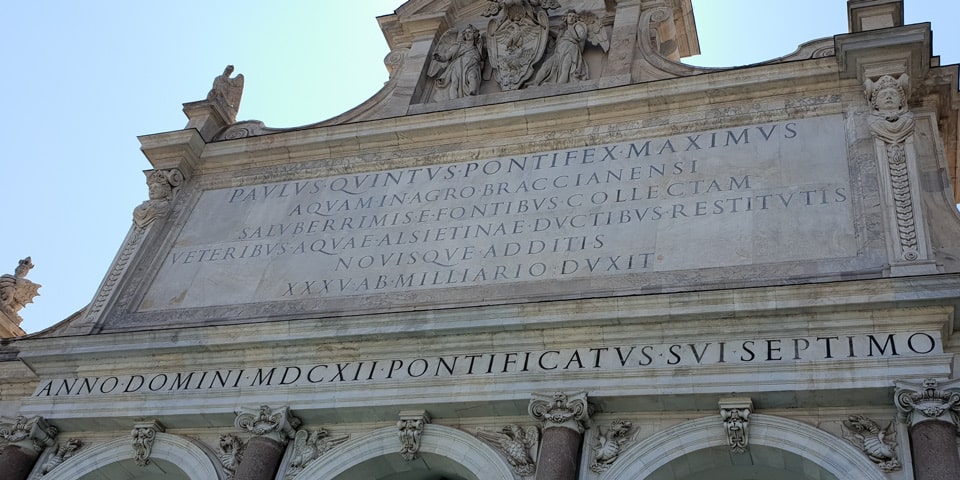
The Latin reads:
PAVLVS QVINTVS PONTIFEX MAXIMVS
AQVAM IN AGRO BRACCIANENSI
SALVBERRIMIS E FONTIBVS COLLECTAM
VETERIBVS AQVAE ALSIETINAE DVCTIBVS RESTITVTIS
NOVISQVE ADDITIS
XXXV AB MILLIARIO DVXIT
ANNO DOMINI MDCXII PONTIFICATVS SVI SEPTIMO
In English, it states that Pope Paul V collected water from healthy springs in the Bracciano territory and brought it from the thirty-fifth milestone after restoring old channels and adding new ones. The final line dates the work to 1612.
One phrase is wrong. The text identifies the ancient channel as the Aqua Alsietina, built under Augustus. Paul V’s engineers had actually reused much of Trajan’s aqueduct. The confusion was understandable because both systems approached Rome from the north-west and Frontinus, the principal ancient author on Roman aqueducts, wrote before the Aqua Traiana was completed. Raffaele Fabretti corrected the identification in his study of 1680, while later archaeological discoveries provided firmer physical evidence.
The error stayed in place. Recutting the dedication would have meant altering the papal monument itself, so the façade still advertises a seventeenth-century mistake in enormous letters.
Much of the fountain was assembled from older Roman material, including white and coloured marble from the Roman Forum and the Temple of Minerva in the Forum of Nerva. The red and grey granite columns had belonged to the Constantinian Old St Peter’s Basilica.
This reuse was deliberate as well as practical. Ancient stone gave the new aqueduct a visual connection with imperial Rome. Paul V could present his water project as the Christian revival of an achievement associated with Trajan.
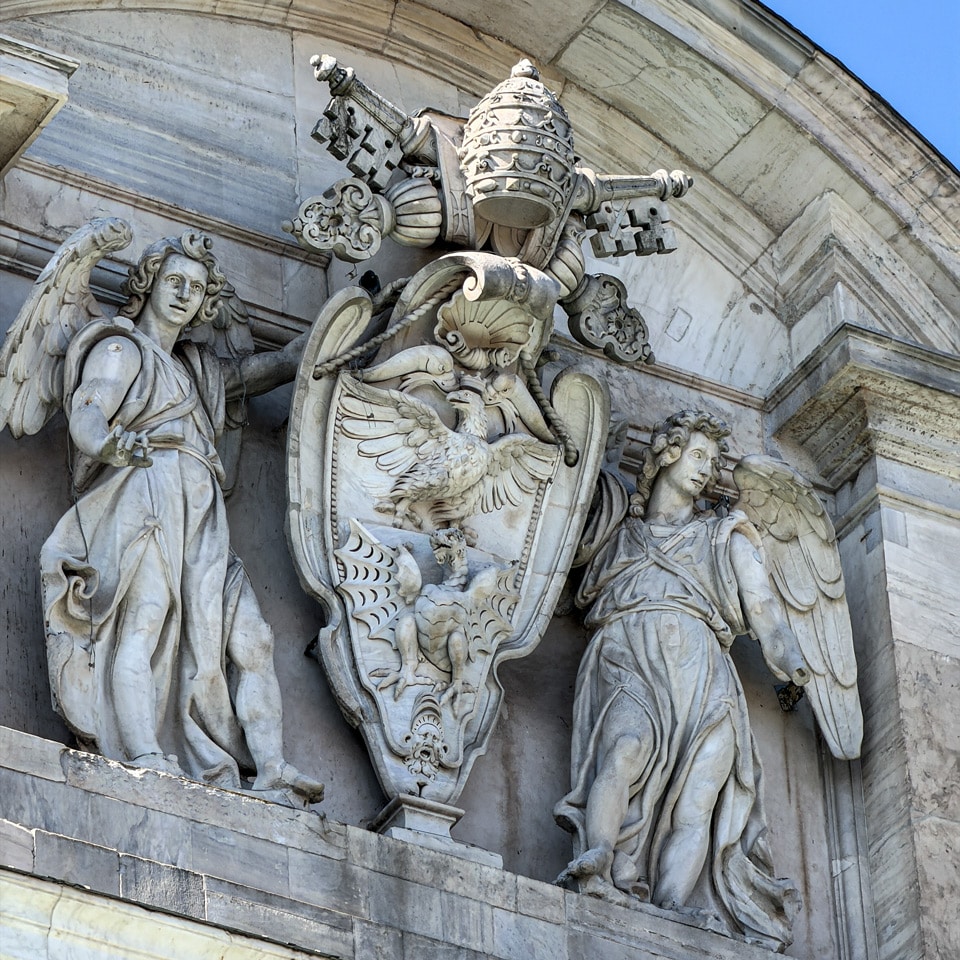
The upper section belongs unmistakably to the Borghese pope. His family shield combines an eagle with a dragon. Above it are the papal tiara and the crossed keys of Saint Peter, while two winged figures support the composition.
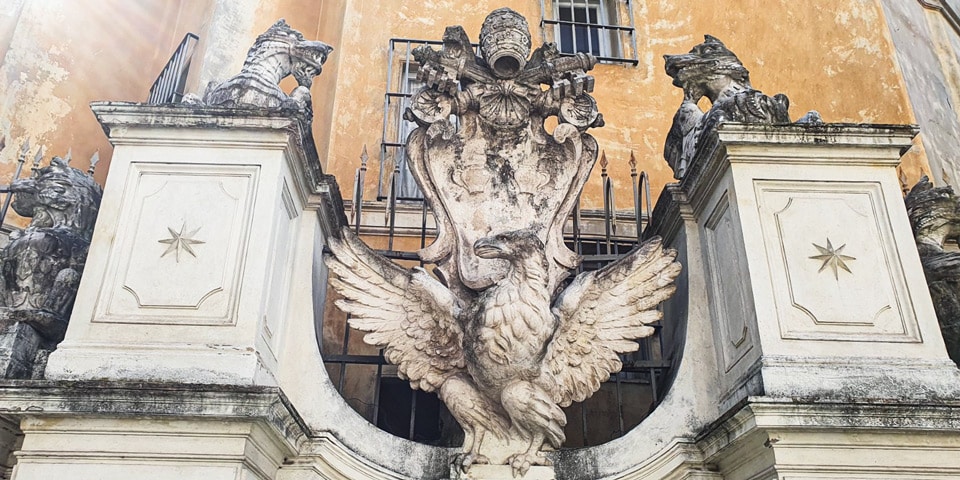
The eagle appears again on the gate beside the monument. That gate leads towards the reservoir area and the small garden behind the façade. The surviving enclosure helps explain why Il Fontanone feels like the entrance to an estate rather than an isolated street fountain.
From 1901 until the 1930s, water from the system also powered Rome’s first hydroelectric plant. That later use fits the monument’s original purpose: the architecture celebrates water because water was working infrastructure.
Step into the covered area at either end and examine the plaques mounted on the walls. Several concern the Acqua Vergine rather than Acqua Paola. They were preserved here as administrative records from the wider system of Roman water management.
One plaque carries the arms of Pope Sixtus IV and warns against breaking or piercing the channel of the Acqua Vergine. It also forbids construction beside the conduit and threatens violators with a fine of 500 scudi plus further penalties.
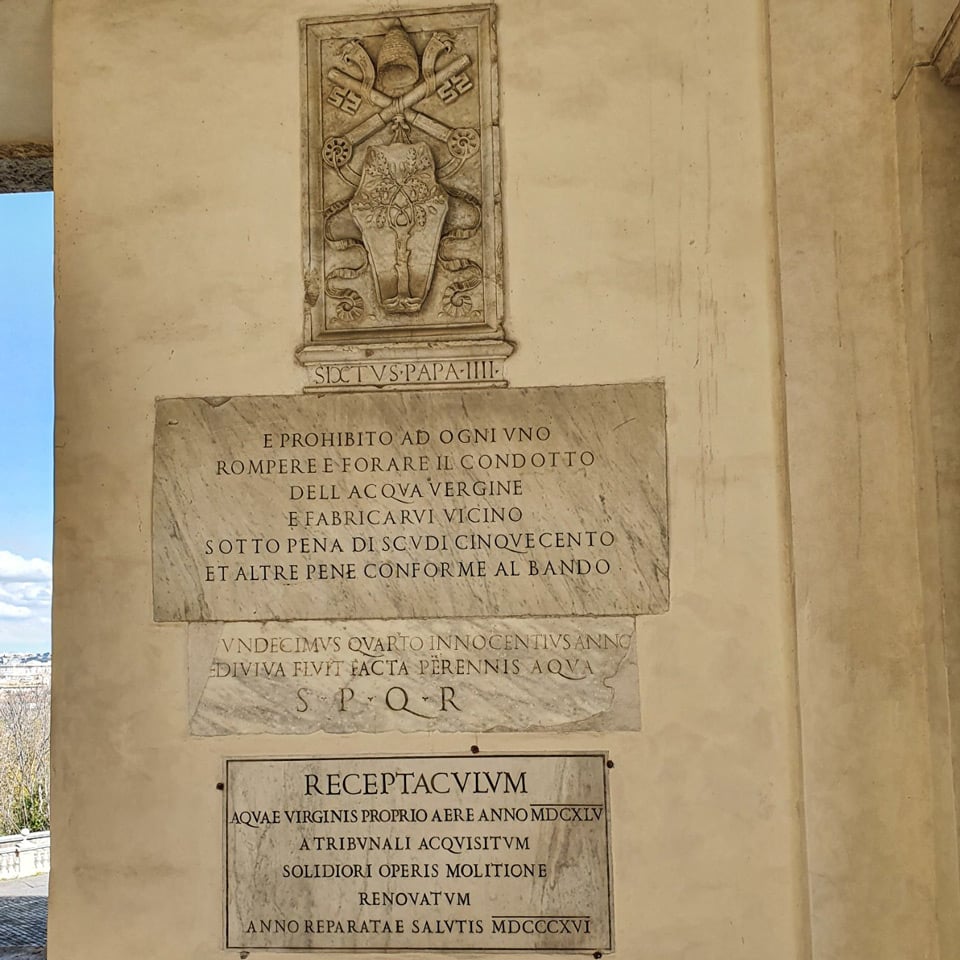
The sum was intended to deter anyone tempted to divert a public supply. Rome’s aqueducts served private properties as well as public fountains and institutions, so every unauthorised opening could affect users farther along the network.
A second plaque, dated 29 May 1720, works like an engineering diagram. Lines cut into the marble identify lead pipes and the properties entitled to use them, including Palazzo Borghese, the Greek College, and religious institutions. The map allowed officials to connect each branch with its legal owner after a rupture or dispute.
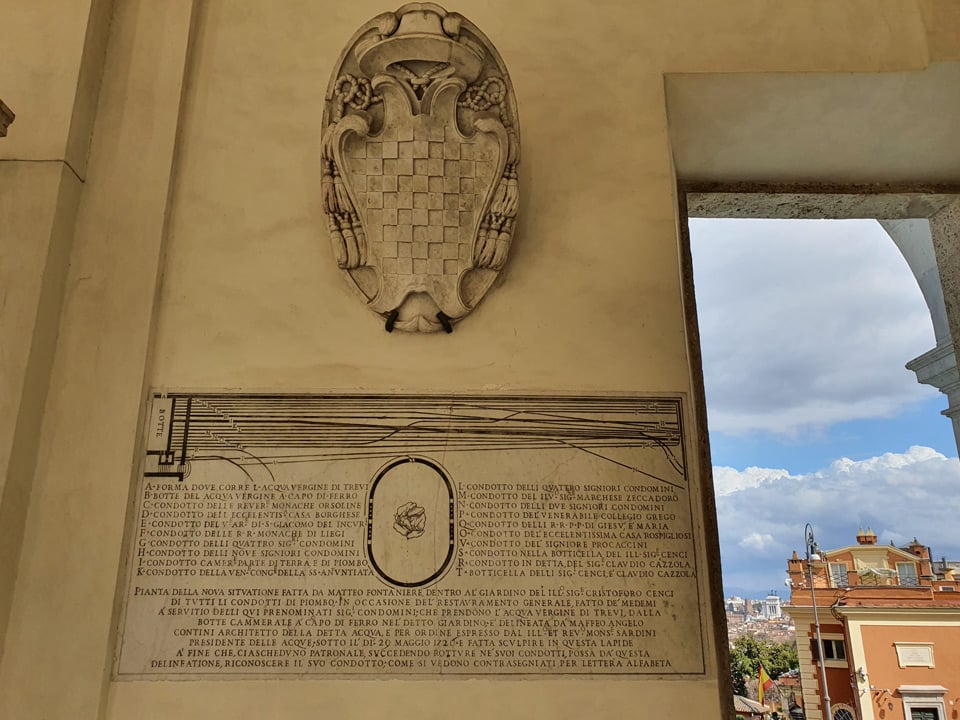
These stones are easy to overlook because they sit away from the main cascade. Together they form a small open-air archive where the grand façade presents papal authority and the side walls preserve the rules that kept water moving through the city.
Il Fontanone established an influential format for later Roman fountain displays. Its palace-scale triumphal-arch façade and broad foreground basin anticipated elements used with greater sculptural complexity at the Trevi Fountain.
The relationship is best described as architectural precedent rather than direct copying. Nicola Salvi worked with a different site and programme at Trevi, turning the façade of Palazzo Poli into a stage filled with figures and artificial rock. Even so, Acqua Paola had already shown how the end of an aqueduct could occupy the full scale of a palace frontage.
Film directors use the contrast between the cascading water and Rome’s distant skyline. The opening scene of Paolo Sorrentino’s The Great Beauty takes place here. A visiting tourist listens to a choir, turns towards the view, and collapses. That abrupt death introduces the film’s fascination with Rome’s beauty and the mortality beneath it.
Turn away from the fountain and the historic centre stretches eastwards across the roofs. The white mass of the Vittoriano is easy to identify. The twin towers of Trinità dei Monti rise farther left, while the low dome of the Pantheon requires a closer look among the buildings.
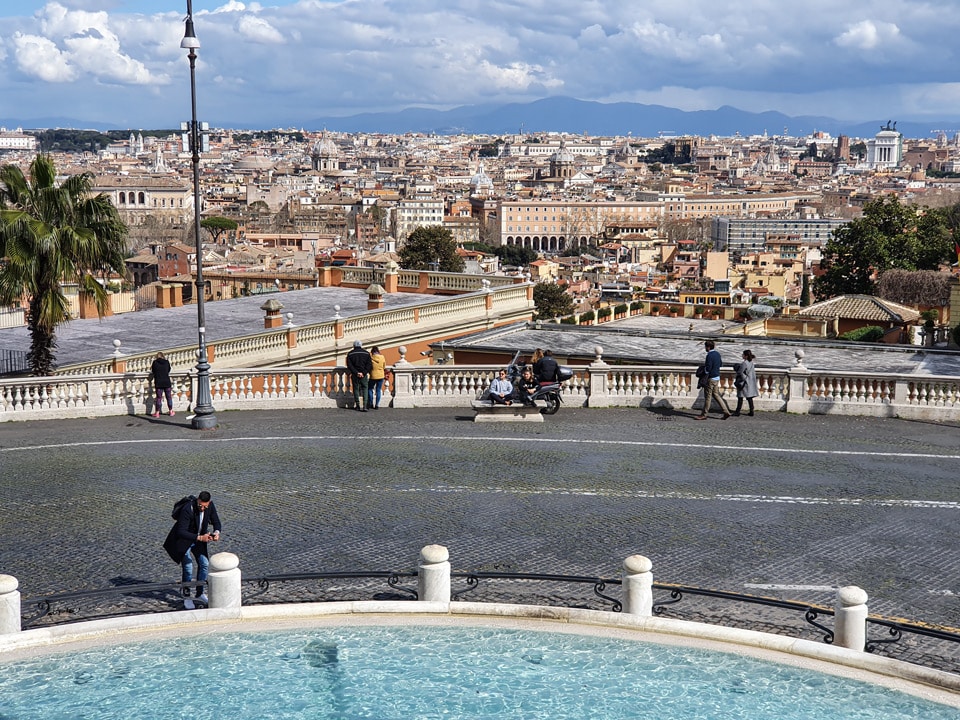
The fountain works best as part of a Janiculum walk. Porta San Pancrazio and the Museum of the Roman Republic stand a few minutes uphill. Continue along the promenade to reach Piazzale Garibaldi and its wider panorama.
I have brought guests here for years, and the reaction is usually the same: the scale surprises them first, then they turn around and notice the city. The quieter details come last. Walk close enough to read the mistaken aqueduct name, find the Borghese dragon, and inspect the marble pipe map before leaving.
RomeItaly.guide © 2026. Created with love by Roman experts and guides.