
991228 travellers read
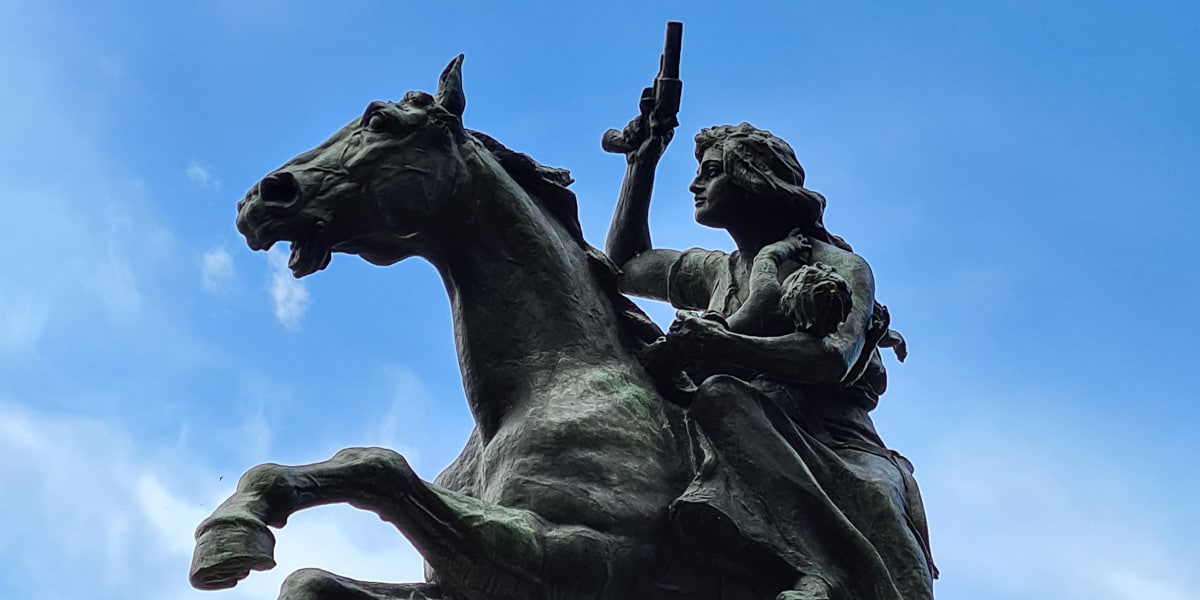
Anita Garibaldi rides above the Janiculum with a pistol in her right hand and her infant son held against her body. The pose feels cinematic. The pedestal gives it a different weight: Anita’s remains are buried inside it.
Mario Rutelli unveiled the monument in 1932. He combined episodes from Anita’s life in the mounted group and used four bronze reliefs to continue the story around the base. To understand the work, look beyond the horse and make a full circuit of the pedestal.
Ana Maria Ribeiro da Silva was born in Santa Catarina, Brazil, in 1821. She met the exiled Giuseppe Garibaldi near Laguna in 1839, during the Farrapos War, a republican uprising against the Brazilian Empire. She left her former life and joined a revolutionary force whose campaigns carried her from Brazil to Uruguay and eventually to Italy.
At Curitibanos in 1840, imperial troops captured Anita. She escaped on horseback while pregnant and rode back towards Garibaldi’s forces. Their first son, Menotti, was born at Mostardas on 16 September of that year. Soon afterwards, another imperial attack forced her to flee with the newborn.
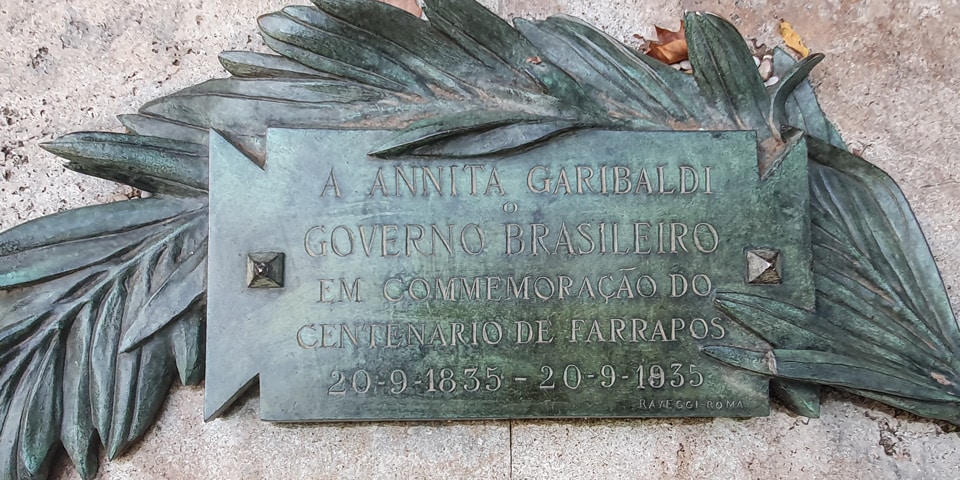
The Portuguese plaque beside the monument preserves the Brazilian part of her story. It reads: “To Anita Garibaldi, from the Brazilian Government, in commemoration of the centenary of the Farrapos Revolution, 20 September 1835 to 20 September 1935.” These dates mark the beginning and centenary of the revolt. They are not dates from Anita’s own life.
Anita and Giuseppe moved to Montevideo in 1841 and married there the following year. She returned to Europe with their children in 1847. In 1849, while pregnant again, she joined Giuseppe during the defence of the Roman Republic and followed the retreat towards Venice after the city fell. She died near Ravenna on 4 August, probably from malaria, at the age of twenty-seven.
Rome’s official description places the mounted scene shortly after Menotti’s birth. A cloth secures the child against Anita’s body. She grips the horse’s mane with her left hand and raises a pistol with her right as she escapes imperial soldiers.
The sculpture combines two episodes usually told separately. Anita’s long horseback escape after Curitibanos occurred while she was pregnant. Her flight with the newborn came later. Rutelli brought both moments together in one image that can be read from the ground within seconds.
Plans for an Anita monument began in 1905. The first competition drew 43 proposals, and a later invited round also failed to produce an accepted design. Ezio Garibaldi, a grandson of Anita and Giuseppe, revived the project in the late 1920s. The commission went to Mario Rutelli, the Sicilian sculptor whose work in Rome also includes the figures of the Fountain of the Naiads.
Rutelli’s 1929 model showed Anita racing on horseback with a pistol and no child. According to Roma Capitale, Menotti appears to have been added at Benito Mussolini’s suggestion. The change suited the message promoted by the Fascist government: Anita could be presented as a fighter while motherhood remained central to her public image. The monument was inaugurated on 2 June 1932, during events marking fifty years since Giuseppe Garibaldi’s death.
The bronze group is about 4.5 metres high and weighs roughly four metric tonnes. Both front legs of the horse rise clear of the base, so the original load passed through the two rear legs. That choice explains the steel support now visible beneath the animal.
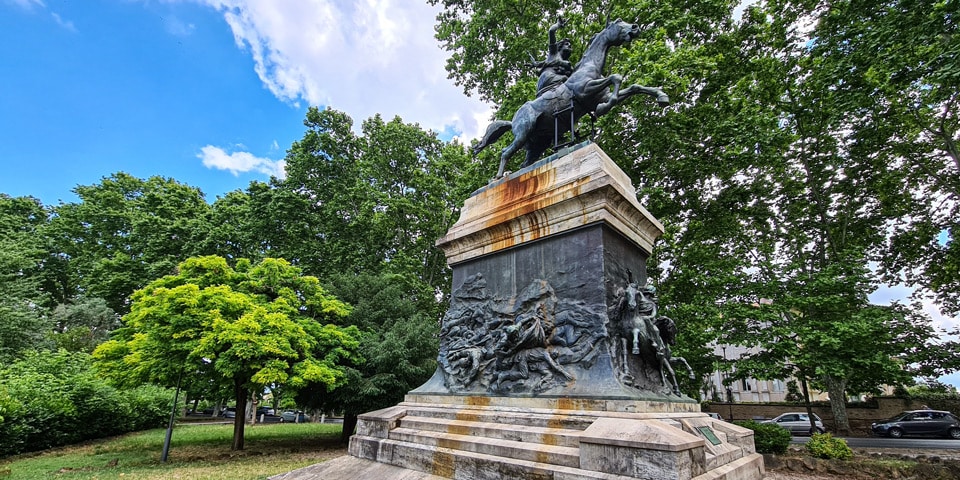
Corrosion affected the internal iron structure, and vertical cracks developed along the rear legs. During the restoration completed in February 2025, conservators placed a reversible steel prop between the horse and the base. Its padded saddle protects the bronze and permits thermal movement while the structure is monitored.
The rearing horse does not make Anita’s statue unique. An equestrian Joan of Arc erected in Montebourg, France, in 1899 uses a comparable pose, and copies of that design stand in several other towns. Rutelli’s composition remains unusual because it places a historical woman on the horse with both a weapon and a baby, above the tomb that holds her remains.
Four bronze high reliefs wrap the travertine pedestal. Rome’s official inventory identifies a separate episode on each side, beginning with the fighting at Curitibanos.
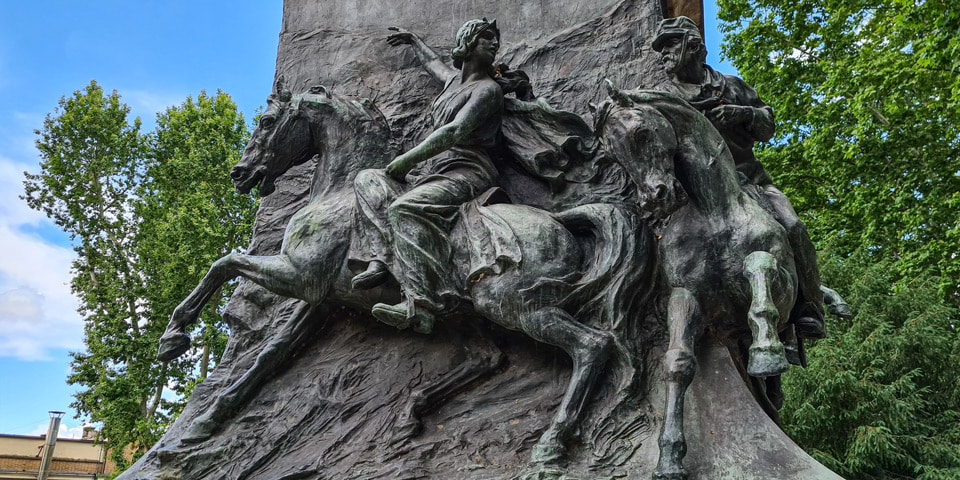
In the first scene, Anita rides at the head of the republican fighters and points forward. A bearded horseman follows her. His features may recall Giuseppe, although official descriptions identify the riders collectively and do not name this figure. The composition keeps Anita in command.
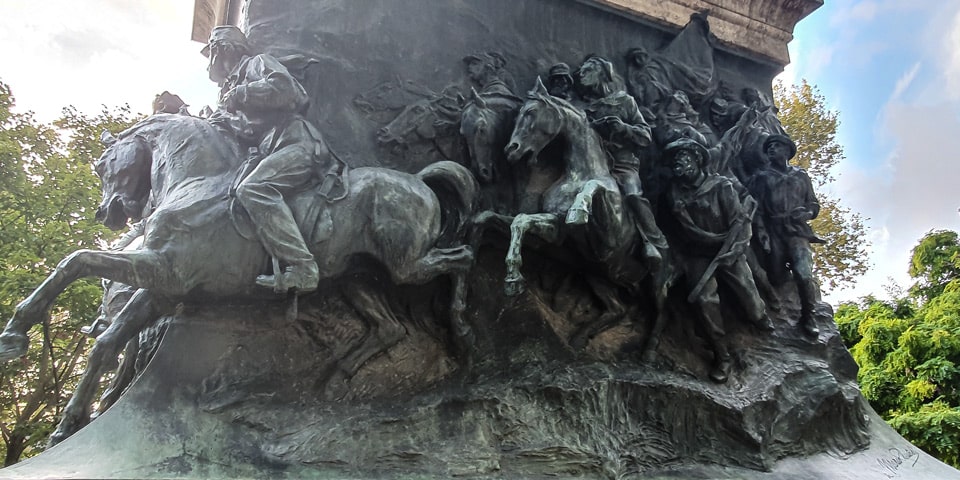
The next panel shows Anita watching the fighters. Horses push into the foreground, with riders and fabric crowded behind them. The dense modelling makes the scene difficult to read from a single angle, so step back and follow it around the corner.
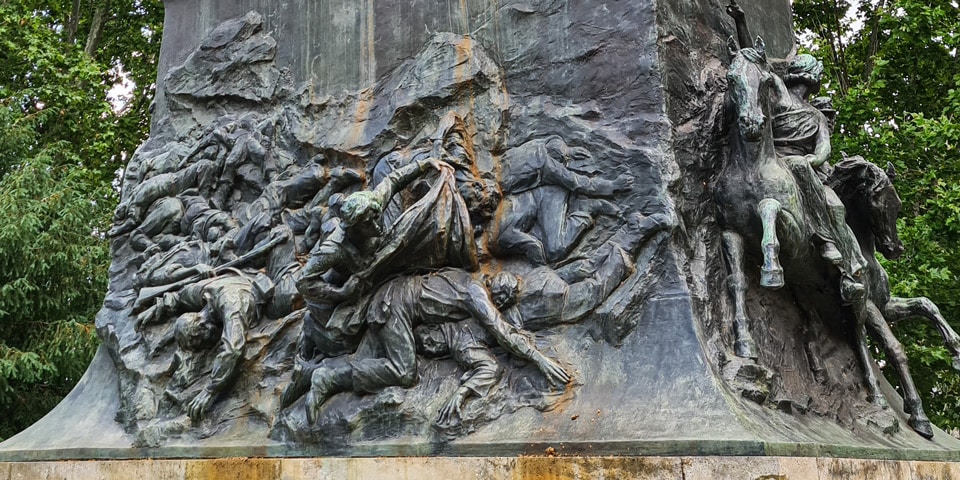
Another side moves from combat to its aftermath. It follows the traditional account that Anita, fearing Giuseppe had been killed, searched for him among the dead before escaping her captors. Her capture and escape are well established. The search across the battlefield comes from the heroic narrative preserved in Garibaldi’s memoirs and later retellings, so the relief records a remembered version of the event.
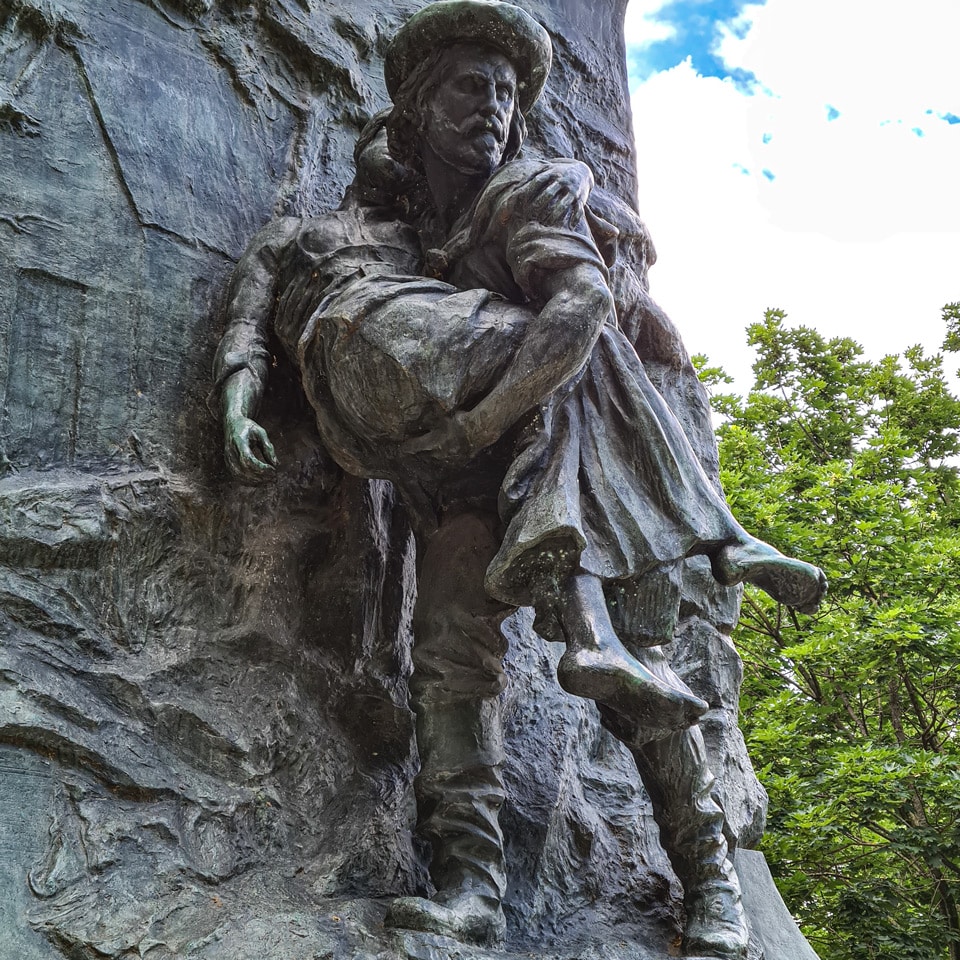
The final relief jumps to 1849. Giuseppe carries the exhausted Anita during the retreat from the fallen Roman Republic towards the Guiccioli farm near Ravenna, where she died. The image compresses the last stage of their journey into one scene. Above it, Anita holds their infant son. Below it, Giuseppe holds Anita.
Anita’s remains reached Rome after several burials. They were interred in the parish cemetery at Mandriole, then transferred to Nice in Giuseppe’s presence in 1859. In January 1932, they were moved to the Staglieno Cemetery in Genoa, then brought to Rome on 1 June for burial inside the new monument.
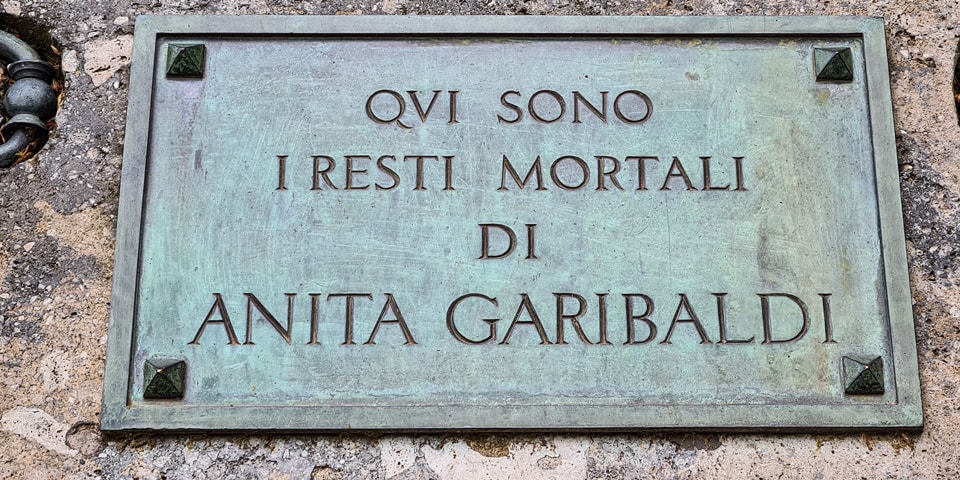
The bronze tablet reads QVI SONO I RESTI MORTALI DI ANITA GARIBALDI, which means “Here are the mortal remains of Anita Garibaldi.” QVI is deliberate. The inscription follows the monumental Roman convention of using V in place of U.
The mounted figure and the first three reliefs refer to Brazil. The location points to the final year of Anita’s life. The Janiculum was the main defensive ground of the Roman Republic in 1849, and its promenade later became Rome’s open-air memorial to the Risorgimento.
Start by looking at the cloth around Menotti and the modern support beneath the horse. Then walk around the pedestal in the order of the four reliefs. Finish at the tomb inscription before continuing to the nearby monument to Giuseppe Garibaldi or the Garibaldi Ossuary Mausoleum. That short circuit gives the statue context without requiring a separate museum visit.
RomeItaly.guide © 2026. Created with love by Roman experts and guides.