
991228 travellers read
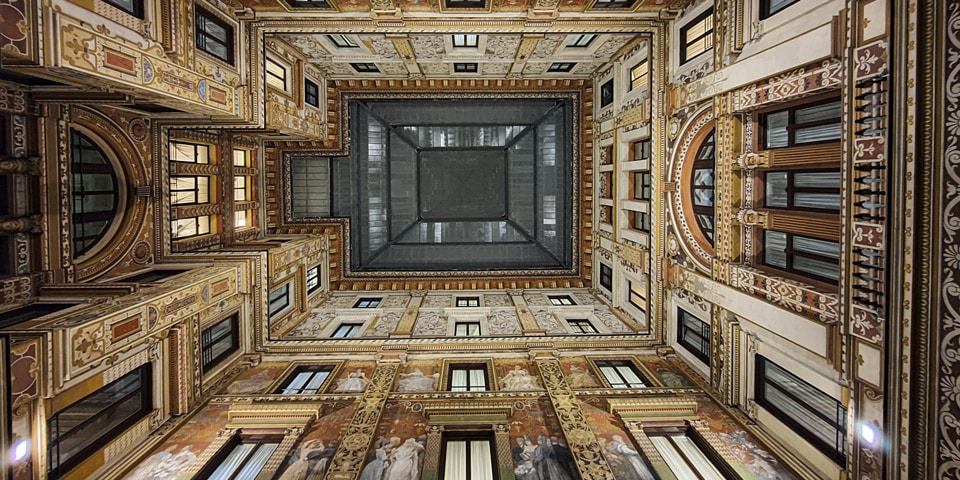
Galleria Sciarra is a covered courtyard near the Trevi Fountain. Walking between them takes less than three minutes. Its entrances look like passages into an office building, which is exactly what they are. Step inside and the scale changes: four painted levels rise beneath an iron-and-glass roof, with female figures, Latin inscriptions, family monograms, and scenes of nineteenth-century domestic life covering the walls.
The privately owned courtyard remains a pedestrian passage during office access hours, with free entry. Crossing it takes less than a minute; reading the decoration takes longer.
Rome was changing quickly in the 1880s. The city had recently become the capital of unified Italy, and the blocks around Via del Corso were being adapted for new streets, offices, newspapers, theaters, and shops. Prince Maffeo Barberini-Colonna di Sciarra commissioned Galleria Sciarra as part of this redevelopment.
Architect Giulio De Angelis designed the covered passage to connect spaces used by the prince and his publishing businesses. The complex housed activities associated with the newspaper La Tribuna and the literary journal Cronaca Bizantina, briefly directed by Gabriele D’Annunzio. Cast-iron columns and the glazed roof brought the materials of contemporary European commercial architecture into a courtyard still framed by classical forms.
The work began in the middle of the decade, and the painted decoration was completed in 1888. Maffeo later suffered severe financial problems during the banking and property crisis of the 1890s. The surviving evidence does not justify blaming the gallery alone for his ruin, although the building belongs to the ambitious phase of development that preceded it.
A major restoration in the 1970s reinforced the structure with concrete while preserving its exterior decoration. The courtyard therefore combines an 1880s artistic program with substantial modern structural work hidden behind the painted surfaces.
Giuseppe Cellini painted the central court in encaustic, using pigments mixed with Punic wax. Literary critic Giulio Salvadori devised the iconographic program. Its title was the Glorification of Women. The cycle follows the respectable female life imagined by upper bourgeois culture, from daughterhood through marriage and motherhood.
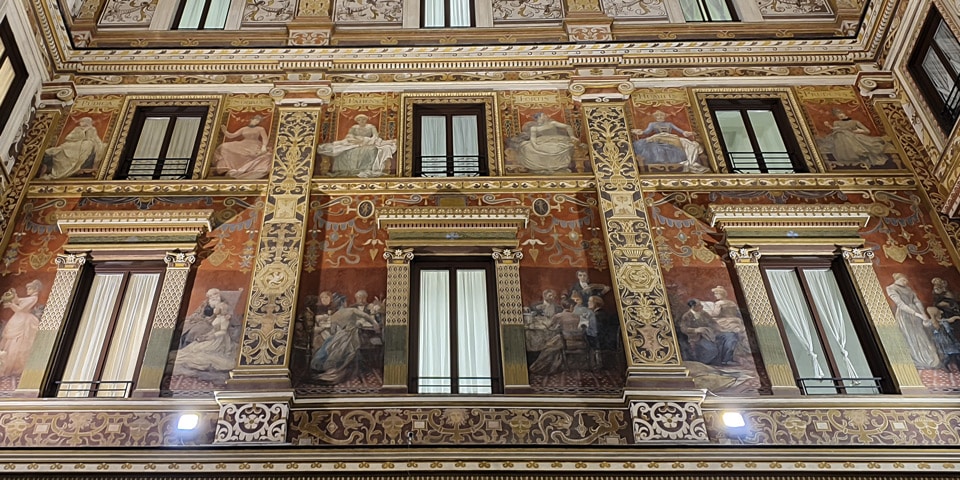
The upper register presents personifications of virtues. Their Latin labels include Pudica (modest), Sobria (self-controlled), Fortis (strong), Humilis (humble), Prudens (prudent), and Patiens (patient). Across the courtyard appear figures identified as kind, faithful, lovable, merciful, just, and ladylike.
Below them, the abstract qualities become scenes from daily life. Women tend a garden, prepare for marriage, care for children, receive guests, make music, share a family meal, and perform charity. The cycle records the behavior that respectable society expected from women at the time. It is valuable today partly because those expectations are displayed so openly.
The family tribute is woven into the ornament. The initials CCS refer to Carolina Colonna di Sciarra, Maffeo’s mother, while MS identifies the prince. The young man in the scene usually called The Gallant Conversation is commonly identified as Gabriele D’Annunzio. His literary career was connected with the publishing circle based in the Sciarra complex.
The Latin is part of the painted argument. Salvadori matched quotations from classical literature to the scenes around them, so the inscriptions tell visitors how the images were meant to be understood.
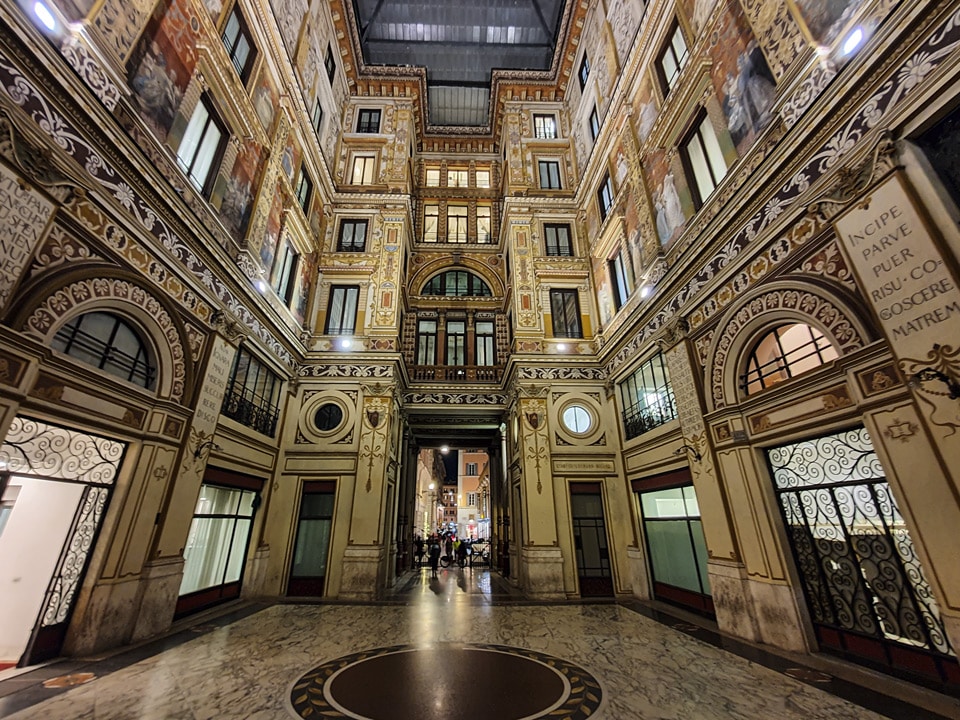
One pillar carries a line from Virgil’s fourth Eclogue:
Incipe, parve puer, risu cognoscere matrem.
Begin, little child, to recognize your mother with a smile.
Its position beside a cycle honoring motherhood is deliberate. The poem also acquired a Christian afterlife: medieval and Renaissance readers interpreted its promised child and new age as a pagan anticipation of Christ. A visitor in the nineteenth century could therefore recognize both the family meaning and the older religious association.
Another pillar quotes Queen Dido in Book 1 of the Aeneid:
Non ignara mali, miseris succurrere disco.
No stranger to suffering, I am learning to help the unfortunate.
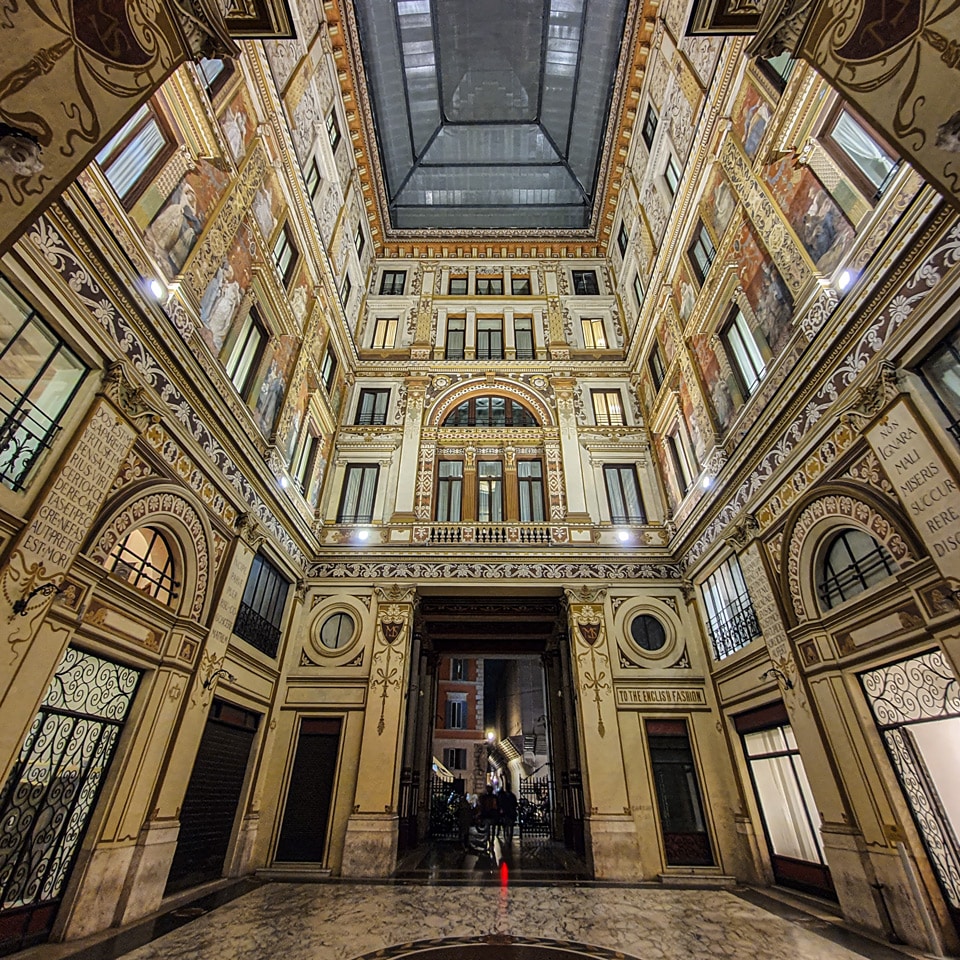
Dido speaks these words after welcoming Aeneas and the shipwrecked Trojans to Carthage. In Galleria Sciarra, the verse accompanies the theme of charity. Knowing the source turns the Latin from background ornament into a precise commentary on the painted action.
The passage runs between Via Marco Minghetti and Piazza dell’Oratorio. Since the surrounding building remains in office use, its gates may be closed in the evening or on holidays. The current access information belongs in the visitor widget at the beginning of the page.
Once inside, stop near the center. Do not walk straight through. Start with the labeled virtues in the upper register. Then follow the domestic scenes below and finish with the Latin quotations on the pillars. This order makes the program much easier to understand.
Allow about ten minutes unless you want to study every panel. Galleria Sciarra fits naturally between the Trevi Fountain and the Pantheon; the Spanish Steps are also within walking distance. This small courtyard gives a compact lesson in the new capital of Italy. Modern architecture meets classical literature and the conservative social ideals promoted by the prince’s publishing circle on the same walls.
RomeItaly.guide © 2026. Created with love by Roman experts and guides.