
RomeItaly.guide
  • About us
  • Where to Stay
    • Best 3-Star Hotels
    • Hostels for Solo Travellers
    • Hotels with Views
    • Near the Colosseum
    • Near Termini Station
  • Ancient Sites
    • Baths of Diocletian
    • Castel Sant’Angelo
    • Colosseum
    • Pantheon
    • Roman Forum
  • Visiting Vatican
    • Sistine Chapel
    • Vatican Museums
    • St Peter’s Basilica
    • St Peter’s Dome
  • Museums & Galleries
    • Ara Pacis Augustae
    • Borghese Gallery
    • Palazzo Farnese
  • Hills
    • Aventine
    • Capitoline
    • Janiculum
    • Pincian
  • Fountains & Squares
    • Acqua Paola
    • Altar of the Fatherland
    • Bernini’s Elephant
    • Four Rivers Fountain
    • Piazza Navona
    • Spanish Steps
    • Turtle Fountain
    • Trevi Fountain
  • Parks & Gardens
    • Knights of Malta Keyhole
    • Orange Garden
    • Rose Garden
    • Villa Doria Pamphilj
    • Villa Borghese
    • Villa Sciarra
    • Umbrella Pine Trees
  • How to Get
    • Fiumicino Airport ➡️ Rome
  1. Home /
  2. Famous Catholic Churches in Rome /
  3. Holy Stairs (Scala Santa) in Rome

Holy Stairs (Scala Santa) in Rome

Written by: Kate Zusmann

The Holy Stairs (Scala Santa) in Rome
Tip

Masses at the sanctuary: Monday–Saturday 06:30, 07:30, 08:30 and 17:30; Sunday and holidays 07:30, 09:30, 11:30 and 17:30.

Confessions: Monday–Saturday 09:00–12:00 and 15:30–18:00; Sunday and holidays 07:30–12:00 and 16:00–18:30.

Opening hours
Sunday: 7:00 AM - 1:30 PM, 3:00 PM - 6:00 PM
Monday: 6:00 AM - 1:30 PM, 3:00 PM - 6:00 PM
Tuesday: 6:00 AM - 1:30 PM, 3:00 PM - 6:00 PM
Wednesday: 6:00 AM - 1:30 PM, 3:00 PM - 6:00 PM
Thursday: 6:00 AM - 1:30 PM, 3:00 PM - 6:00 PM
Friday: 6:00 AM - 1:30 PM, 3:00 PM - 6:00 PM
Saturday: 6:00 AM - 1:30 PM, 3:00 PM - 6:00 PM
Recommended tour
Closest bus stops
P.Za S. Giovanni In laterano3 min 138 m: 16 85 87
Porta San Giovanni2 min 120 m: 16 81 85 87
Closest subway stations
Manzoni9 min 435 m: A
Lodi 19 min 936 m: C
Address P.za di S. Giovanni in Laterano, 14, Roma
Website https://www.scala-santa.com/informazioni/

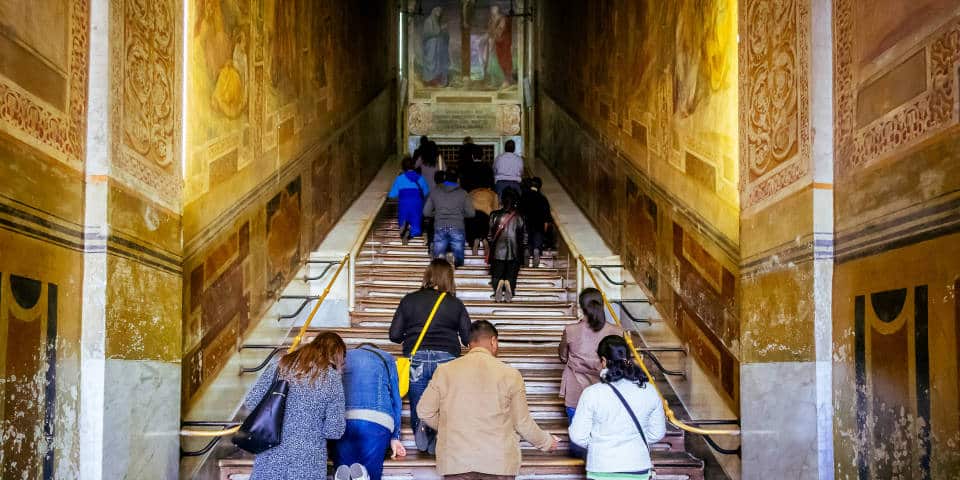
La Scala Santa (Holy Stairs), located in Rome, is one of the most valuable relics of the Christian faith. Twenty-eight marble steps lead to the Holy of Holies (Latin: Sancta Sanctorum), the chapel of the popes, located in the Lateran Palace (Italian: Palazzo del Laterano).

The legend says it is the very stairs down which procurator Pontius Pilate walked Jesus Christ to judgment.

Contents

Toggle
  • Things to Know Before Visit Holy Stairs in Rome
  • History
  • Architecture
  • Interesting Facts
  • Things To Do After Visiting the Holy Stairs

Things to Know Before Visit Holy Stairs in Rome

Can I climb up the Holy Stairs in Rome?
Yes, of course. Climbing the holy stairs is an essential act of worship for all Christians. To make the pilgrimage, you must climb 28 steps on your knees.
Was Jesus crucified in Rome?
No, Jesus was not crucified in Rome. Instead, the Bible describes the execution of Jesus of Nazareth in Jerusalem under Roman rule at the beginning of the Christian era (between 30 and 36 AD).
Did Jesus ever walk in Rome, Italy?
Jesus himself never came to Rome in Italy. However, in Rome, many places are associated with the worship of Jesus thanks to his followers, the apostles Peter and Paul.
Who brought the Holy Stairs to Rome?
The Holy Stairs was brought to Rome from Pontius Pilate’s palace in Jerusalem in 326 by Saint Helena, mother of the Roman Emperor Constantine after she had converted to Christianity.
What are the famous steps in Rome?
The most famous steps in Rome are:


  1. Spanish Steps, leading from the Spanish Square to the French monastery church of Trinita dei Monti.
  2.  

  3. The Capitoline Hill cordonata, leading from Piazza d’Aracoeli to Piazza del Campidoglio
  4.  

  5. Holy Steps, on which the son of God, condemned to death, stepped.

History

According to the Holy Scripture, the trial of Jesus was held in Pilate’s property (Pretoria) in Jerusalem. Sentenced to death, the son of God went along wide marble steps. Pontiff Sergius II writes that in the 4th century AD, the relic remained in Rome due to Iulia Helena Augusta, mother of Emperor Constantine I. Bishop Sylvester I received gifts from her and ordered to establish the relic in the papal palace.

At the end of the 16th century, Lateran Palace was significantly reconstructed. The Scala Santa acquired its current location. It is also assumed that 4 more steps were added to the original 24 ones. Construction works were carried out in a short time, workers did not dare to desecrate the relic with their feet. The staircase was set out from top to bottom.

By the end of the 19th century, the worship of the Scala Santa or Stairs of Pilate (Latin: Scala Pilati) had reached its peak. Numerous pilgrims flocked to the Lateran Palace on the eve of all the great church holidays. People gathered to walk the way from the foot of the stairs to the Basilica of San Lorenzo (Italian: Cappella di San Lorenzo in Palatio) on their knees reading the appropriate prayers at every step. Finally, they had to cover marble under the wooden blades to prevent it from complete destruction.
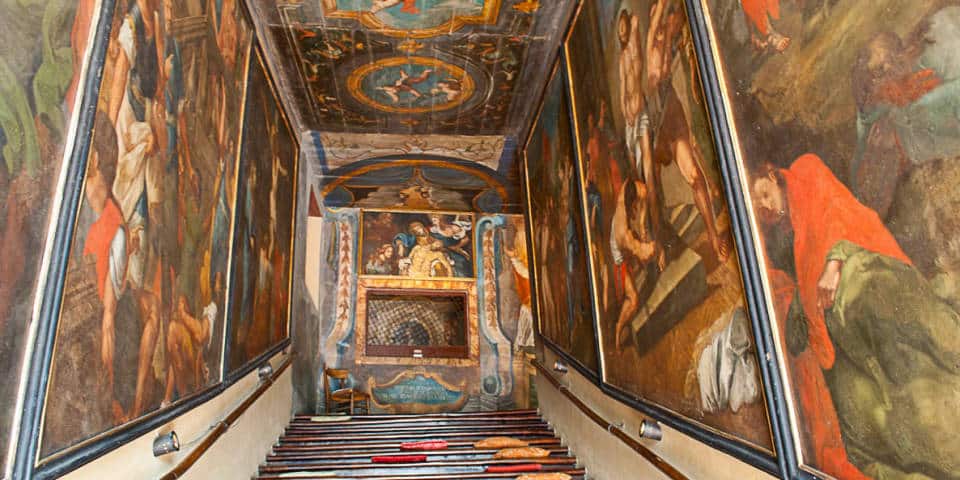
Scala Santa

Visitors can see marks traditionally associated with the Saviour’s suffering on the way to Calvary. The slits in the form of a cross on the protective wooden panels allow reach the most valuable relics of the Holy Stairs. Now the stairs have unique windows with a good field of view which are mounted on the 2nd, 11th, and 28th steps.

Architecture

The frescoes of medieval painter Baldassare Croce create a special atmosphere on the path leading to the Sancta Sanctorum. The centrepiece is a painting depicting crucified Christ, Mother of God, and St. John. The rest of the illustrations of the Holy Scripture emphasize the importance of the Lateran Palace and the Scala Santa.

In 2007, the stairs were restored, and Croce’s works found lost colours and expressiveness.
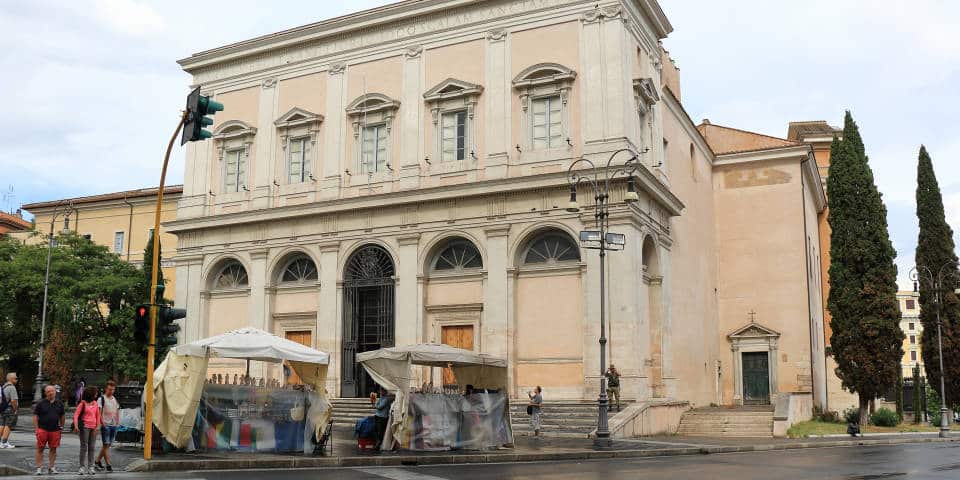
Holy Stairs in Rome

Near the Scala Santa’s first step is two white marble statues. One of them is “The Kiss of Judas” by Alberto Giacometti, and the second is “Pilate’s court” made by the same sculptor. Giacometti lived and worked in the XX century; his works are dated from 1901 to 1966.

Interesting Facts

It is believed that the pilgrims who have climbed the Scala Santa during the celebration of a great post (every Friday) acquire indulgence. During all the other days, visitors get a partial remission of sins if they walk all the steps on their knees with an open and humble heart.

Being on the ancient steps, Catholics send up “Prayers while climbing the Scala Santa” and Orthodox, Akathist to the Divine Passion of Christ.

There are sidesteps to the Holy of Holies passing a series of worshipers on bended knees.

The Basilica of San Lorenzo or Sancta Sanctorum, where the steps lead, is where the treasures of the Roman pontiffs are kept. The chapel’s most valuable property is the miraculous icon with the face of the Saviour Akeropit (the 6th century AD).

Things To Do After Visiting the Holy Stairs

After visiting the holy stairs, I recommend taking a tour of the San Callisto Catacombs and, of course, visiting the Archbasilica of St. John Lateran.

Author: Kate Zusmann

Kate Zusmann

I’ve lived in the Eternal City for the past 12 years. They say every corner of Rome holds a story, and I’m here to share some of the most fascinating historical facts and local legends.

Dive Deeper into Rome's Stories

Vatican Museums Visitor Guide

992108 travellers read

The Vatican Museums

Rome Italy Tourist Attractions

29399 travellers read

Top 30 Attractions in Rome

Beste Hotels in Rom mit Aussicht

11398 travellers read

Best Hotels with Views in Rome

How to Book Vatican Museums & Sistine Chapel Tickets

16750 travellers read

How to Book Vatican Museums & Sistine Chapel Tickets

St. Peter's Basilica dome seen through the trees from the far side of Piazzale Garibaldi, Rome

12082 travellers read

Janiculum Hill (Gianicolo): Viewpoints and Walking Route

The Church of the Gesù in Rome

16 travellers read

Church of the Gesù

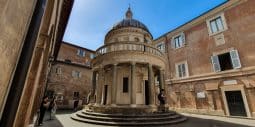
Tempietto del Bramante in the courtyard of San Pietro in Montorio on Janiculum Hill

1072 travellers read

Tempietto del Bramante

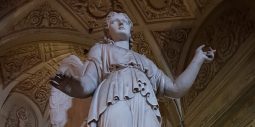
Marble angel beside the high altar inside San Pietro in Montorio

613 travellers read

Church of San Pietro in Montorio

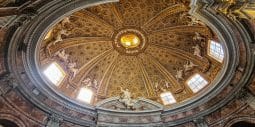
The Church of Saint Andrew on the Quirinal

2433 travellers read

Sant’Andrea al Quirinale

Show more

About us

About us ROME.US Authors Kate Zusmann and Artur Jakucewicz
We're Kate and Artur, a duo bound by our shared fascination with the Eternal City – Rome. Our paths, driven by a mutual passion for its timeless stories and architectural marvels, converged in a way we had never imagined.

Explore Rome

  • Knights of Malta keyhole view st Peters Basilica Aventine Rome

    Knights of Malta Keyhole: Aventine Hill View of St Peter’s

  • Spanische Treppe in Rom

    Spanish Steps

  • Pinien in Rom – Symbol der Ewigen Stadt

    Umbrella Pine Trees in Rome – Symbol of the Eternal City

  • Einkaufsstraße Via del Corso in Rom

    Via del Corso – Longest Rome Shopping Street

  • St Peter's Basilica in the Vatican City

    St Peter’s Basilica in the Vatican City

RomeItaly.guide

This website uses cookies. For more info read the cookies policy

RomeItaly.guide © 2026. Created with love by Roman experts and guides.
  • American English
  • Español
  • Deutsch
  • Polski
  • Français