
991228 travellers read
Two minutes from Termini station, the Baths of Diocletian combine massive Roman ruins, two former monastic cloisters, and galleries of ancient sculpture. The rooms are usually calm enough to study a piece without a crowd pressing from behind, even in the middle of the day.
I took every photograph on this page during daytime visits, including the images of rooms with no one else in view. The museum gives ancient history and sculpture room to breathe, and two hours pass easily here.
To understand the surviving walls, picture what stood here seventeen centuries ago. The Baths of Diocletian were the largest public baths built in ancient Rome, bigger even than the famous Baths of Caracalla. The emperors Diocletian and Maximian commissioned the complex, which was completed between AD 298 and 306. It covered about thirteen hectares, roughly the footprint of a small neighbourhood, and could hold around 3,000 bathers at once.
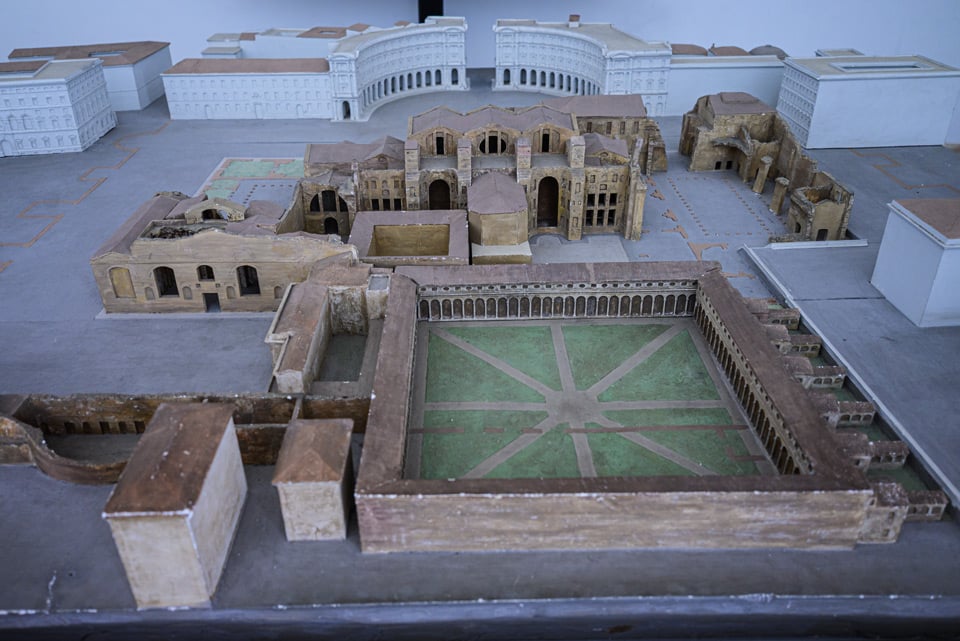
A Roman bath functioned as a social centre as well as a place to wash. It combined the roles of a spa, gym, library, and public square. Bathers followed a fixed sequence through the cold frigidarium, the warm tepidarium, and the hot caldarium. The complex also contained exercise grounds, gardens, and reading rooms. Water arrived through a dedicated branch of the Aqua Marcia aqueduct and collected in a huge cistern near today’s Termini station, whose name still recalls these thermae.
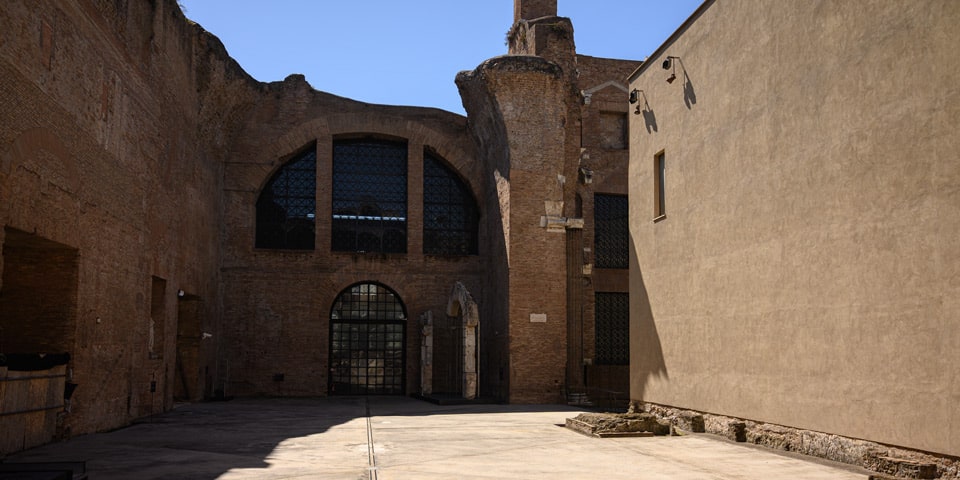
The baths stayed in use for more than two centuries, until Gothic armies besieging Rome cut the aqueducts in AD 537 and stopped the water supply on which the immense complex depended. The ruins were gradually quarried, built over, and absorbed into the growing medieval city. Today the surviving pieces include a church, a museum, two cloisters, and open stretches of ancient brick. Understanding how they once connected makes the visit much easier to read.
The largest surviving room of the baths now functions as a church. In 1561, Pope Pius IV asked the ageing Michelangelo to convert the vast central hall, the frigidarium, into a basilica. Michelangelo worked within the Roman structure and kept the soaring vaults and colossal red-granite columns in their ancient positions.
The result, Santa Maria degli Angeli e dei Martiri, preserves the scale of the ancient frigidarium. Its original columns still support the roof more than 1,700 years after Roman builders set them in place, and free entry makes the church a logical stop before or after the museum.
The Great Cloister anchors the visit. Its elegant colonnade is traditionally attributed to Michelangelo, who is thought to have designed the vast square courtyard near the end of his life for the Carthusian monastery established among the ancient ruins. Today, hundreds of sculptures and architectural fragments surround a garden of box hedges and tall cypresses.
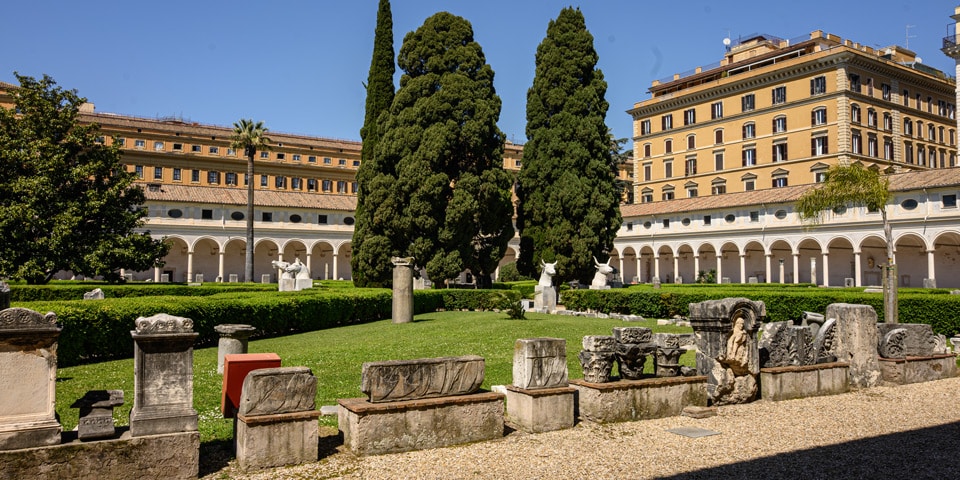
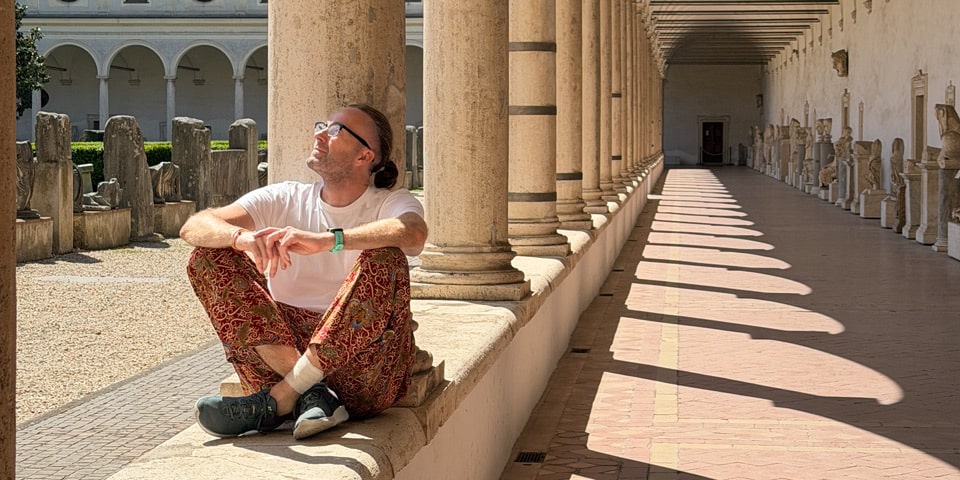
It is the calmest corner of the whole complex. Sit on a bench in the shade of the colonnade, with the sun moving across the gravel and the marble, and you understand what the place is for. This was a monastery for three centuries, and the monks knew how to build for silence.
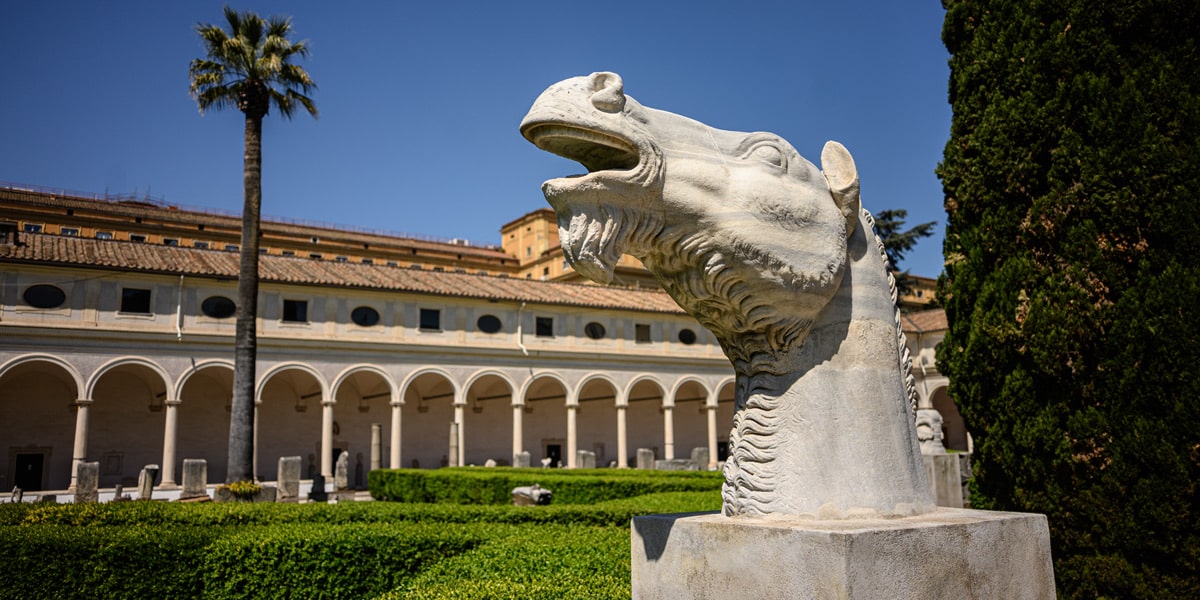
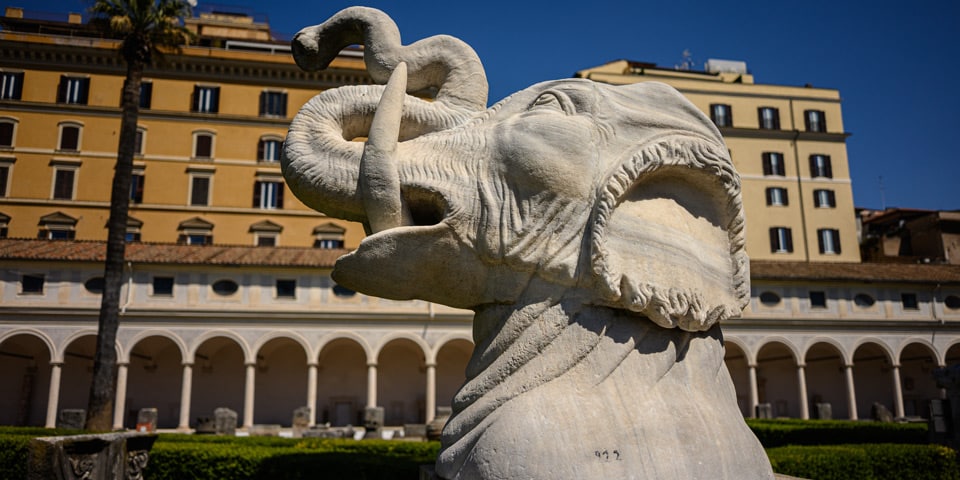
Enormous marble animal heads stand on plinths among the cloister hedges, each about the size of a small car. The group includes a ram, camel, horse, bull, ox, rhinoceros, and elephant. None was made for the baths, and only five are ancient.
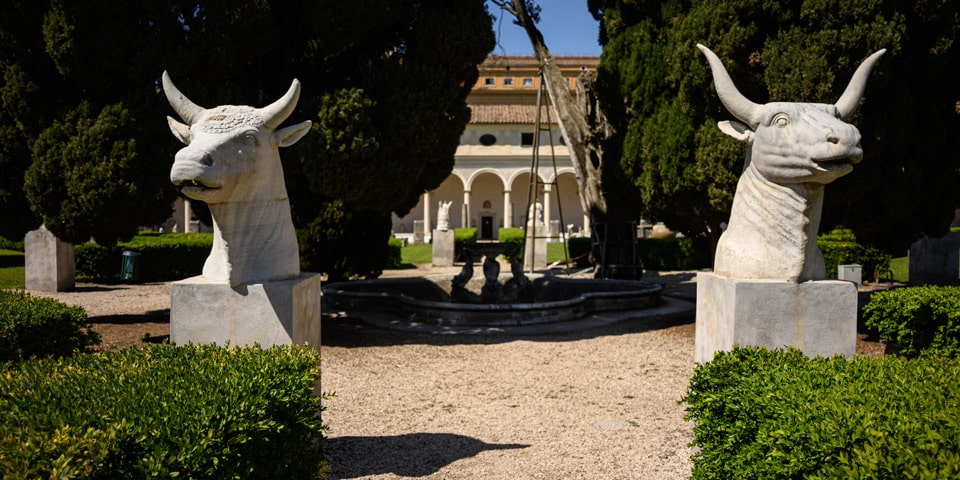
The five Roman heads represent a ram, camel, horse, bull, and ox. They were carved for the Forum of Trajan and most likely came from the Temple of the Deified Trajan. Builders uncovered them in 1586 while working on a cardinal’s palace near Trajan’s Column. Cardinal Michele Bonelli kept them in his new residence, where they remained for nearly three centuries. They were moved to the cloister in the early 1900s and arranged around the garden fountain.
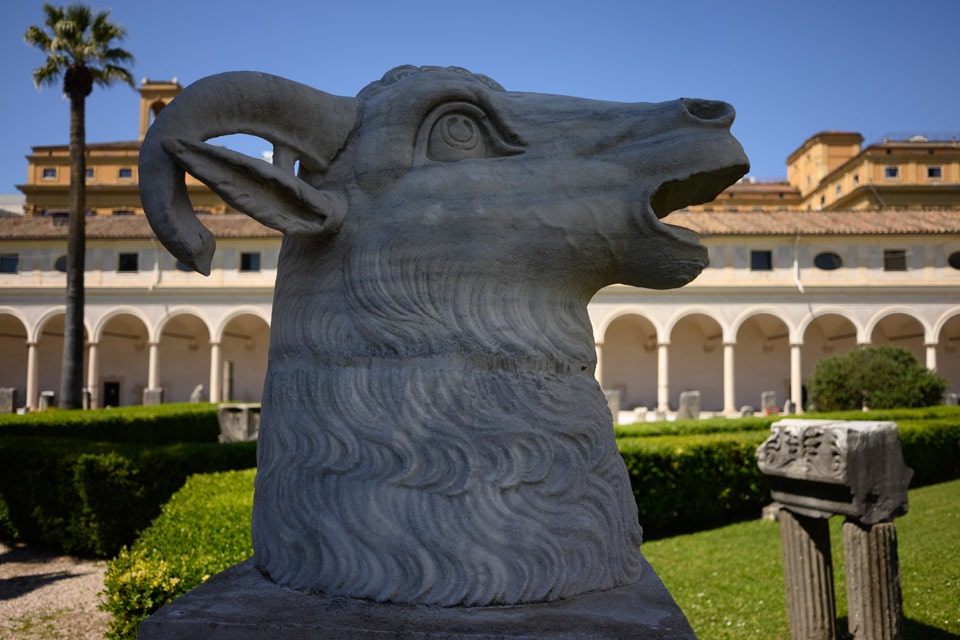
The other two are deliberate imitations. The cardinal wanted a larger set, so he commissioned a rhinoceros and an elephant to supplement the ancient heads. The elephant gives itself away through the serpent coiling around its trunk and a softer, more decorative style. These Renaissance additions have passed for ancient pieces for four hundred years.
At the centre of the garden stands the fountain around which the heads were arranged. Built in 1695, its basin rests on carved dolphins that twist upwards towards the bowl. Four cypresses frame it. One has a hollow trunk and now relies on an iron support. Tradition identifies it as Michelangelo’s cypress and claims it was planted while he worked on the basilica in the 1560s. If the story is true, the tree is over 450 years old.
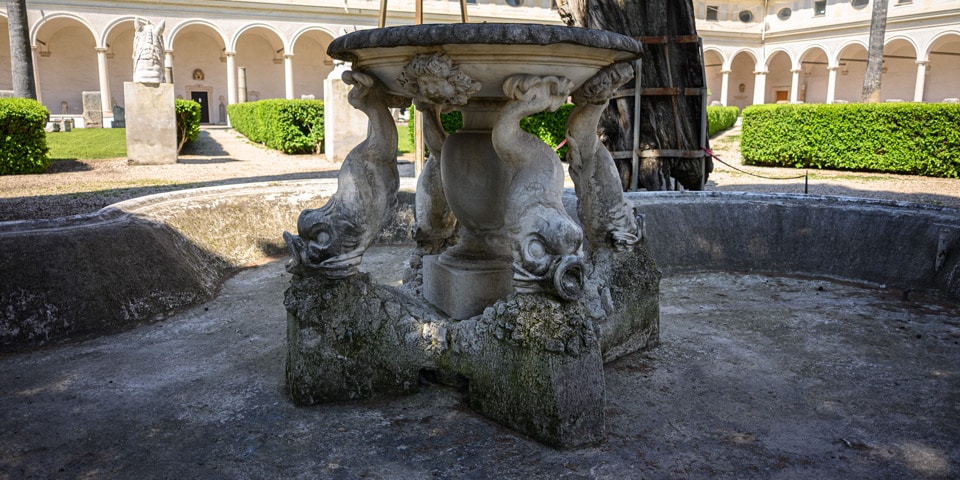
The fountain has seen better days and is often under restoration rather than running. Traffic on the nearby streets becomes difficult to hear once you are inside the colonnade, especially beneath the cypresses at the far side of the garden.
The covered walkways around the cloister slow the pace of the visit. Each side runs for about a hundred metres beneath a low vaulted ceiling. Ancient statues, portrait busts, funerary altars, carved urns, sarcophagi, and inscribed slabs line the walls, while the garden remains open on the other side.
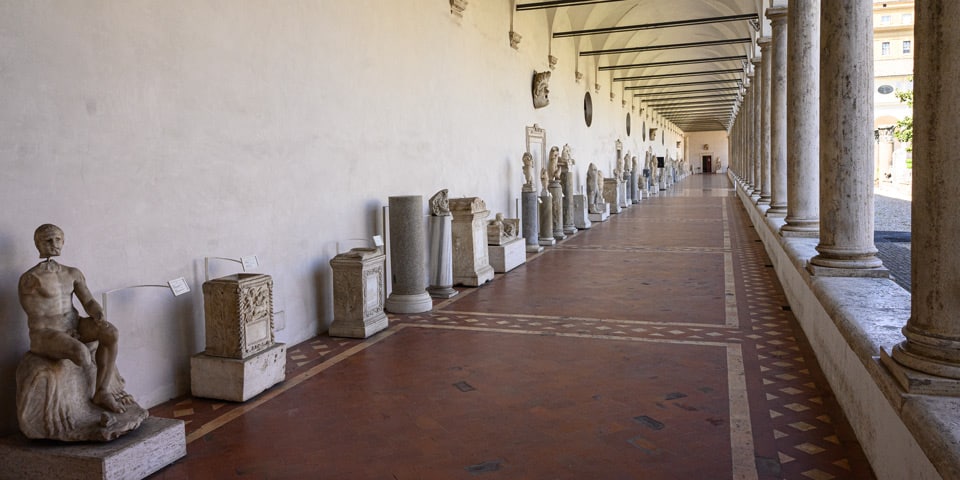
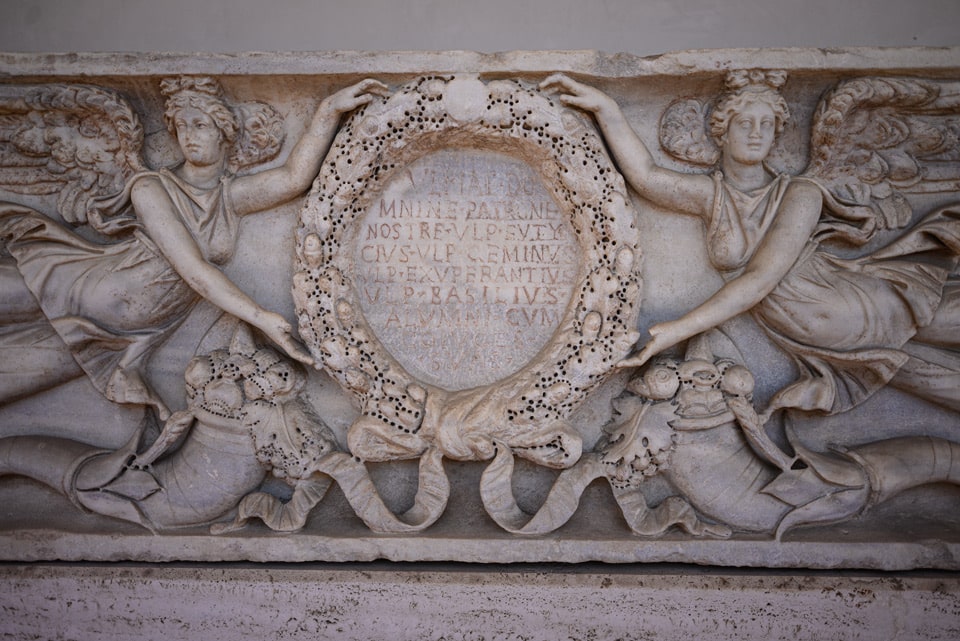
There is no set path through the collection. Much of the material is funerary and came from tombs across Rome. It preserves the names of freedmen and families who paid to be remembered in stone. In one relief, two winged Victories hold a wreath around an inscription commissioned by a freedman’s family for the patroness who had once freed them. The family had begun life in slavery, gained freedom, and used finely carved marble to record its new standing.
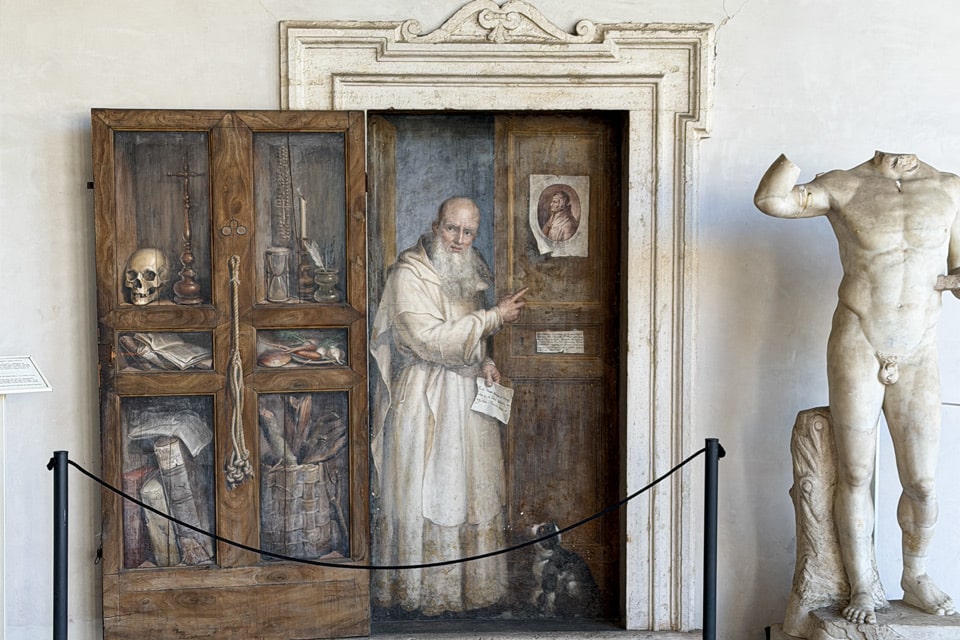
Near the entrance to the cloister, don’t walk past the door with the monk. It looks at first like a real doorway with a white-robed Carthusian leaning out of it, a slip of paper in one hand, a little dog at his feet. It is entirely painted, a trompe-l’oeil by Filippo Balbi from 1885, so convincing that visitors still slow down and look twice. Beside the monk, a painted cupboard holds a skull, an hourglass, a guttering candle, and scattered books. The monks who lived here would have recognised these symbols of mortality at a glance.
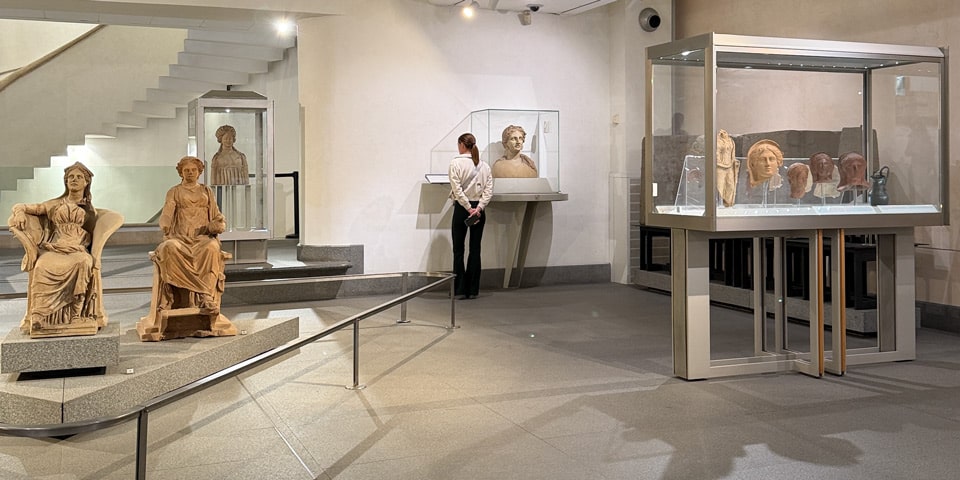
From the cloister, the visit moves indoors into the galleries of the National Roman Museum, which holds finds gathered from across the ancient city. The rooms are well lit, and the displays leave plenty of space around the statues and busts. I have often found these galleries nearly empty.
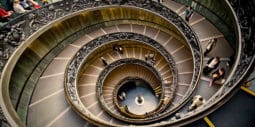
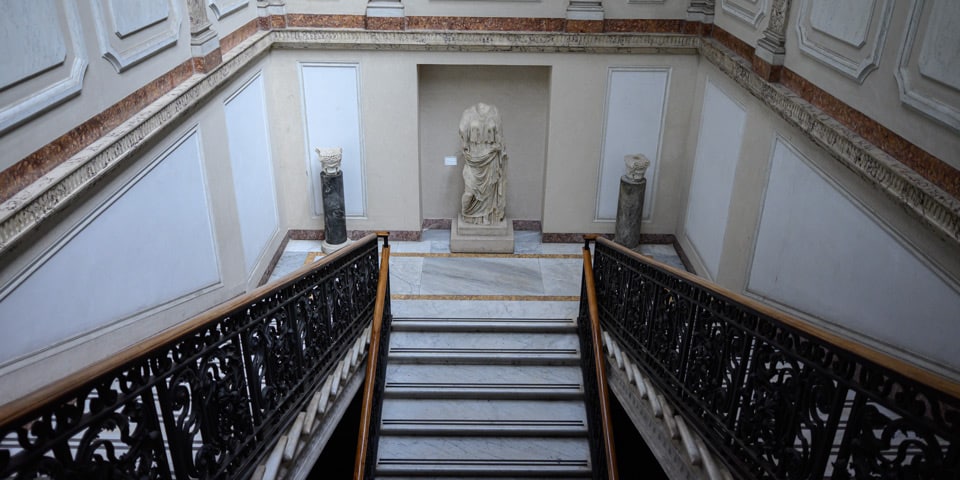
A grand marble staircase with wrought-iron railings connects the floors. An ancient statue occupies a niche at its turn. The staircase makes the building’s chronology visible because a Roman collection now fills a former monastery.
Look down. A Roman floor mosaic near the start of the galleries places Medusa at the centre of a circular medallion. Snakes writhe through her hair as coloured stone radiates outwards around her face. Up close, thousands of tiny tesserae shift from pale skin to deep shadow.
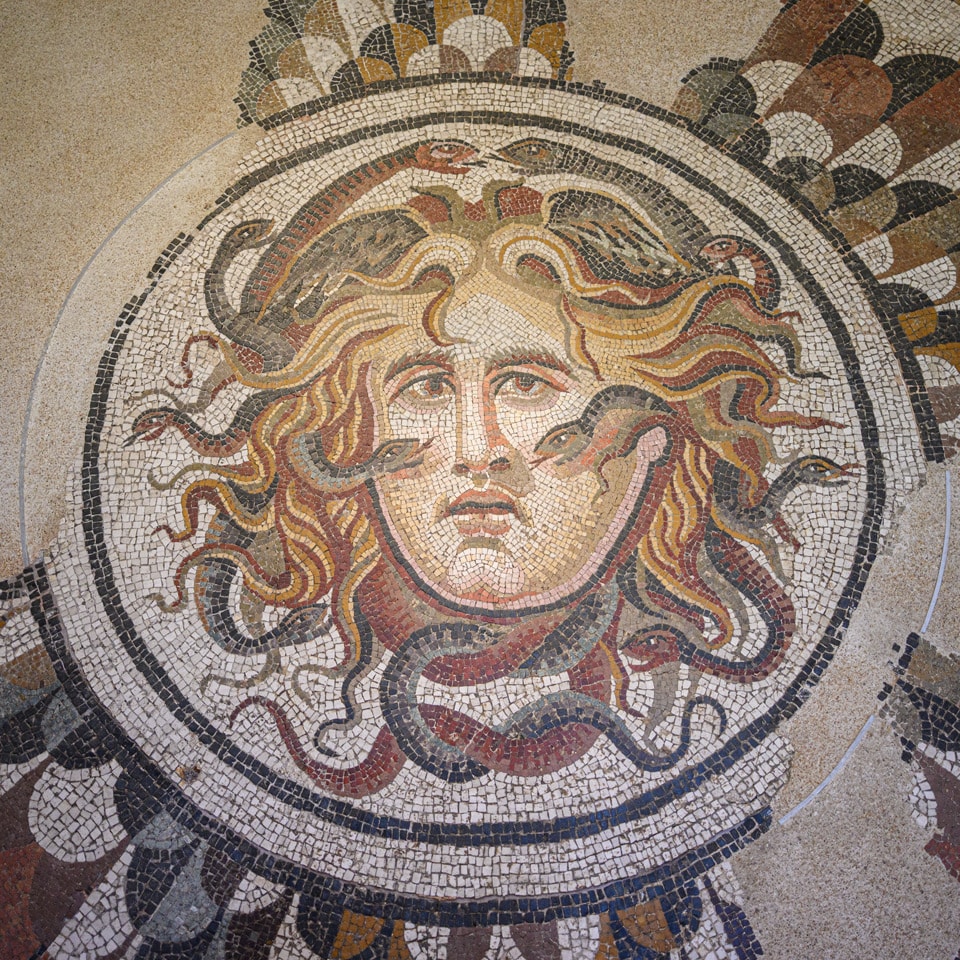
The monster guards the floor for a reason. Romans treated the head of Medusa, or Gorgoneion, as a protective image that could ward off evil. They placed it on floors, doorways, shields, and armour to turn danger away. This Medusa protected the room and the people who entered it.
Several portrait heads reward a second look because of their hair. Roman styles changed with imperial fashion, and archaeologists use those changes to date a sculpture to within a few decades. A hairstyle worked much like a timestamp.
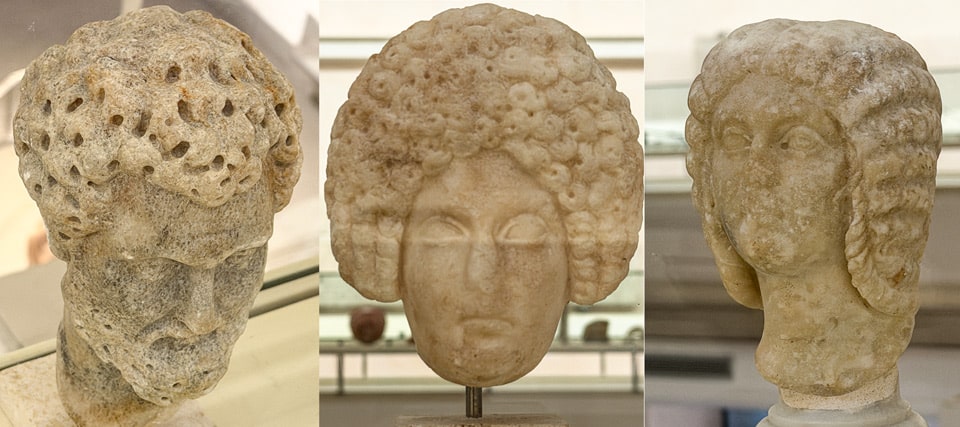
The most dramatic is the towering crown of tight, drilled curls rising in a half-circle above the forehead. This style identifies portraits from the Flavian era in the late 1st century AD. Aristocratic women piled their hair into a honeycomb of ringlets so tall that the satirist Juvenal compared the finished figure to a building. Achieving it took hours. Hairpieces were sewn in with needle and thread by a trained slave hairdresser called an ornatrix. Under Augustus, hair had usually been parted in the middle and rolled back. Under Trajan and Hadrian, fashion shifted towards elaborate braids and stacked diadems.
The men’s portraits keep their hair short and their beards neat beside the women’s architectural coiffures. Roman men could signal rank through clothing, while women’s dress revealed less about status. Hair therefore carried more of that message. A complex coiffure that required hours of work and trained servants displayed wealth and leisure. The marble heads record imperial fashion as clearly as they record individual faces.
Spend time with the marble relief displayed behind glass. Traces of its original red paint and gold leaf remain on the surface. A young man in a flowing cloak and soft peaked cap drives a dagger into a bull’s neck. He is Mithras, whose cult spread widely through the Roman Empire during the same centuries as early Christianity.
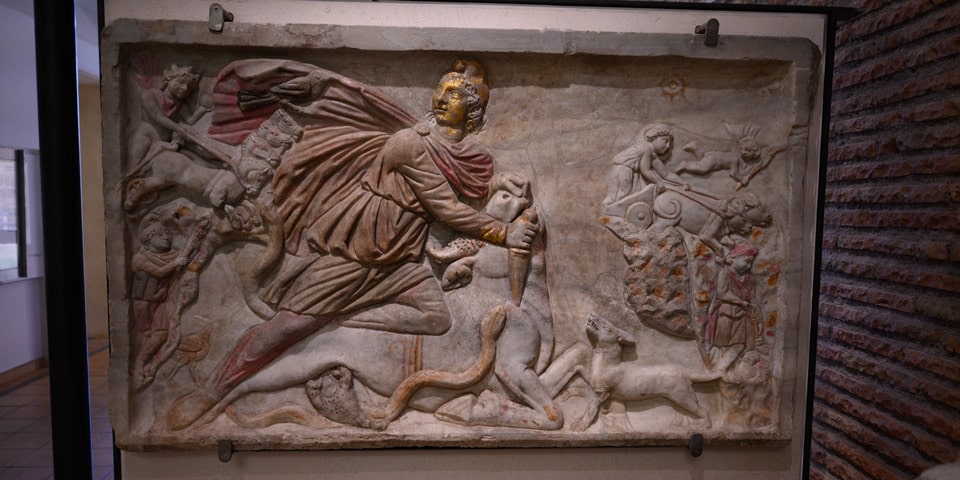
The scene is called a tauroctony, or bull-slaying, and it occupied the central position in Mithraic temples. Its usual figures appear around Mithras: a dog and snake reach towards the wound, a scorpion waits below, a raven watches, and two torch-bearers stand at the sides. The image represented a cosmic event in which the bull’s death released life into the world. Worshippers did not reenact it as a sacrifice. This late 3rd-century relief came from a mithraeum, an underground temple, beneath the nearby basilica of Santo Stefano Rotondo.
Mithraism spread especially through the Roman army. Soldiers carried it to the frontiers of Britain, the Rhine, and the Danube. Members passed through seven grades of initiation, shared ritual meals, and expected a form of life after death. Known Mithraic communities admitted men, which narrowed the cult’s reach. Christianity grew among a much broader population. After the empire became Christian in the 4th century, Mithraic temples closed, and churches were sometimes built directly above them.
Roman religious life absorbed deities from across the empire. Here a marble woman wears a fringed cloak knotted across her chest, long ringlets, and a small crown. She is Isis, an Egyptian goddess whose cult developed a large following in the Roman world.
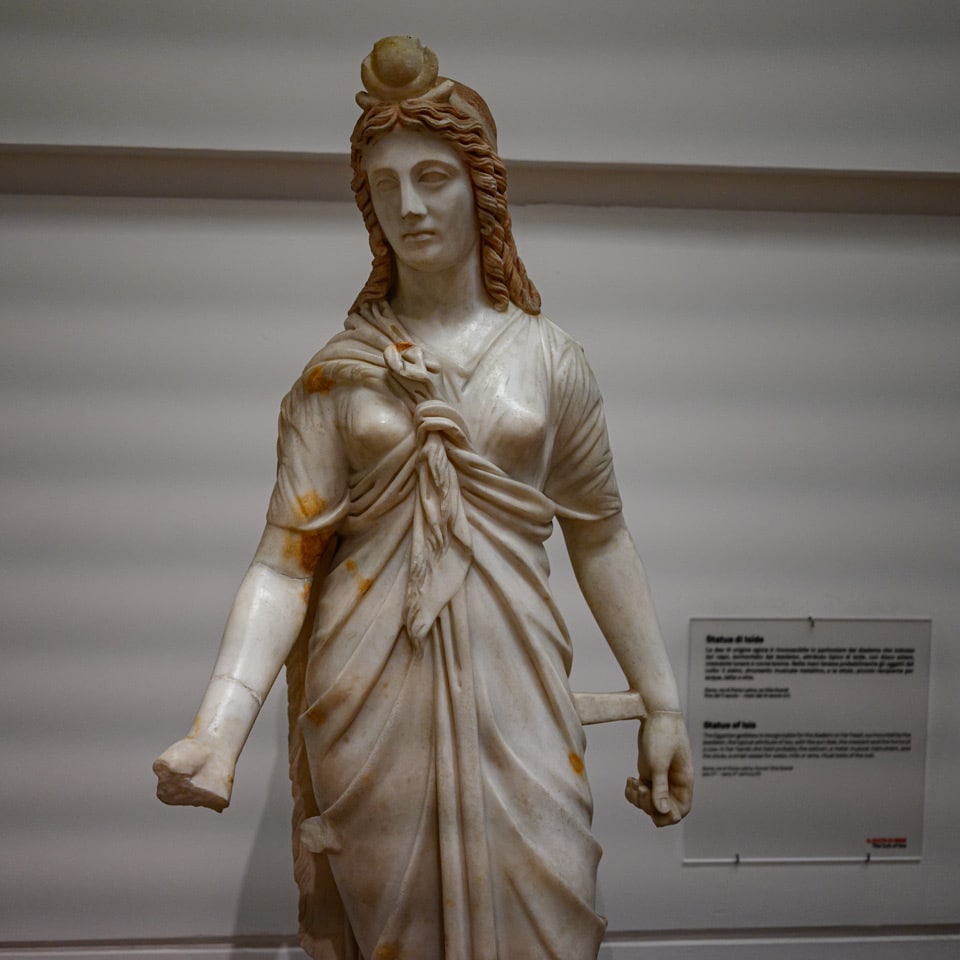
You can recognise her by the details. On her head sits the basileion, a crown of a sun disk framed by cow’s horns and a crescent moon. In her hands she once held the tools of her cult. One was a sistrum, a metal rattle shaken during worship. The other was a situla, a small vessel for sacred liquids. This statue came from a site on the Via di Porta Latina and dates from the late 2nd or early 3rd century AD.
The cult of Isis reached Rome from Egypt, where people had worshipped her since the 4th millennium BC. She represented motherhood, healing, and salvation after death. In her myth, she restored her murdered husband Osiris to life. That promise helped her cult gain broad appeal, and by the mid-1st century BC it had entered official Roman religion. In 43 BC the ruling triumvirs, including the future emperor Augustus, built her a great temple in the Campus Martius called the Iseum Campense.
The temple left traces across central Rome. Several Egyptian obelisks in the city originally stood at the sanctuary, including the small one carried by Bernini’s marble elephant near the Pantheon. The nearby church of Santa Maria sopra Minerva also preserves a medieval mistake in its name. Romans of that period attributed the ruins beneath it to Minerva rather than to the Iseum, and the error remained.
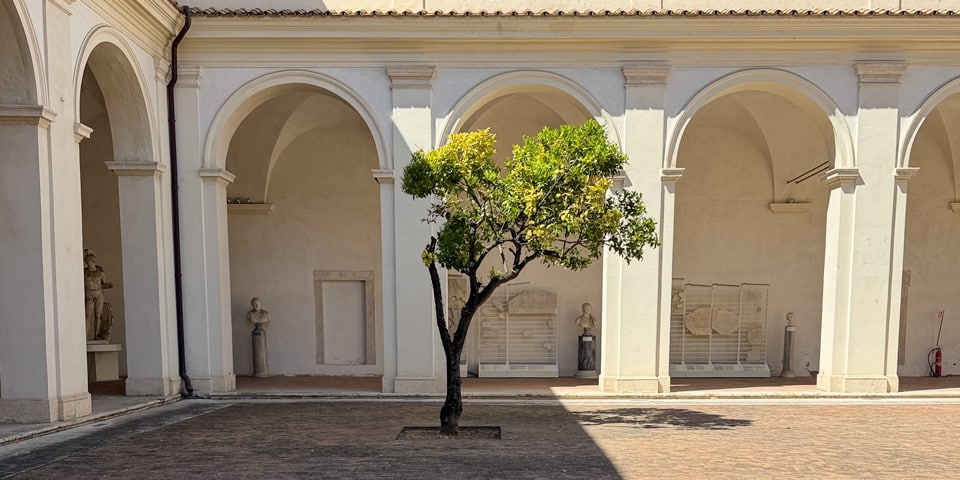
Beyond the great cloister lies a smaller courtyard. Marble busts line the walkways against plain white walls, and a single lemon tree grows at the centre.
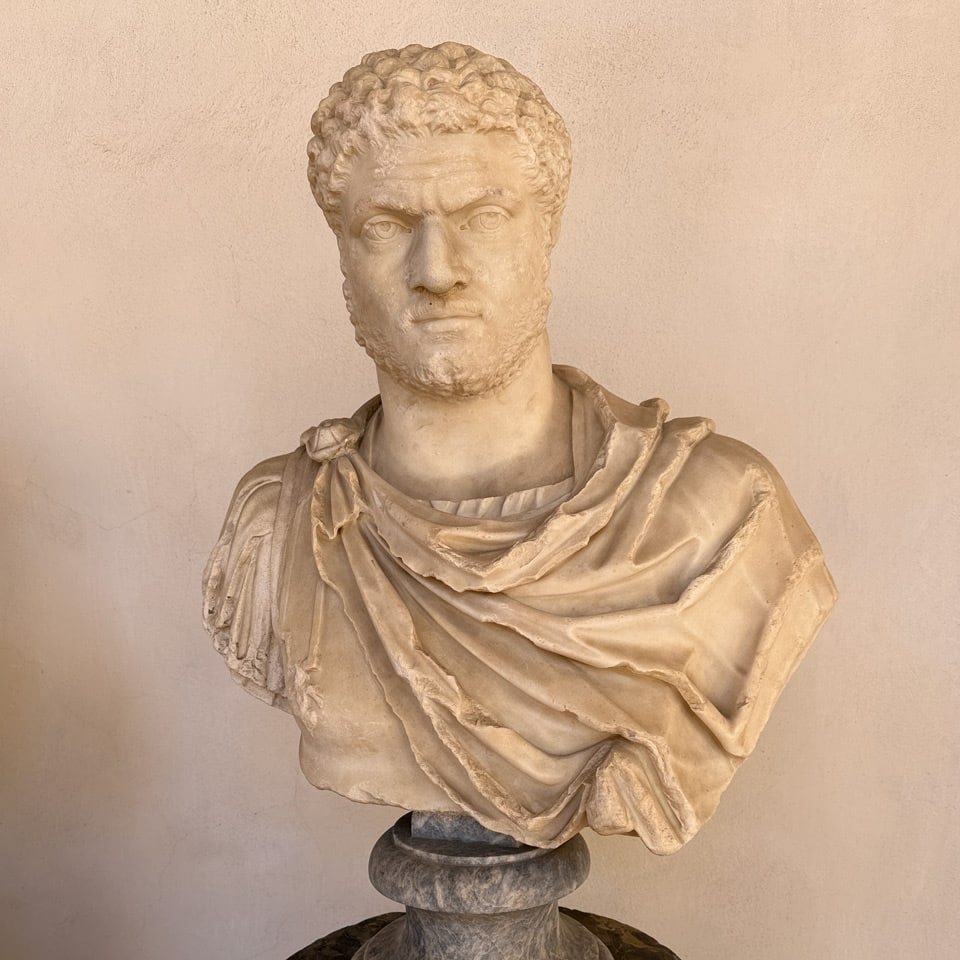
Two portraits here are worth seeking out. The first is a bust of the emperor Caracalla, carved between AD 209 and 211 and found in the House of the Vestals on the Roman Forum. Most imperial portraits flatter their subjects by showing calm, idealised rulers. This one scowls, furrows its brow, and turns its head sharply. The menace is deliberate. Caracalla wanted the image of a hard soldier-emperor, and shortly afterwards he murdered his brother Geta to rule alone. Caracalla also commissioned Rome’s other great bath complex, the Baths of Caracalla. Encountering his portrait here creates an apt connection between the two sites.
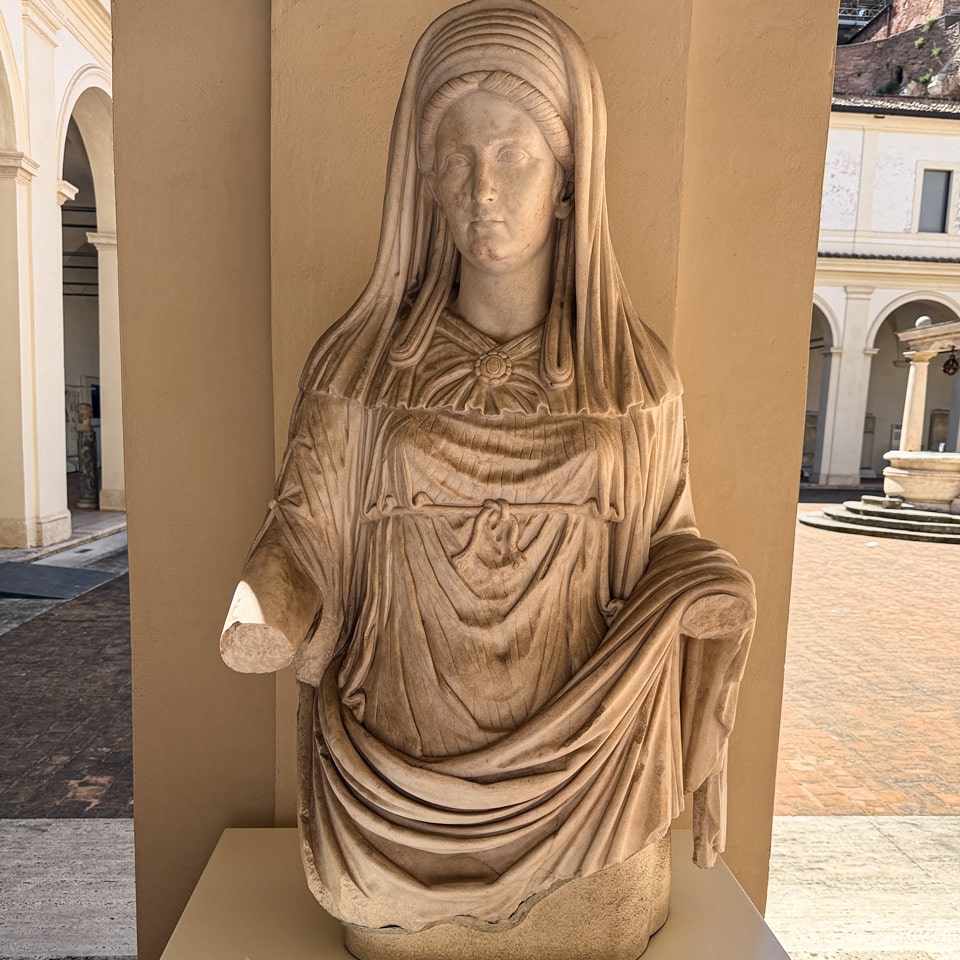
Nearby stands a statue of a very different Roman figure: a Vestalis Maxima, the chief of the Vestal Virgins, veiled and wearing a turreted crown.
The Vestals ranked among Rome’s most respected priestesses and kept the sacred flame of Vesta burning in the Forum. They took a thirty-year vow of chastity and received unusual legal privileges in return. They could own property, make a will, and occupy reserved seats at public games. Breaking the vow was punished by burial alive. This 2nd-century statue also came from their residence on the Forum, the House of the Vestals.
The detail on one sarcophagus deserves a close look. Carved around AD 270, its front shows shepherds among trees and buildings, surrounded by horses, cattle, and sheep. The deep relief covers a single block of marble as long as a person is tall.
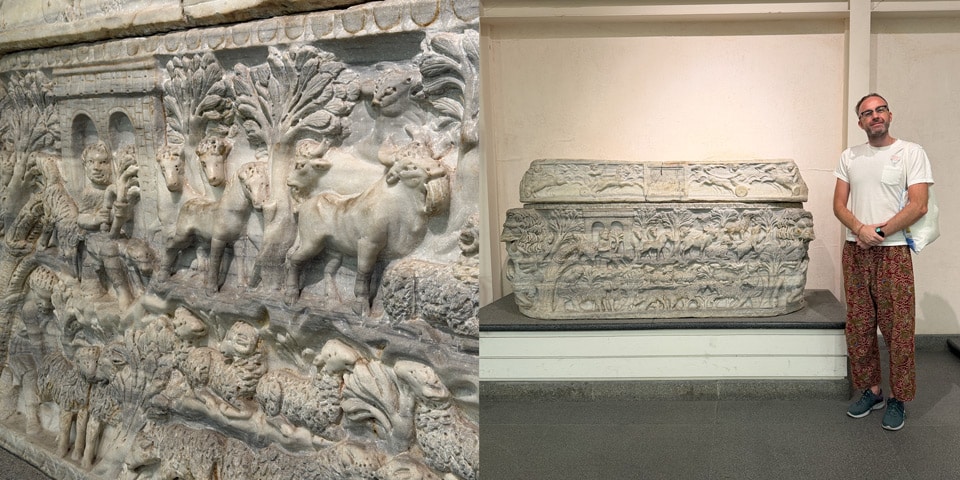
The inscription records who lay inside: a man named Iulius Achilleus, honoured by his wife. He had held the rank of vir perfectissimus and worked in the imperial chancellery. He ended his career as superintendent of the Ludus Magnus, the great gladiator barracks beside the Colosseum. The sarcophagus was found near the Baths of Caracalla. Like many objects here, it entered a museum that gathers finds from across the ancient city.
If you concentrate on one sculpture, choose this near life-size marble group. Mars wears a plumed helmet and sword belt. Venus leans against his shoulder with one hand resting on him. The god of war and the goddess of love appear in an unexpectedly intimate pose.
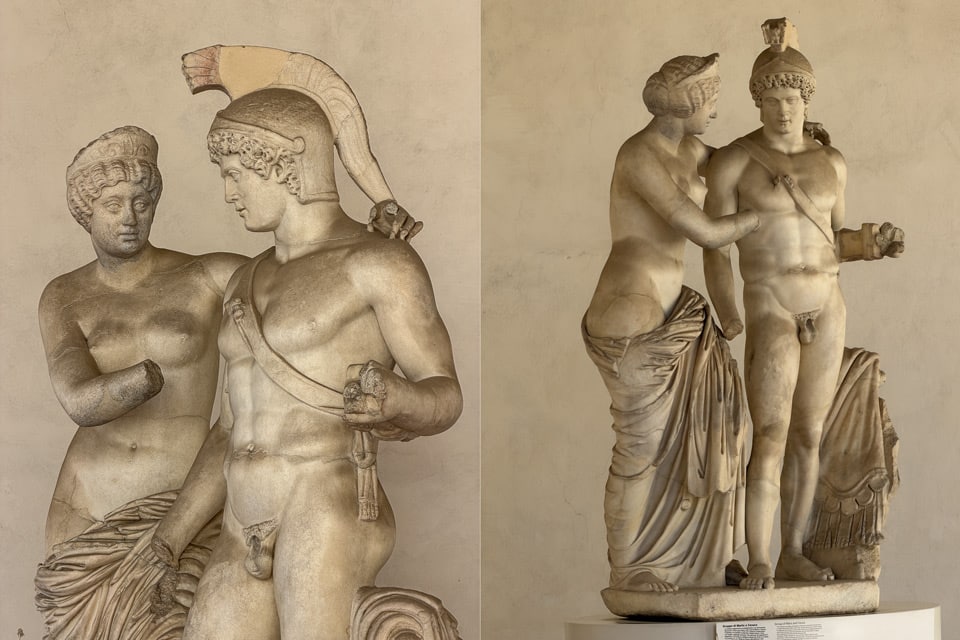
Look closer at the faces. They portray a real Roman husband and wife who had themselves carved as Mars and Venus around AD 170. Wealthy Romans sometimes commissioned portraits in the guise of gods, borrowing divine bodies to flatter themselves. The sculptor used famous models: the Ares Borghese for the man and the Aphrodite of Capua for the woman. He then replaced the divine faces with those of the couple. The group probably crowned their funerary monument in Ostia, Rome’s port city. It presented their marriage as equal to that of the gods.
The mythology covers a very human ambition. This wealthy couple paid to appear as gods and to have that image outlast them. Eighteen centuries later, the sculpture still does what they intended. It keeps them in view.
Before leaving, check whether the larger ancient halls contain a temporary exhibition. Contemporary installations sometimes occupy the two-thousand-year-old brick spaces and reveal their scale better than an empty room would.
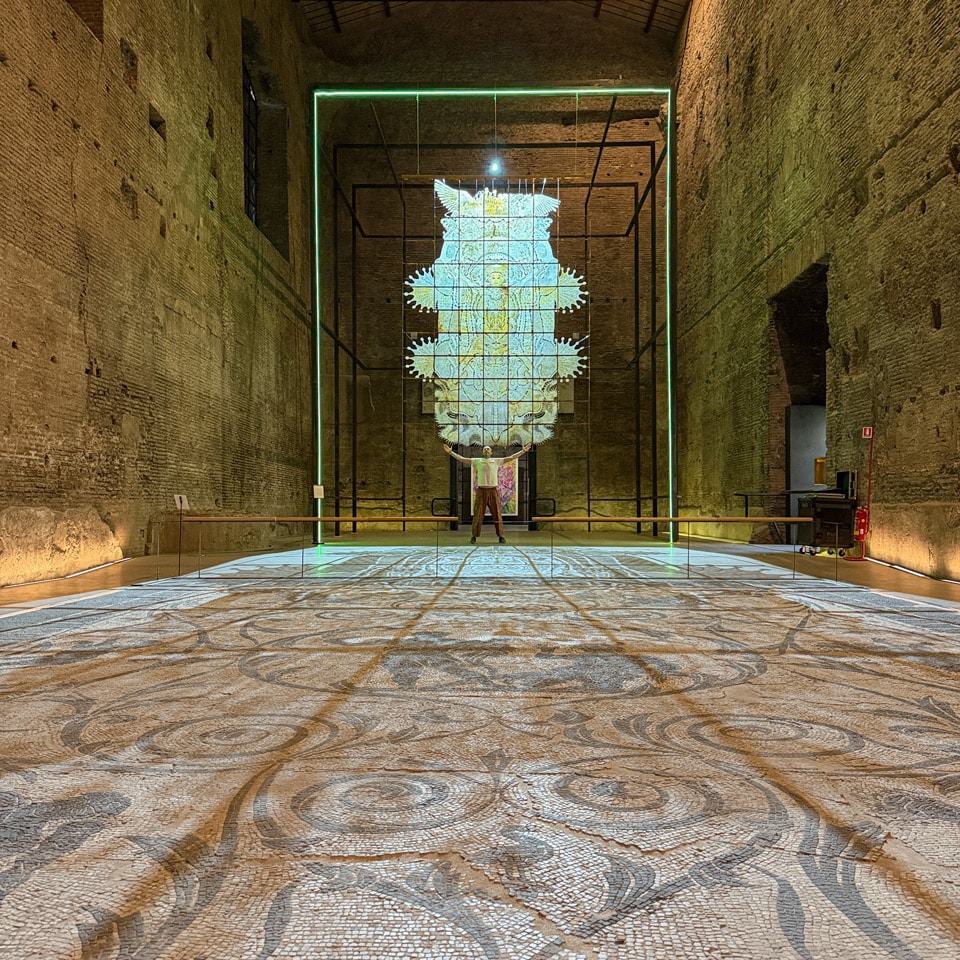
The halls show how often the complex has changed function. Roman baths became a Carthusian monastery, an archaeological museum, and now an occasional contemporary gallery.
I would prioritise this museum if you enjoy ancient sculpture or want time to examine objects without being pushed through a crowded gallery. The cloisters and collection justify about two hours, and Termini is only a couple of minutes away. On a first trip limited to one day, the museum will probably rank below Rome’s defining monuments unless Roman art is already a main interest.
Allow about two hours for the Baths of Diocletian. Palazzo Massimo stands directly across the street, while Palazzo Altemps is near Piazza Navona. The National Roman Museum may offer combined admission to these sites, so check its official website before choosing a ticket.
RomeItaly.guide © 2026. Created with love by Roman experts and guides.