
28994 travellers read
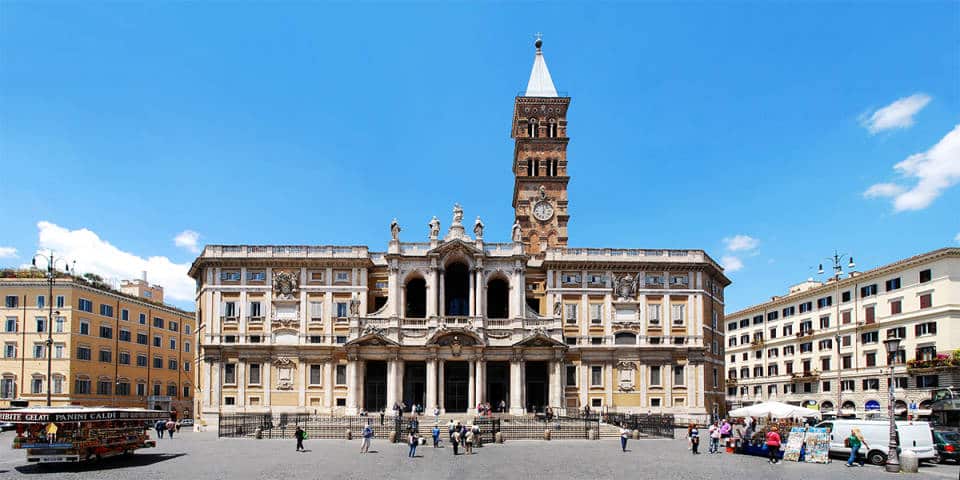
The Basilica di Santa Maria Maggiore is a major papal basilica and the largest Catholic Marian church in Rome.
The Basilica venerates the image of Salus Populi Romani, portraying the Blessed Virgin Mary as the help and protectress of the Roman people, which received a canonical coronation from Pope Gregory XVI on 15 August 1838, accompanied by his papal bull Cælestis Regina.
According to the Lateran Treaty of 1929 between the Holy See and Italy, the Basilica lies within Italian territory and not within the territory of the Vatican City State. Even so, the Holy See wholly owns the Basilica, and Italy is legally committed to recognising its full ownership and granting it “the immunity granted by international law to the headquarters of the diplomatic agents of foreign States.”
The Basilica of Santa Maria Maggiore was built on the site of a pagan temple dedicated to the goddess Cybele. The current building was completed in 1584 under the orders of Pope Liberius.
According to legend, the Virgin appeared before the Pope with instructions for building the church, and the layout was based on a miraculous snowfall.
Previously, the Basilica was also called Saint Mary of the Snow (because of the snow that determined the shape of the church), Santa Maria Liberiana (after Pope Liberius), and Saint Mary of the Nativity (because it received a relic of the Holy Nativity). Finally, the church became known as Santa Maria Maggiore because it is the largest of the 26 churches in Rome dedicated to the Virgin Mary.
[https://youtu.be/u2DymvQeIww](https://youtu.be/u2DymvQeIww)
These basilicas used to be called Patriarchal Basilicas. The term “Patriarchal Basilica” was used to refer to basilicas ceremonially assigned to one of the Patriarchs. Santa Maria Maggiore was initially assigned to the Patriarch of Antioch.
The Basilica represents several architectural styles, from early Christianity to Baroque. It was renovated during the 18th century. Moreover, Santa Maria Maggiore retains the bell tower, while its mosaics and marble floors date from the medieval period, along with some Ionic columns from ancient Roman buildings.
The first design of Santa Maria Maggiore was classical and traditionally Roman, perhaps to convey the idea that Santa Maria Maggiore represented ancient imperial Rome as well as its Christian future.
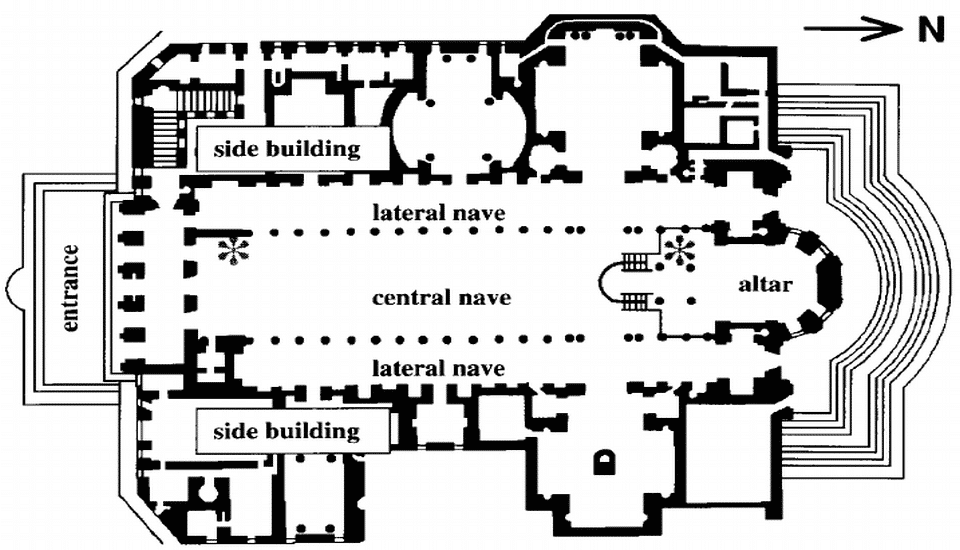
Although Santa Maria Maggiore is vast in area, it was built to a plan. The design of the Basilica was a typical one in Rome at this time: “a tall and wide nave; an aisle on either side; and a semicircular apse at the end of the nave.” The key feature that made Santa Maria Maggiore a significant landmark in church building during the early 5th century was the beautiful mosaics found on the triumphal arch and nave.
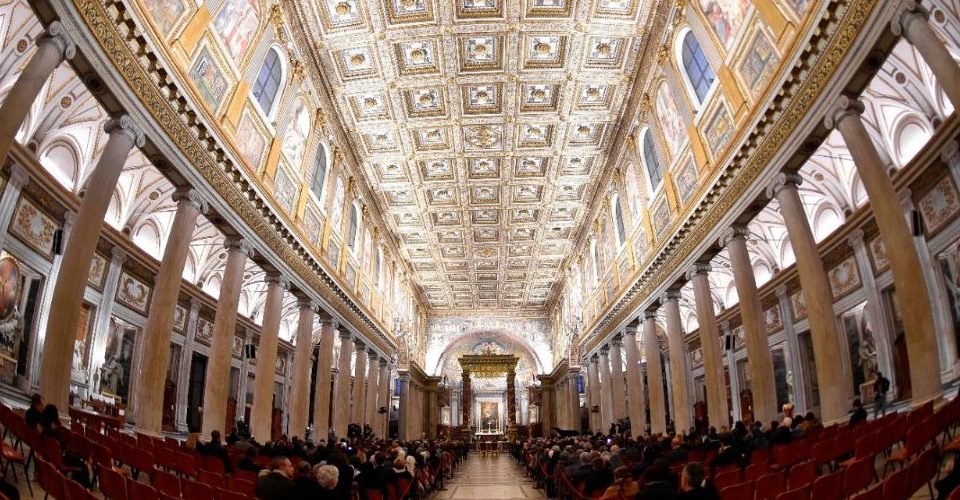
The Athenian marble columns supporting the nave are older and either come from the original Basilica or another ancient Roman building; thirty-six are marble and four are granite, pared down, or shortened to make them identical by Ferdinando Fuga, who provided them with matching gilt-bronze capitals.
The 14th-century campanile, or bell tower, is the tallest in Rome, at 246 feet (approximately 75 m).
The Basilica’s 16th-century coffered ceiling, to a design by Giuliano da Sangallo, is said to be overlaid with gold, first brought by Christopher Columbus and presented by Ferdinand and Isabella to the Spanish pope, Alexander VI. The apse mosaic, the Coronation of the Virgin, dates from 1295 and is signed by the Franciscan monk Jacopo Torriti. The Basilica also contains frescoes by Giovanni Baglione in the Cappella Borghese.
Read also about Villa Borghese Gardens.
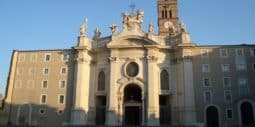
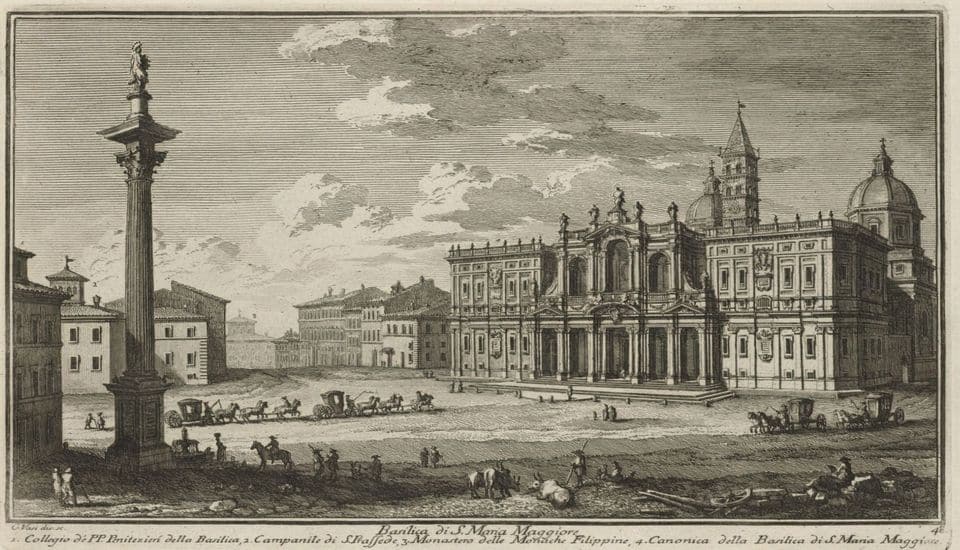
The 12th-century façade has been masked by a restoration, with a screening loggia added by Pope Benedict XIV in 1743, to designs by Ferdinando Fuga, without damaging the façade mosaics. The wing of the Canonica (sacristy) to its left and a matching wing to the right (planned by Flaminio Ponzio) give the Basilica’s front the appearance of a palace facing Piazza Santa Maria Maggiore. To the right of the Basilica’s façade is a memorial resembling a column in the form of an upturned cannon barrel topped with a cross: it was erected by Pope Clement VIII to celebrate the end of the French Wars of Religion.
The Marian column, erected in 1614 to designs by Carlo Maderno, is the model for many Marian columns raised in Catholic countries in thanksgiving for deliverance from plague during the Baroque era.
Under the high altar of the basilica is the Crypt of the Nativity, or Bethlehem Crypt, with a crystal reliquary designed by Giuseppe Valadier, said to contain wood from the Holy Crib of the Nativity of Jesus Christ. Here is the burial place of Saint Jerome, the 4th-century Doctor of the Church who translated the Bible into Latin (the Vulgate).
Parts of the Nativity scene, believed to be by 13th-century Arnolfo di Cambio, were moved beneath the altar of the large Sistine Chapel off the right transept of the church. This Chapel of the Blessed Sacrament is named after Pope Sixtus V and should not be confused with the Sistine Chapel of the Vatican, named after Pope Sixtus IV. The architect Domenico Fontana planned the chapel, which contains the tombs of Sixtus V himself and his early patron Pope Pius V. The main altar within the chapel has four gilded bronze angels by Sebastiano Torregiani, holding up the ciborium, which is a model of the chapel itself.
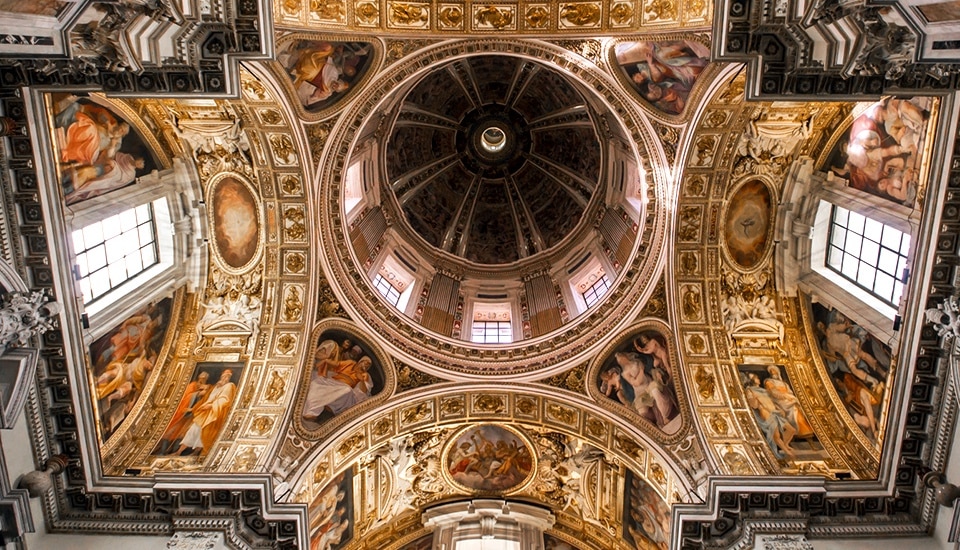
Beneath this altar is the Oratory or Chapel of the Nativity, on whose altar, formerly housed within the Crypt of the Nativity below the church’s main altar, Saint Ignatius of Loyola celebrated his first Mass as a priest on 25 December 1538.
Just outside the Sistine Chapel is the tomb of Gian Lorenzo Bernini and his family.
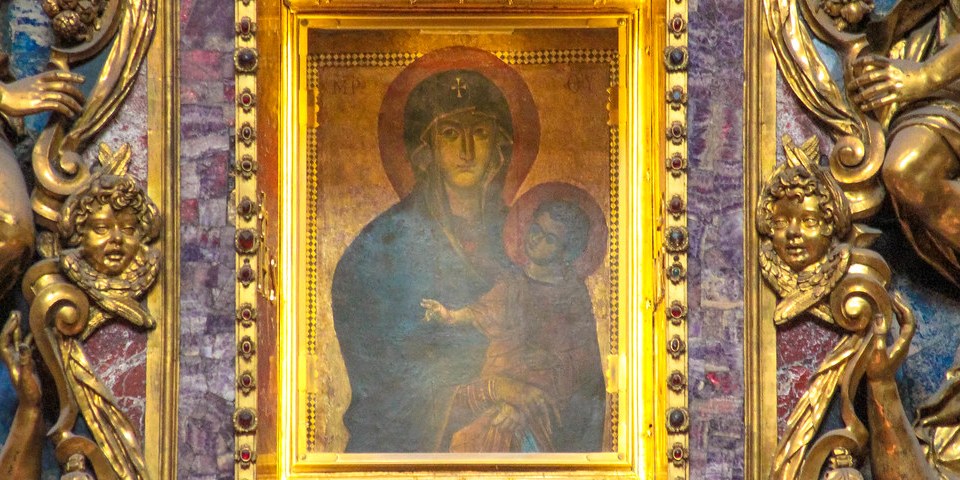
The column in Piazza Santa Maria Maggiore celebrates the famous icon of the Virgin Mary, now venerated within the Borghese Chapel of the Basilica. It is known as Salus Populi Romani, or Health of the Roman People, or Salvation of the Roman People, after a miracle in which the icon reportedly helped protect the city from the plague. The icon is at least a thousand years old and, according to tradition, was painted from life by St Luke the Evangelist using the wooden table of the Holy Family in Nazareth.
The Salus Populi Romani has been a favourite of several popes and has served as a key Mariological symbol.
Read also about the Borghese Gallery in Rome.
As a papal basilica, the pope frequently uses Santa Maria Maggiore. He presides over the rites for the annual Feast of the Assumption of Mary on 15 August. Except for some priests and the Basilica’s archpriest, the canopied high altar is reserved for use by the pope alone. Pope Francis visited the Basilica the day after his election.
The pope entrusts the Basilica to an archpriest, usually a cardinal. In the past, the archpriest was the titular Latin Patriarch of Antioch, a title abolished in 1964. Since 29 December 2016, the archpriest has been Stanisław Ryłko.
RomeItaly.guide © 2026. Created with love by Roman experts and guides.