
RomeItaly.guide
  • About us
  • Where to Stay
    • Hotels with Views
  • Visiting Vatican
    • Sistine Chapel
    • Vatican Museums
    • St Peter’s Basilica
    • St Peter’s Dome
  • Fountains & Squares
    • Altar of the Fatherland
    • Four Rivers Fountain
    • Piazza Navona
    • Spanish Steps
    • Turtle Fountain
    • Trevi Fountain
  • Parks & Gardens
    • Knights of Malta Keyhole
    • Orange Garden
    • Rose Garden
    • Villa Borghese
    • Umbrella Pine Trees
  • Museums & Galleries
    • Ara Pacis Augustae
    • Borghese Gallery
    • Palazzo Farnese
  • How to Get
    • Fiumicino Airport ➡️ Rome
Home / Famous Catholic Churches in Rome /

The Church of Trinità dei Monti

Written by: Kate Zusmann

Kirche Trinità dei Monti in Rom
Opening hours
Sunday: 10:15 AM - 6:30 PM
Monday: 10:15 AM - 6:30 PM
Tuesday: 10:15 AM - 6:30 PM
Wednesday: 10:15 AM - 6:30 PM
Thursday: 10:15 AM - 6:30 PM
Friday: 10:15 AM - 6:30 PM
Saturday: 10:15 AM - 6:30 PM
Closest bus stops
Mercede4 min 223 m: 100
Veneto/Emilia9 min 471 m: 52 53 61 63 83
Closest subway stations
Spagna2 min 82 m: A
Barberini 11 min 532 m: A
Address Piazza della Trinità dei Monti, 3, Roma
Website trinitadeimonti.net

The Church of Trinità dei Monti, situated at the top of the Spanish Steps, is a beautiful French Renaissance church with an iconic twin-towered façade. Built in the 16th century, the church offers panoramic views of Rome from its elevated position. Known for its elegant architecture and historical significance, it is a prominent landmark in the city centre.

Contents

Toggle
  • Things to Know Before Visiting Trinità dei Monti Church
    • Who built Trinità dei Monti?
    • Who built La Scalinata di Trinità dei Monti?
    • Who worked on the interior of Trinita dei Monti?
    • What to see near Trinità dei Monti?
  • History of Trinita dei Monti Church
    • Order of the Minims and the Observant Franciscans
  • Interior of Trinita dei Monti
  • Interesting Facts
  • How to Visit Trinita dei Monti
  • Best‑value hotels near Trinita dei Monti Church
  • Nearby Attractions

Things to Know Before Visiting Trinità dei Monti Church

Who built Trinità dei Monti?

The construction of Trinità dei Monti in Rome was commissioned by King Louis XII of France, and the church was built between 1502 and 1519. King Louis XII oversaw the project as part of a broader initiative to establish a French presence in the city.

Who built La Scalinata di Trinità dei Monti?

The construction of La Scalinata di Trinità dei Monti, commonly known as the Spanish Steps, was financed by the French diplomat Étienne Gueffier. The architects Francesco de Sanctis and Alessandro Specchi designed the steps, built between 1723 and 1725. The Spanish Steps connect Piazza di Spagna at the base with Piazza Trinità dei Monti at the top, where the Trinità dei Monti church is located.

Who worked on the interior of Trinita dei Monti?

The interior of Trinità dei Monti features notable contributions from artists such as Daniele da Volterra, who painted frescoes in the Chapels of St John the Baptist and St Anne. While specific details about all the artists involved may not be extensively documented, the interior showcases a blend of artistic elements that contribute to the church’s cultural and historical significance.

What to see near Trinità dei Monti?

Near Trinità dei Monti, you can explore the iconic Spanish Steps, a monumental stairway leading to Piazza di Spagna, and enjoy the tranquil surroundings of the Villa Borghese Gardens. Additionally, the nearby Piazza del Popolo, with its Egyptian obelisk and twin churches, offers a charming square to visit in the heart of Rome.

History of Trinita dei Monti Church

The Church of Trinità dei Monti has a rich history dating back to the 16th century. Commissioned by King Louis XII of France, the church was constructed between 1502 and 1519 under the direction of the French architect Louis XII. Its construction was part of the French presence in the city, and the church is a notable example of French Renaissance architecture in Rome.

Order of the Minims and the Observant Franciscans

The Church of Trinità dei Monti in Rome has historical associations with the Order of Minims, a Catholic religious order founded by Saint Francis of Paola in the 15th century. The Minims, officially known as the Order of Minims (O.M.), is a monastic order within the Roman Catholic Church that emphasises a life of humility and austerity.

In the case of Trinità dei Monti, King Louis XII of France sponsored the church’s construction in the early 16th century. The French king invited the Minims to establish a friary adjacent to the church, and they played a significant role in the early history of the Trinità dei Monti. The friary served as the residence for the friars of the Order of Minims, who were responsible for the church’s spiritual life and its surroundings.

Over time, the church and friary underwent various changes and renovations. While the Minims were initially associated with Trinità dei Monti, the church eventually came under the care of the Observant Franciscans. Despite the shift in religious orders, the church retained its historical and cultural significance.
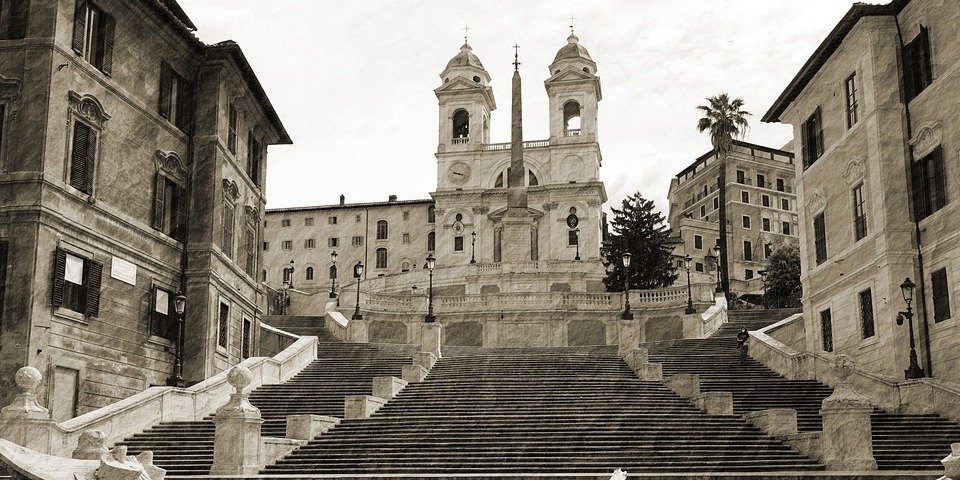
Trinita dei Monti church in Rome

Today, the Church of Trinità dei Monti is a prominent landmark in Rome, known for its French Renaissance architecture, art, and historical connections to the Minims and the Observant Franciscans.

In addition to its architectural significance, the Church of Trinità dei Monti holds cultural and artistic importance. The interior features notable works of art, including frescoes by Daniele da Volterra and a crucifixion scene by Daniele da Volterra and Pietro da Cortona. The church and its location at the top of the Spanish Steps make it a popular destination for religious pilgrims and tourists exploring Rome’s historic and artistic treasures.

Read also about San Clemente Church.

Interior of Trinita dei Monti

The interior of the Church of Trinità dei Monti in Rome is characterised by its harmonious blend of Renaissance and Baroque elements, reflecting the transitions and renovations it has undergone over the centuries.

The church’s central nave features a bright and spacious interior with several side chapels adorned with elegant decorations. The high altar, dating back to the 16th century, is a notable focal point, displaying a crucifixion scene attributed to Daniele da Volterra and flanked by Saint John the Baptist and Saint John the Evangelist statues.
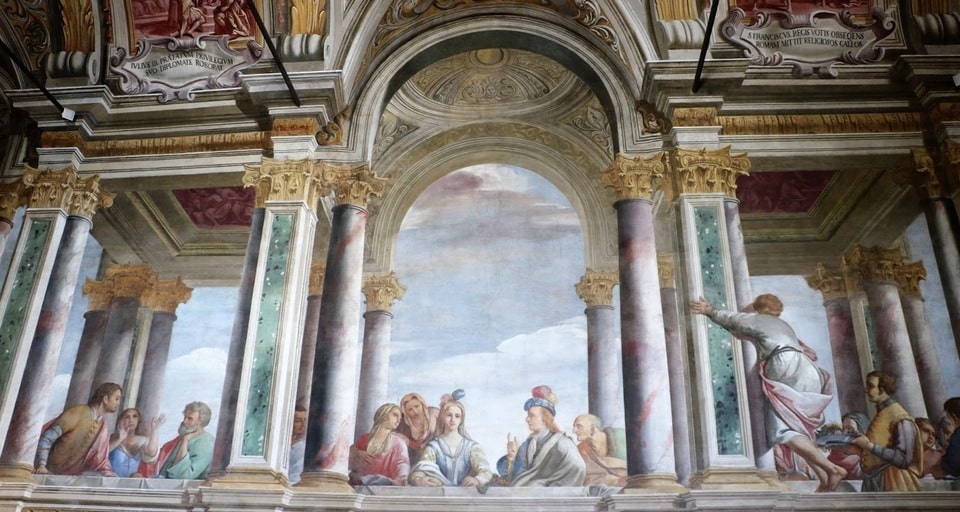
Trinita dei Monti frescoes inside

The church also houses several valuable works of art, including frescoes and paintings. Notable among them are the frescoes by Daniele da Volterra, an Italian Renaissance artist, in the Chapels of St John the Baptist and St Anne. The Chapel of St Anne, in particular, features scenes from the life of the Virgin Mary. Additionally, visitors can admire the Crucifixion scene painted by Daniele da Volterra and Pietro da Cortona, which graces the chapel ceiling.

Interesting Facts

The elegant and tranquil atmosphere of Trinità dei Monti’s interior and artistic treasures give visitors a glimpse into this historic church’s rich cultural and religious heritage, overlooking the iconic Spanish Steps in the heart of Rome.

  1. Trinità dei Monti was commissioned by King Louis XII of France, and the French crown funded its construction. This historical connection is evident in the church’s French Renaissance architectural style, making it a unique cultural and artistic presence in Rome.
  2. Positioned at the top of the Spanish Steps, the church offers a stunning panoramic view of Rome. The scenic overlook includes the rooftops and landmarks of the city, providing a picturesque backdrop that attracts both tourists and locals.
  3. Initially associated with the Order of Minims, the friars of this religious order played a significant role in the early history of Trinità dei Monti. While the church eventually came under the care of the Observant Franciscans, the Minims left an indelible mark on the church’s early years.
  4. The interior of Trinità dei Monti is adorned with valuable works of art. Notable frescoes by Daniele da Volterra, including those in the Chapels of St John the Baptist and St Anne, showcase the church’s artistic richness. A Crucifixion scene painted by Daniele da Volterra and Pietro da Cortona adds to the church’s cultural significance.
  5. Trinità dei Monti has undergone various renovations and modifications over the centuries. These changes have contributed to the church’s unique blend of architectural styles, with influences ranging from the original French Renaissance design to later Baroque elements.
  6. The church is on Pincian Hill, also known as “Monte Pincio”. Its elevated position provides stunning views, adding to the church’s prominence in the Roman skyline.
  7. Trinità dei Monti has featured in various films and is perhaps most famously associated with the classic film “Roman Holiday”, starring Audrey Hepburn and Gregory Peck. The Spanish Steps and the church play a significant role in the iconic scene where Hepburn’s character enjoys an ice cream.

Read also: Best Books on Roman History and Ancient Rome.

How to Visit Trinita dei Monti

Visiting the Church of Trinità dei Monti is fairly straightforward, and you can enjoy the church and the surrounding area, including the iconic Spanish Steps, the Trevi Fountain (less than a 10-minute walk), and Villa Borghese. As a church, admission to Trinità dei Monti is usually free. However, there may be an entrance fee for special exhibitions or events. Check the church’s official website or on-site notices for any specific details.

When visiting religious sites in Italy, it’s respectful to dress modestly. Avoid wearing shorts or sleeveless tops; consider carrying a shawl or scarf to cover bare shoulders if needed.

Read also about: Districts of Rome

Best‑value hotels near Trinita dei Monti Church

Croce Di Malta
4 min
623 ft
190 m
Suite Artis Barberini
10 min
1640 ft
500 m
IHH Suites
15 min
2493 ft
760 m
Relais Piazza Del Popolo
19 min
3051 ft
930 m
Flaminiarooms
20 min
3248 ft
990 m
History Suite
27 min
4429 ft
1.4 km
Relais Villa Borghese
27 min
4429 ft
1.4 km

Nearby Attractions

Spanish Steps
1 min 200 ft 60 m
House of Monsters
2 min 300 ft 90 m
Via del Corso
9 min 1410 ft 430 m
Pincian Hill
12 min 1900 ft 580 m
Ara Pacis
13 min 2130 ft 650 m
Piazza del Popolo
15 min 2530 ft 770 m
Santa Maria del Popolo
16 min 2620 ft 800 m
San Carlo alle Quattro Fontane
16 min 2690 ft 820 m
Pantheon
19 min 3150 ft 960 m
The Fountain of Neptune
22 min 3640 ft 1.1 km

Author: Kate Zusmann

Kate Zusmann

I’ve lived in the Eternal City for the past 12 years. They say every corner of Rome holds a story, and I’m here to share some of the most fascinating historical facts and local legends.

Dive Deeper into Rome's Stories

Vatican Museums Visitor Guide

989840 travellers read

The Vatican Museums

Rome Italy Tourist Attractions

27697 travellers read

Top 30 Attractions in Rome

Beste Hotels in Rom mit Aussicht

9495 travellers read

Best Hotels with Views in Rome

How to Book Vatican Museums & Sistine Chapel Tickets

13664 travellers read

How to Book Vatican Museums & Sistine Chapel Tickets

The Basilica di Santa Maria Maggiore

12340 travellers read

Basilica di Santa Maria Maggiore

Santa Croce in Gerusalemme

18726 travellers read

Basilica di Santa Croce in Gerusalemme

Sankt Paul vor den Mauern

88994 travellers read

Basilica of Saint Paul Outside the Walls

Basilika Santa Cecilia in Trastevere

10609 travellers read

Basilica di Santa Cecilia in Trastevere

when vatican was built

6482 travellers read

When was the Vatican Built?

Show more

About us

About us ROME.US Authors Kate Zusmann and Artur Jakucewicz
We're Kate and Artur, a duo bound by our shared fascination with the Eternal City – Rome. Our paths, driven by a mutual passion for its timeless stories and architectural marvels, converged in a way we had never imagined.

Explore Rome

  • Fontana del Mascherone di Santa Sabina | Aventine Rome

    Fountain of the Mask

  • Knights of Malta keyhole view st Peters Basilica Aventine Rome

    Knights of Malta Keyhole: Aventine Hill View of St Peter’s

  • Rome 3 Day Itinerary

    Rome 3 Day Itinerary – Highlights & Travel Tips

  • Piazza del Popolo in Rom

    Piazza del Popolo

  • Vatican Museums Visitor Guide

    The Vatican Museums

RomeItaly.guide

This website uses cookies. For more info read the cookies policy

RomeItaly.guide © 2026. Created with love by Roman experts and guides.
  • American English
  • Español
  • Deutsch
  • Polski