
991228 travellers read
The Papal Basilica of St Paul Outside the Walls (Italian: Basilica Papale di San Paolo fuori le Mura) was founded 17 centuries ago. It is one of the four major papal basilicas in Rome. During the Holy Door opening ritual, numerous parishioners and pilgrims flood into the church to receive absolution. Since 1980, the church has been on the World Heritage List.
Read articles about papal basilicas:
In AD 67, the Apostle Paul (Latin: Paulus) was subjected to numerous tortures and executed as a preacher of the new faith by order of Emperor Nero. The Christian apostle was buried three kilometres from the place of his death, and the grave was marked by a memorial sign. Afterwards, this area of Rome was called St Paul at the Three Fountains (Italian: San Paolo alle Tre Fontane). According to legend, after St Paul was decapitated, his head bounced three times, opening the way to three underground springs.
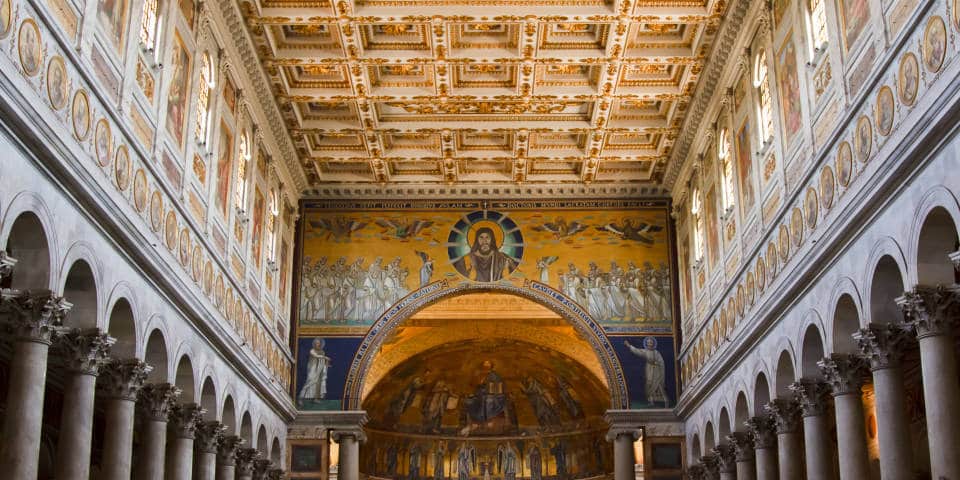
St Paul Outside the Walls impresses with its grandeur and solemn appearance. The poet Prudentius’ poem, written in honour of Emperor Honorius, immortalised the beauty of the holy place in poetic form. The picturesque basilica is located outside the Aurelian Walls, which lay beyond the boundary of Rome by the standards of the early Christian era.
The Porta San Paolo (San Paolo Gate) is part of another memorable landmark – the wall outlining the boundaries of the capital. It is believed that the Apostle Paul set out for his execution from this very spot. From the gate, a road runs south, at the end of which stands St Paul Outside the Walls.
The basilica was built above the tomb of St Paul in Rome, on the site where he was buried. Originally, many believers came to the tomb, so it was marked with a memorial stone. To honour the memory of the apostle, Emperor Constantine I built a church here in the 4th century AD.
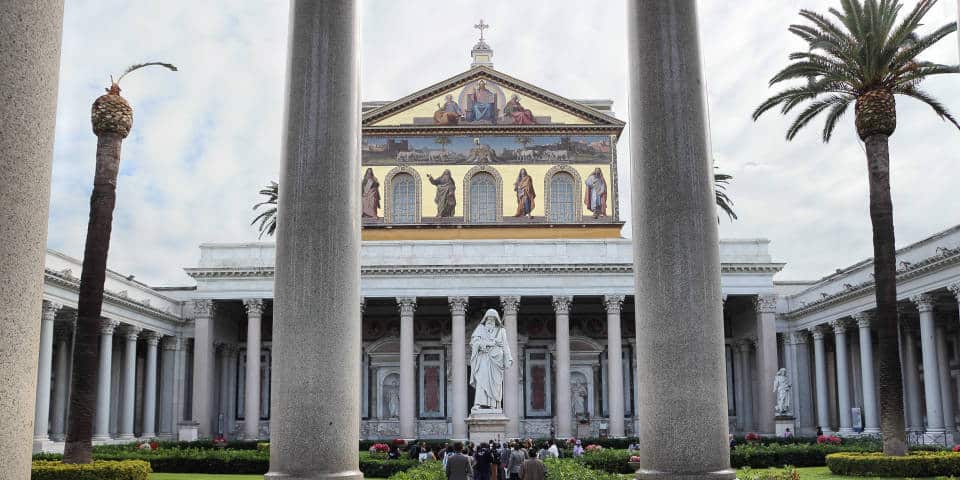
Valentinian I expanded the complex, and Theodosius I made it truly magnificent. In 590–604, Pope St Gregory the Great altered the church again: he built a new altar and adorned the courtyard with more than a hundred columns. In the centre of the open courtyard, they raised a monument to St Paul, holding a large book and a sword. It is so lifelike that, looking at the saint, you can understand he was ready to give his life for the Christian faith.
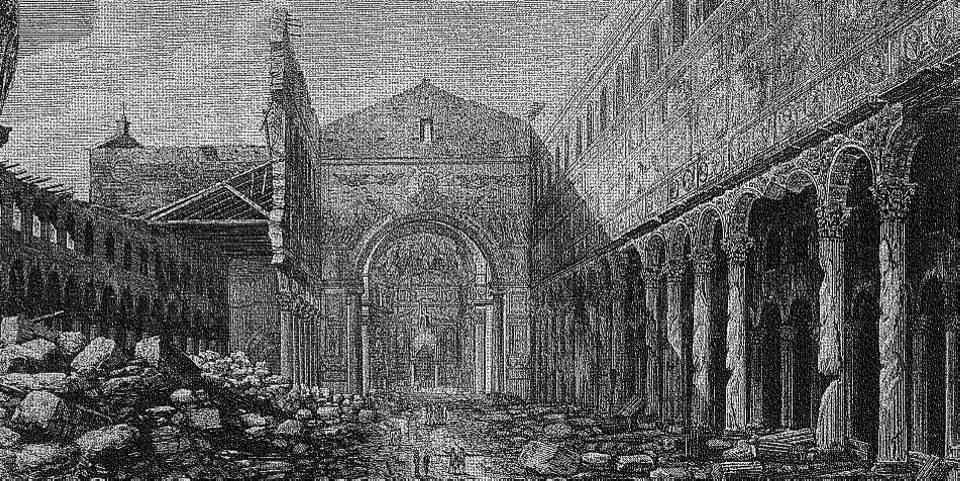
The church was first damaged in the 9th century during a Saracen attack, and in 1823, there was a major fire. Thirty-one years later, it was rebuilt, and Pius IX himself consecrated the site with the support of the wider Christian world. The cathedral was embellished with a new façade, frescoes, and mosaics depicting St Paul, Jesus and the major prophets. In the 13th century, the monastery at the basilica in Rome was established.
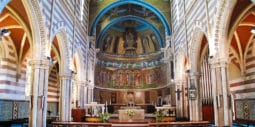
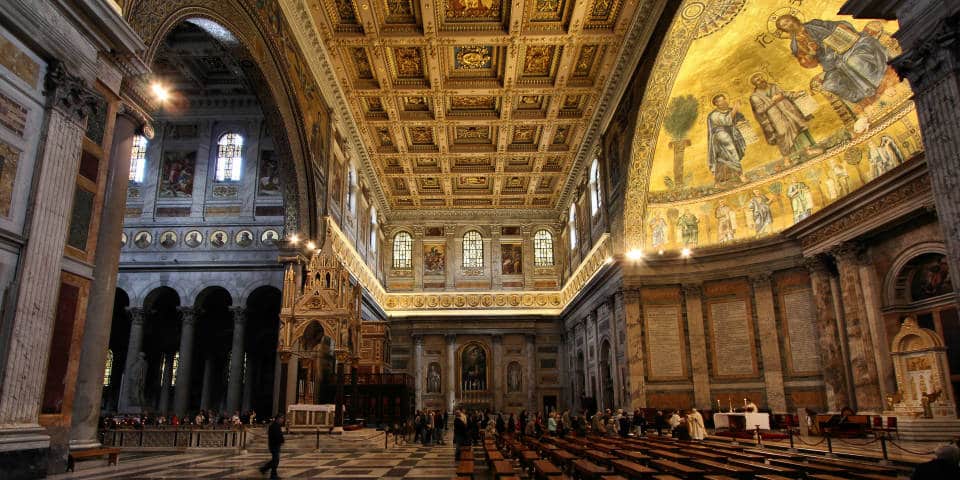
From the outside, St Paul Outside the Walls resembles an ordinary fortress, but the main splendour is within. The cathedral’s interior is rich in Classicist and Neoclassical decoration. The basilica has three doors, each individually decorated. Remains of ancient door panels dating from the 19th century were found in the right-hand door, near which you can see an image of Christ’s resurrection.
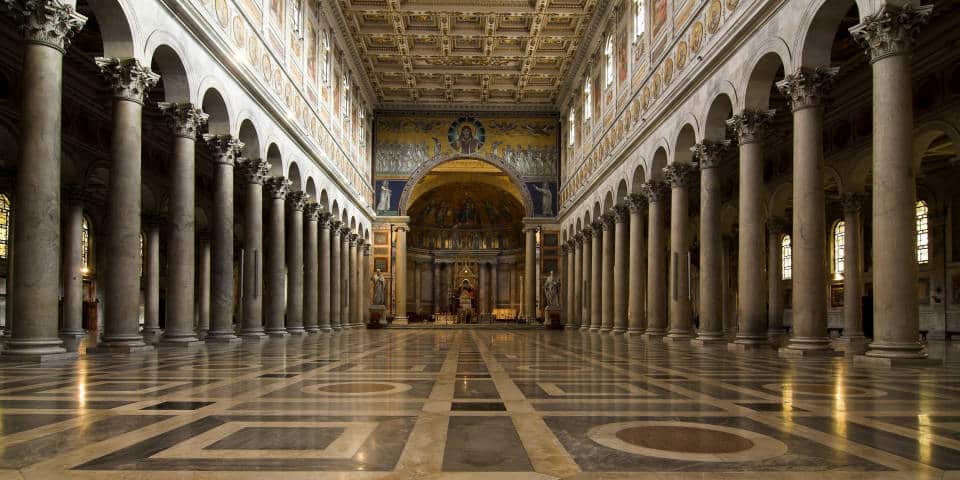
Inside the cathedral, there are five aisles; the central one is divided by 80 granite columns. The colonnade and ceiling frescoes date to the 19th century. The ceiling is decorated with carved gilded panels. The church also preserves part of the 5th-century construction – fragments of mosaics and the triumphal arch. One of the names of the arch is the Arch of Galla Placidia. It is believed that it was erected in honour of the Roman emperor’s wife. Each window has a unique pattern through which sunlight enters and fills the cathedral with warm light. The floor is paved with images of various animals.
The gallery of St Paul Outside the Walls contains 236 portraits of the pontiffs. Now, almost all medallions are filled. There is a legend that when the last Pope dies and no empty medallion is left, the world will come to an end.
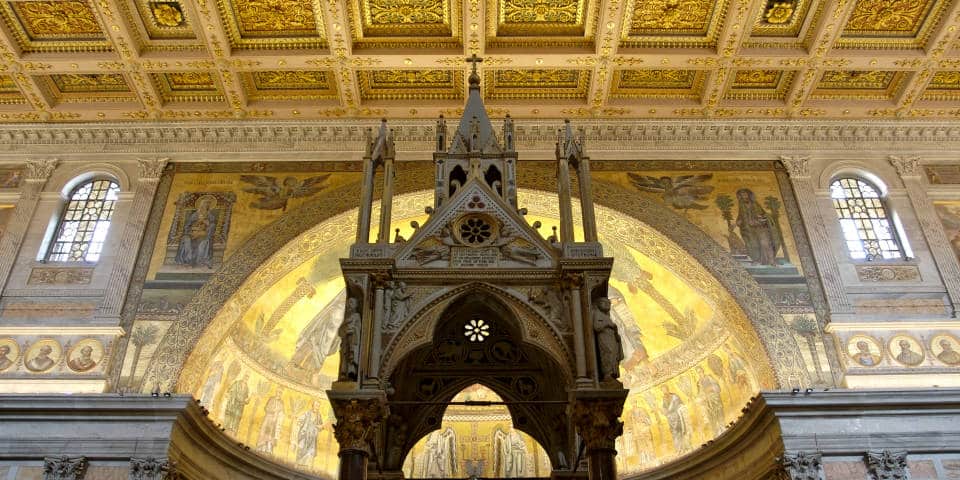
In the centre of the church, visitors can see a sarcophagus containing the relics of St Paul – its main attraction. Above it rises the tabernacle of 1285, decorated with skilfully blended pagan and Christian motifs. Next to it stands a 13th-century candlestick, 5.5 metres (18 ft) tall. The right to celebrate Mass here belongs only to the Pope.
The tomb has holes used by visitors to place a piece of cloth inside, so it touches the holy site. Near the sarcophagus, there is an altar with a small window that allows anyone to make a confession.
The basilica also preserves:
In 2011, the cathedral hosted the 10th International Festival of Sacred Music (Italian: X ° Festival Internazionale di Musica ed Arte Sacra). Within the church’s holy walls, a symphony orchestra performed Anton Bruckner’s Symphony No. 7.
St Paul Outside the Walls is located in the southern part of the city, two kilometres from the Aurelian Walls. You can visit the cathedral either on a guided tour or independently. The site aims to provide comfortable conditions for visitors, including offering wheelchairs and allowing blind people to bring a guide dog.
There are souvenir shops at the entrance to St Paul Outside the Walls.
RomeItaly.guide © 2026. Created with love by Roman experts and guides.