
RomeItaly.guide
  • About us
  • Where to Stay
    • Best 3-Star Hotels
    • Hostels for Solo Travellers
    • Hotels with Views
    • Near the Colosseum
    • Near Termini Station
  • Ancient Sites
    • Baths of Diocletian
    • Castel Sant’Angelo
    • Colosseum
    • Pantheon
    • Roman Forum
  • Visiting Vatican
    • Sistine Chapel
    • Vatican Museums
    • St Peter’s Basilica
    • St Peter’s Dome
  • Museums & Galleries
    • Ara Pacis Augustae
    • Borghese Gallery
    • Palazzo Farnese
  • Hills
    • Aventine
    • Capitoline
    • Janiculum
    • Pincian
  • Fountains & Squares
    • Acqua Paola
    • Altar of the Fatherland
    • Bernini’s Elephant
    • Four Rivers Fountain
    • Piazza Navona
    • Spanish Steps
    • Turtle Fountain
    • Trevi Fountain
  • Parks & Gardens
    • Knights of Malta Keyhole
    • Orange Garden
    • Rose Garden
    • Villa Doria Pamphilj
    • Villa Borghese
    • Villa Sciarra
    • Umbrella Pine Trees
  • How to Get
    • Fiumicino Airport ➡️ Rome
  1. Home /
  2. Ancient Roman Sites and Ruins

The Appian Way in Rome

Written by: Artur Jakucewicz

Via Appia Antike Straße
Tip The park covers several areas. Check the official visitor information for your route, cycle hire and site-specific access.
Recommended tour
Address Via Appia Antica, 42, Roma
Website www.parcoappiaantica.it

The Appian Way or Via Appia Antica in Rome is an ancient road built in 312 B.C. by Appius Claudius Caecus. The city’s gateway to the East connected Rome with Capua. It stretched from the Roman Forum to Brindisi, where ships sailed to Egypt and Greece, and it served as a military and economic artery. Today, it is one of the best sites to enjoy a sunny Roman day by stepping back in time.

Contents
  1. Things to Know Before Visit Appian Way
  2. Interesting Facts about the Appian Way
  3. How to Get to the Appian Way
  4. History of Appian Way
  5. The crucifixion of Spartacus
  6. Catacombs
  7. Appian Way Regional Park
    1. Via Latina Tombs
    2. Caffarella Park
    3. Aqueduct Park
    4. Tor Fiscale Park
    5. Villa of The Quintilii

Things to Know Before Visit Appian Way

What is the Appian Way, and when was it built?
The Appian Way, or Via Appia, is an ancient Roman road built in 312 BC. It was constructed by Appius Claudius Caecus to connect Rome to Brindisi in southeastern Italy.
Why was the Appian Way important for the Roman Empire?
As one of the earliest and strategically important Roman roads, the Appian Way facilitated trade, military movement, and communication, helping the Roman Republic move people and supplies across Italy.
How long is the Appian Way?
The road was first built from Rome towards Capua and later extended to Brindisi, a route of roughly 530 km. Different ancient and modern measurements may vary.
What famous historical events occurred on the Appian Way?
The Appian Way witnessed significant events, including the crucifixion of 6,000 enslaved people in 71 BC after the defeat of Spartacus. Tombs of notable Romans also stood along the route.
Why is the Appian Way also known as the “Queen of Roads”?
Ancient writers called the Appian Way Regina Viarum, or “Queen of Roads”. Its long route linked Rome to southern Italy.
What materials were used to build the Appian Way?
The Appian Way was built using layers of gravel, stones, and sand, topped with large polygonal blocks of basalt or volcanic rock, which provided a durable and stable surface for travel.
What kind of structures can be found along the Appian Way?
Various structures, such as tombs, monuments, villas, and catacombs, can be found along the Appian Way. The road was lined with these structures. Their size showed the wealth of their owners.
Can the Appian Way still be visited today?
Yes, parts of the Appian Way are preserved and accessible today. For example, a section known as the “Appia Antica” is now a regional park in Rome, where visitors can walk or cycle along the ancient road.
What challenges did the builders of the Appian Way face?
The builders of the Appian Way faced various challenges, such as marshy terrain and the need for drainage systems. They employed innovative engineering techniques to overcome these obstacles.
How did the construction of the Appian Way influence other Roman roads?
The construction of the Appian Way set a standard for Roman road engineering, leading to the creation of an extensive network of roads throughout the empire, spanning over a vast network.

Interesting Facts about the Appian Way

Here are 20 interesting and unusual facts about the Appian Way that only expert historians know. Memorize a few and surprise your friends during a self-guided walk.

  1. The Appian Way was named after Appius Claudius Caecus, a Roman censor, who initiated its construction in 312 BC.
  2. It was the first Roman road built specifically for military purposes. It helped troops and supplies move efficiently.
  3. The road was built using a groundbreaking technique called “opus caementicium,” a form of concrete that allowed engineers to create a durable and stable surface.
  4. The Appian Way played a crucial role in Rome’s expansion, as it connected the city to the southern provinces, enabling the conquest of new territories.
  5. The road was often used for “triumphal processions,” where victorious generals and their armies marched back to Rome to celebrate their victories.
  6. In 71 BC, after the defeat of Spartacus and his slave rebellion, the Romans crucified 6,000 enslaved people along the Appian Way as a warning to others who might consider rebellion.
  7. The Apostle Peter is said to have met Jesus on the Appian Way while fleeing persecution in Rome. According to tradition, Jesus told Peter he was returning to Rome to be crucified again, inspiring Peter to return to the city and face martyrdom.
  8. The Appian Way was a prestigious location for the burial of notable Romans, such as the poet Horace and the orator Cicero, whose tombs were situated along the road.
  9. Numerous catacombs, like the Catacombs of San Sebastiano and San Callisto, were built along the Appian Way, housing the remains of early Christians and martyrs.
  10. The road’s strategic importance prompted its inclusion in the “Antonine Itinerary,” a Roman guidebook listing the empire’s road network and important landmarks.
  11. The Appian Way was crucial for trade, enabling the transport of goods such as olive oil, wine, and grain from southern Italy to Rome.
  12. The Milvian Bridge, an important crossing along the Appian Way, was the site of a pivotal battle between Constantine and Maxentius in 312 AD, leading to Constantine’s conversion to Christianity.
  13. The road’s construction required advanced engineering techniques, such as building viaducts and bridges to traverse difficult terrains like marshlands and rivers.
  14. The road featured mile markers called “miliarium,” which indicated the distance to Rome. Travellers used it to judge the remaining distance.
  15. The Appian Way was continually maintained and repaired by the Roman government. This maintenance kept it in use for centuries.
  16. Emperor Augustus commissioned a monumental arch at the entrance to the Appian Way in Rome, called the “Porta San Sebastiano,” which still stands today.
  17. The road was also home to many villas and country estates, such as the Villa of the Quintilii, which belonged to wealthy and influential Romans.
  18. The Appian Way inspired the famous saying, “All roads lead to Rome,” emphasizing the importance of the Roman road network in connecting the vast empire.
  19. The road continued to be used during the Middle Ages and the Renaissance, playing a key role in developing Europe’s road systems.
  20. Today, the Appian Way is a popular tourist attraction and an important historical site, with the Appia Antica regional park preserving a section of the ancient road for visitors to explore.

How to Get to the Appian Way

It is quite easy to get to the Appian Way, using public transport. You need to:
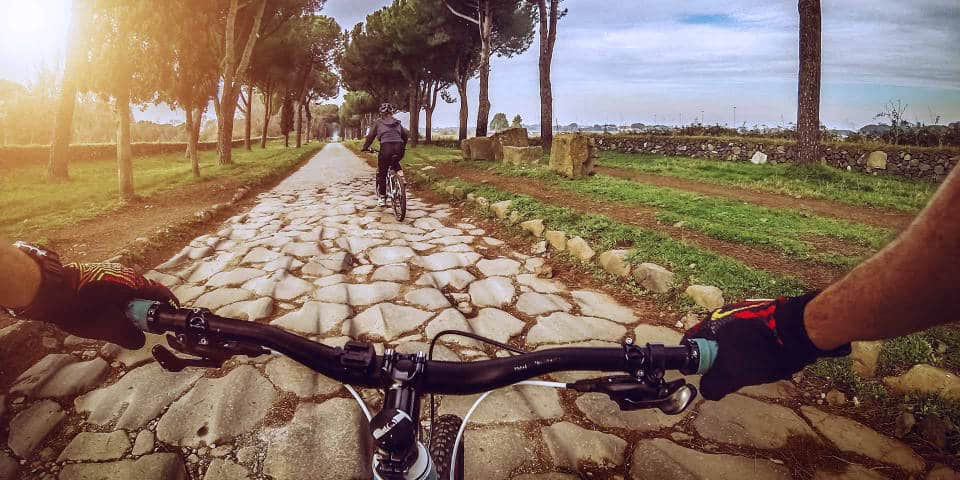
  • Take the Metro to the Piramide station.
  • Then, take a bus №118 from the station.
  • Your stop will be “Catacombs of San Callisto.”
  • From here, you can walk, use a bicycle, or cycle along the parts of the ancient road open to visitors.
  • Bike rental in Appia Antica Caffe: check current hire hours with the park.
  • Price: check the current price with the hire operator.

Bike rental via Appia Antica in Rome

Moreover, there are many tour options available to the Appian Way.

History of Appian Way

The road was named after Appius Claudius Caecus, the Roman censor who began and completed the first section of a military road in 312 B.C. The road was constructed to create fast communication between Rome and Capua near Naples.

The Appian Way began at the Circus Maximus and passed along the Baths of Caracalla, eventually, the Aurelian Wall. The route to Capua was a substantial journey in antiquity. Talking about the first line, it stretched between Rome and Terracina. Moreover, the Appian Way was revolutionary for that period and was the first Roman road to feature lime cement.
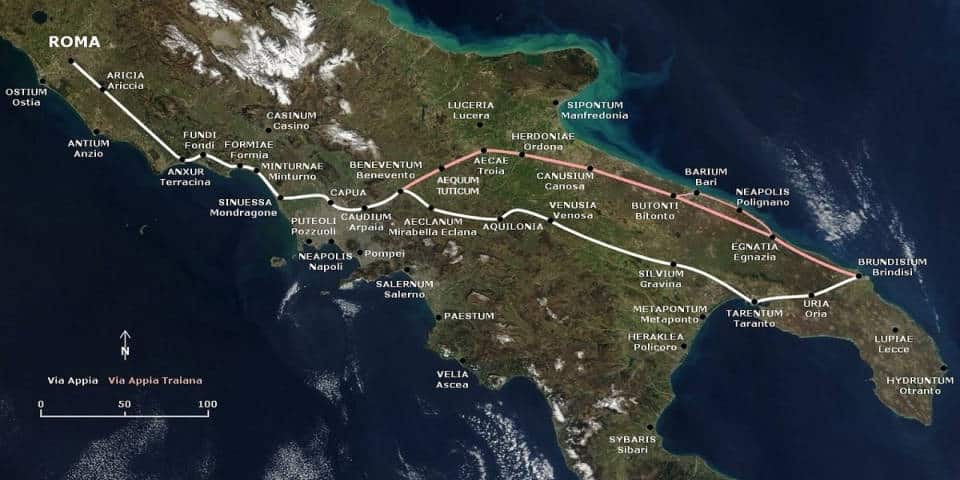
Via Appian way Antica on Italy map

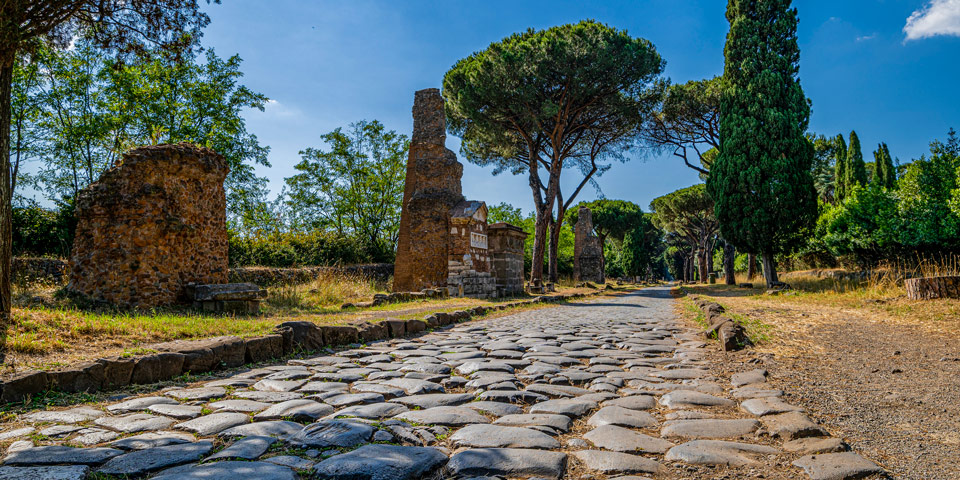
The entire road is made of large slabs of stone

The part of the Appian Way is now called Via Sacra or Sacred Way, which begins at Capitoline Hill. The road borders Palatine Hill and Circus Maximus.

The crucifixion of Spartacus

In ancient times, it was forbidden to bury the dead on the territory of Rome, and they were planted along the roads out of the city. Famous people were buried in tombs for themselves or for the whole family.

However, besides numerous tombs alongside the Appian Way, there are also monuments such as the Christian Catacombs, the Temple of Hercules, the Church Quo Vadis (Saint Peter met Christ there), remains of the gothic Church of San Nicola, and tombs of San Sebastian, San Domitilla, San Callixtus, and the tomb of Cecilia Metella. Moreover, the Circus Maxentius is near the tomb of Romulus, which is one of the most preserved Roman circuses. Gallienus and Geta Roman Emperors were buried there.

In 73 B.C., a slave revolt appeared against the Romans under the ex-gladiator Spartacus

He managed to defeat many Roman armies in two years of conflict. Still, when he tried to escape, Spartacus moved his forces in the Apulia/Calabria trap and was pinned between Legions from the whole Empire. Romans considered his defeat as a loss of the right to life for the slaves. Later, in 71 B.C., 6 thousand slaves, including Spartacus, were crucified on the 200-kilometre of the Appian Way from Rome to Capua.

Catacombs

Near the Appian Way are extensive underground tunnels, known as catacombs, where early Christians were buried, and during the times of persecution, hidden churches held services. The most famous of them are the Catacomb of Callixtus and the Catacomb of Saint Sebastian.

Reccomend to visit private tour to Catacombs and Crypts.
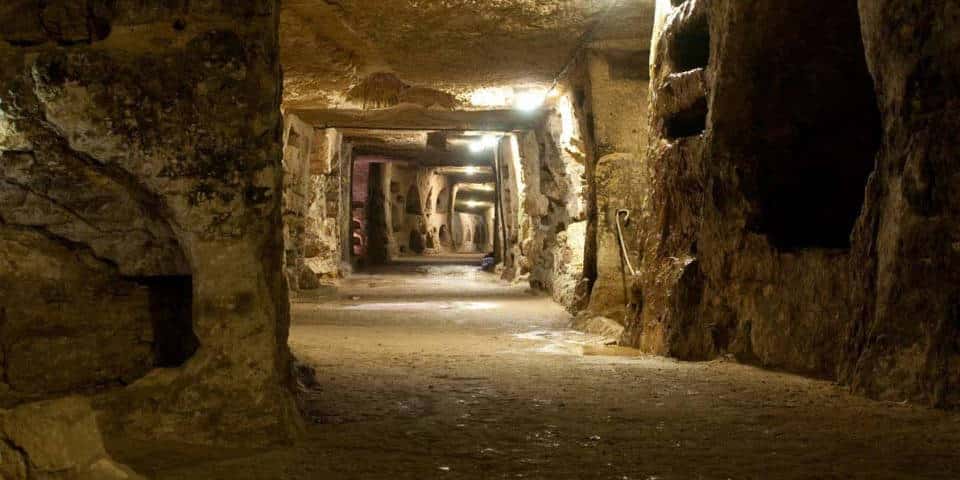
Catacomb of Saint Sebastian Below the Appian Way in Rome

Appian Way Regional Park

Parco Regionale dell’Appia Antica or The Appian Way Regional Park is on Via Appia Antica and is a colossal old park owned by different individuals. This area is occupied by farmers whose income goes from agriculture. It is famous for its ancient treasures, ruins, and archeological remains. Moreover, there are old churches and catacombs such as Annia Regilla and Tomba Tomba. Other famous sites are Villa dei Quintili, Caffarella Valley, Farnese, Tormacrancia, Circo di Massenzio, and Via Latina.
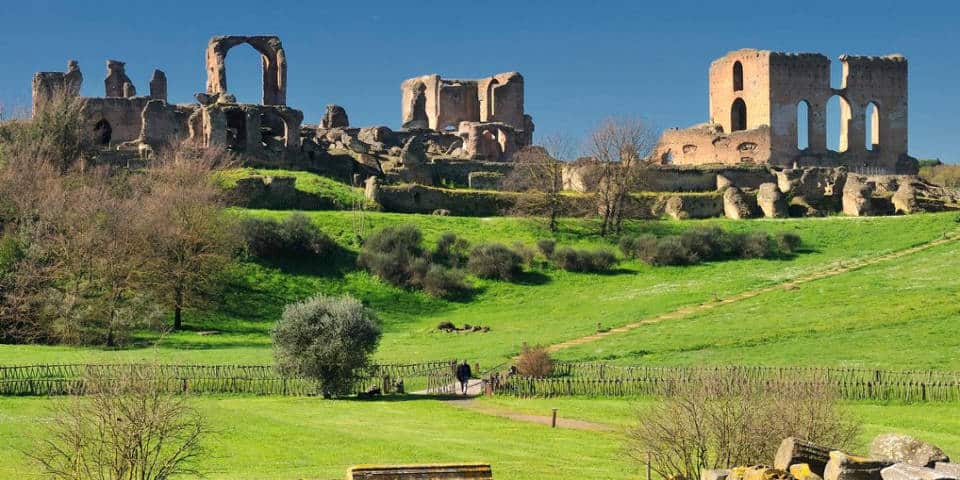
Appian Way Regional Park in Rome

The park is around 3400 hectares and protected since 1988.

There are bicycles available for rent and restaurants to stop at for lunch/dinner. Moreover, there are more than 70 kinds of animals in the park. Among them, you can meet rabbits, frogs, foxes, salamanders, turtles, and other species.

Via Latina Tombs

The Tombs of Via Latina are mainly from the 2nd century A.D., located along a stretch of the old Roman road of Via Latina, within the Regional Park. The tombs were discovered in 1857-58. Its excavations were maintained by Pope Pius IX.

Caffarella Park

The Caffarella Park is bordered on the northern side by the Via Latina and on the southern side by the Appian Way. It begins from the Aurelian Wall up to the Via del’Almone. There is a working farm with 78 species of birds and other animals. Herodes Atticus was a Greek who became a senator of Rome and married Annia Regilla, acquired the land of a large estate known as the Triopius, which occupied much of the area. There you will find the tomb Annia Regilla and the Nymphaeum of Egeria.

Aqueduct Park

The Parco degli Acquedotti is a public park of around 240 hectares. It is named after the aqueducts that split it, the Aqua Felix and the Aqua Claudia. Also, there you will find the remains of the Villa delle Vignacce.
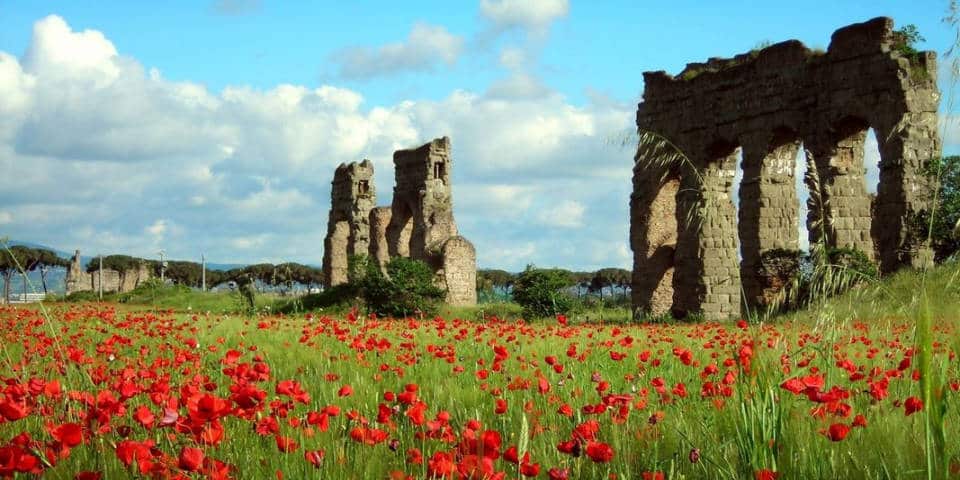
Aqueduct Park near the Appian Way in Rome

Tor Fiscale Park

Six Roman aqueducts go to Rome through the Tor Fiscale Park. Over the centuries, it was a famous encampment from armies that tried to invade Rome as it was on the Via Latina, very close to the Appian Way.

Villa of The Quintilii

The Villa of the Quintilii (Villa dei Quintili) is an ancient Roman villa located on the fifth mile of the Appian Way. It was constructed by the brothers Sextus Quintilius Maximus and Sextus Quintilius Condianus during the 2nd century. Moreover, the villa contained a thermae fed by its aqueduct and a hippodrome from the 4th century.

Undoubtedly, it is worth visiting the Appian Way. The road is full of history and represents ancient times. It would be an excellent choice for a day trip in the sunny weather, discovering Roman ruins, monuments, and catacombs and taking beautiful photos.

Author: Artur Jakucewicz

Artur Jakucewicz

I’ve lived in Rome for over a decade and am delighted to share my knowledge and experience. Passionate about ancient history and architecture, I’m the author of travel guides to Italy designed especially for independent travellers.

Dive Deeper into Rome's Stories

Vatican Museums Visitor Guide

992122 travellers read

The Vatican Museums

Rome Italy Tourist Attractions

29415 travellers read

Top 30 Attractions in Rome

Beste Hotels in Rom mit Aussicht

11418 travellers read

Best Hotels with Views in Rome

How to Book Vatican Museums & Sistine Chapel Tickets

16764 travellers read

How to Book Vatican Museums & Sistine Chapel Tickets

St. Peter's Basilica dome seen through the trees from the far side of Piazzale Garibaldi, Rome

12098 travellers read

Janiculum Hill (Gianicolo): Viewpoints and Walking Route

Largo di Torre Argentina archaeological site in Rome

15 travellers read

Largo di Torre Argentina and the Cat Sanctuary

Der Mund der Wahrheit in Rom

19 travellers read

Mouth of Truth in Rome

bridge of the angels

20 travellers read

Ponte Sant’Angelo: Bridge of Angels

Pyramide des Caius Cestius in Rom

15 travellers read

Pyramid of Cestius

Show more

About us

About us ROME.US Authors Kate Zusmann and Artur Jakucewicz
We're Kate and Artur, a duo bound by our shared fascination with the Eternal City – Rome. Our paths, driven by a mutual passion for its timeless stories and architectural marvels, converged in a way we had never imagined.

Explore Rome

  • Regola District in Rome

    Regola District

  • Roman amphitheatre

    How Many Roman Amphitheatres Are There?

  • The Colosseum in Rome

    Why the Colosseum is Important?

  • Bust of the Roman emperor Nero

    Emperor Nero

  • galleria sciarra vaulted courtyard ceiling rome

    Galleria Sciarra, the Art Nouveau Courtyard Most Tourists Miss

RomeItaly.guide

This website uses cookies. For more info read the cookies policy

RomeItaly.guide © 2026. Created with love by Roman experts and guides.

  • American English
  • Español
  • Deutsch
  • Polski
  • Русский
  • Français