RomeItaly.guide
  • About us
  • Where to Stay
    • Best 3-Star Hotels
    • Hostels for Solo Travellers
    • Hotels with Views
    • Near the Colosseum
    • Near Termini Station
  • Ancient Sites
    • Baths of Diocletian
    • Castel Sant’Angelo
    • Colosseum
    • Pantheon
    • Roman Forum
  • Visiting Vatican
    • Sistine Chapel
    • Vatican Museums
    • St Peter’s Basilica
    • St Peter’s Dome
  • Museums & Galleries
    • Ara Pacis Augustae
    • Borghese Gallery
    • Palazzo Farnese
  • Hills
    • Aventine
    • Capitoline
    • Janiculum
    • Pincian
  • Fountains & Squares
    • Acqua Paola
    • Altar of the Fatherland
    • Bernini’s Elephant
    • Four Rivers Fountain
    • Piazza Navona
    • Spanish Steps
    • Turtle Fountain
    • Trevi Fountain
  • Parks & Gardens
    • Knights of Malta Keyhole
    • Orange Garden
    • Rose Garden
    • Villa Doria Pamphilj
    • Villa Borghese
    • Villa Sciarra
    • Umbrella Pine Trees
  • How to Get
    • Fiumicino Airport ➡️ Rome
  1. Home /
  2. Roman Emperors /
  3. Emperor Constantine the Great

Emperor Constantine the Great

Written by: Kate Zusmann

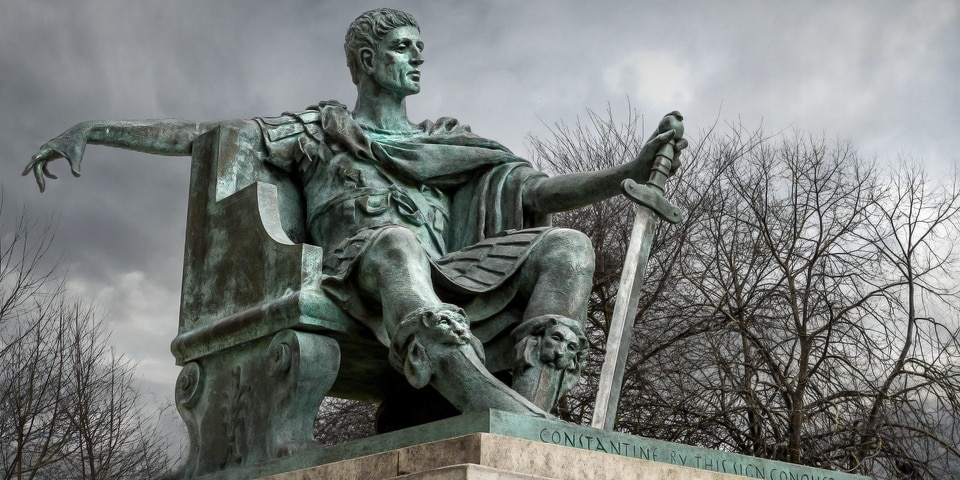
Portrait of Constantine the Great

Constantine I, or Constantine the Great, was a Roman emperor from 306 to 337 AD. Diocletian’s previous emperor decided to split the empire into two parts since it was too large to be ruled by one person, and established a tetrarchy, or rule by four. Diocletian ruled the east from Nicomedia as an “Augustus,” with Galerius as his “Caesar.” Maximian and Constantius the Pale ruled the west.

The son of Constantius, Constantine, reunited the split empire and moved the capital away from Old Rome and built a new capital, Constantinople.

Contents

Toggle
  • Early Life
    • Race for Power
  • The Battle of Milvian Bridge
  • Emperor Constantine the Great
  • Byzantium
  • Christians
  • Interesting Facts
  • Death of Constantine the Great
  • Things to Know About Constantine the Great

Early Life

Constantine, Gaius Flavius Valerius Constantinus, was born at Naissus in today’s Serbia from 272 to 285 AD. His father was a military commander and the caesar of the West, so Constantine lived his life in the imperial court with a later rise in ranking as a staff officer for Diocletian. All the people who surrounded Constantine thought about him as a person with endless energy.

In 305, Diocletian and Maximian abdicated their thrones to Galerius in the East and Constantius in the West. However, the sons of Maximian, Maxentius, and Constantine felt betrayed. It led to a long battle over control of both parts of the empire. After the abdication of Diocletian, Galerius allowed Constantine to return to the West in 306 and to serve under his father. Thus, before Constantius died of leukemia (the reason he was called “Pale”) in 306 in York, Constantine had a chance to campaign with his father in Britain against the Picts.

After his father’s death, Constantine continued to build a reputation as a person able to make strong decisions in a fast way, and in 307, he attacked the Franks. There, he killed two Frankish kings by throwing them to beasts in the amphitheater at Trier. He gained the respect of the army, and they started to trust him.

With the death of Constantius and the success of the war in Britain, people expected Constantine to become the new Augustus in the West. However, Severus, who was Caesar and a close friend of Galerius, was advanced to the post despite the claim that Constantius had named his son Augustus before his death.

Race for Power

Despite the official decree, Constantine was declared Augustus by his people. Galerius, however, refused to acknowledge this statement, calling himself a Caesar. It shouldn’t be overlooked that Maxentius ignored Galerius and Constantine and declared himself Augustus in 307 AD. With the support of Rome and the Praetorian Guard, he controlled Sicily, Corsica, Sardinia, and some parts of North Africa. In the end, six different people will eventually take control of the West.

Because of the friendship with Galerius, Severus was not trusted by both Constantine and the brother-in-law of Constantine Maxentius. They united with the former Augustus Maximian to defeat the new Augustus and joined forces against Severus. Unfortunately for Severus, who received the order to stop Maxentius, his army left him. Being feared for his life, he moved to Ravenna to be killed outside of Rome. His death prompted Galerius’s unsuccessful invasion of the West with the military forces. In 308 AD, a new tetrarchy was formed, with Licinius as the new Augustus, while Constantine retained the position of Caesar. Eventually, Maximian committed suicide.

The Battle of Milvian Bridge

Maxentius left Rome to meet with Constantine in the famous Battle of Milvian Bridge in 312. One day before the battle, According to later accounts, Constantine saw a sign in the sky that he interpreted as a Christian symbol. Later during the night, Constantine had a dream with the sign’s explanation, where Christ appeared in front of him, telling him to carry the sign of the cross into the battle.

The next day, the old banners were changed with new ones with the sign of the cross. Constantine easily defeated Maxentius, who fled back to Rome. However, before coming to the city, he fell into the river and drowned. Historians consider this victory an important turning point in history, which meant a fusion of church and state.

Constantine gained complete control over the west. One of his first acts was to issue the Edict of Milan, a toleration of all religions

Emperor Constantine the Great

Galerius and Maximinus Daia were serving as Augustus and Caesar in the east. However, Galerius soon died, and Maximinus and Licinius started fighting for the East’s control. This led to the split of the empire between them, where Licinius got the Balkans, and Maximinus got Asia Minor with eastern provinces. Their arrangement didn’t last long, and soon, they met in a fight in Thrace in 313. Moreover, Licinius fought under the sign of the cross in that battle.

Licinius and Constantine didn’t have good relationships. Moreover, Licinius married Constantine’s half-sister Constantia. The two men first met on the battlefield in Cibalae in 316, where Constantine defeated Licinius. During the following years, Licinius executed Christians and destroyed churches. This led Constantine to gather an army and defeat him in a second battle at Hadrianopolis.

In 324, Licinius was totally defeated at Chrysopolis and Constantine’s victory reunited the empire

Byzantium

Constantine became the sole emperor when he was 52 years old. He realized that Old Rome was not the city that he wanted to see as the capital, and he changed it to Byzantium. The ancient city had a valuable location on the European side of the Strait Bosporus to control traffic to and from the Black Sea. The city had wide streets with statues of Alexander, Caesar, Diocletian, and Constantine. He rebuilt Christian churches and pagan temples and worked on many other public projects. Finally, in 330, the city was dedicated.

Christians

Constantine showed his religious tolerance to both Christians and pagans. In 312, he officially started to claim himself to be a Christian. His mother, Helena, was a devout Christian, and her influence on the son had an obvious effect. Constantine tolerated certain pagan religious practices, but crucifixions were abolished, and pagan sacrifices became forbidden. Moreover, his reign gave an end to the gladiator contests, and there were several new laws against sexual immortality and ritual prostitution.

Interesting Facts

  1. Constantine the Great, known for his seemingly boundless energy, tirelessly led his troops through numerous battles and reforms, and influenced Roman history.
  2. After the death of Constantius and his victorious campaign in Britain, the Roman populace eagerly anticipated Constantine’s ascension as the new Augustus of the Western Roman Empire.
  3. A momentous event occurred the day before the Battle of the Milvian Bridge in 312 CE: Constantine witnessed a miraculous vision. In the sky, he beheld a cross superimposed over the sun, which he interpreted as a sign of Christian victory.
  4. At the age of 52, Constantine achieved the pinnacle of his career, becoming the sole ruler of the Roman Empire, consolidating his power and influence.
  5. Recognizing that Old Rome did not align with his vision for a new capital, Constantine selected Byzantium, renaming it Constantinople, which would later become a thriving imperial metropolis.
  6. Constantine’s reign was marked by remarkable religious tolerance, where Christians and pagans enjoyed freedom of worship and coexisted peacefully under his rule.
  7. In the year 312 CE, Constantine formally embraced Christianity, setting a historic precedent for future Christian emperors and reshaping the religious landscape of the Roman Empire.
  8. The Triumphal Arch of Constantine, adjacent to the Colosseum and Roman Forum, commemorates his victory and remains one of ancient Rome’s best-preserved arches.
  9. Helena, Constantine’s devoutly Christian mother, played a pivotal role in his conversion to Christianity, and influenced his beliefs and policies.
  10. Following his passing, Constantine was interred at the Church of the Holy Apostles in Constantinople. His legacy lived on through his three sons, Constantine II, Constantius II, and Constans, who inherited the empire, perpetuating the era of the Constantinian dynasty.

Death of Constantine the Great

Constantine was a military commander and the emperor. In 328, he fought the Alemani with his son Constantius II, defeating the Goths in 332 and capturing the lost territories from the Dacians. He died from being ill in 337. The emperor ruled for 31 years. He was buried at the Church of the Holy Apostles in Constantinople. His three sons succeeded him: Constantine II, Constantius II, and Constans. Eventually, Constantinus II defeated his brothers to become the sole emperor.

Things to Know About Constantine the Great

Why was Constantine the Great so important?
Constantine the Great was vital for consolidating the Roman Empire’s unity in the early 4th century. He legalized Christianity through the Edict of Milan in 313 AD, ending persecution, and played a significant role in the Council of Nicaea in 325 AD, which helped establish early Christian doctrine. Constantine’s leadership led to the foundation of Constantinople (modern-day Istanbul) as a new capital, shifting the empire’s focus to the east.
Where was Constantine the Great born?
Constantine the Great was born in Naissus, a city located in the province of Moesia (modern-day Niš, Serbia), on February 27, 272 AD.
What did Constantine the Great do?
Constantine the Great is renowned for several key actions. He converted to Christianity, granting religious tolerance through the Edict of Milan in 313 AD. Constantine also convened the Council of Nicaea in 325 AD, which helped define early Christian doctrine. Additionally, he established Constantinople as the new eastern capital, significantly impacting the Roman Empire’s future.
How did Constantine the Great die?
Constantine the Great died on May 22, 337 AD, in Nicomedia (modern-day İzmit, Turkey). His exact cause of death remains uncertain, but it is believed to be natural, possibly from illness or old age. He was in his early 60s at the time.
How did Constantine the Great rise to power?
Constantine’s rise to power involved his victory in the Battle of Milvian Bridge in 312 AD, where he defeated Maxentius, a rival claimant to the Roman Empire’s throne. According to legend, Constantine attributed his victory to the Christian God and adopted the Chi-Rho symbol. This marked his embrace of Christianity and eventual conversion, leading to his ascent as the sole ruler of the Roman Empire after a series of political maneuvers and battles.

Author: Kate Zusmann

Kate Zusmann

I’ve lived in the Eternal City for the past 12 years. They say every corner of Rome holds a story, and I’m here to share some of the most fascinating historical facts and local legends.

Dive Deeper into Rome's Stories

Vatican Museums Visitor Guide

992108 travellers read

The Vatican Museums

Rome Italy Tourist Attractions

29399 travellers read

Top 30 Attractions in Rome

Beste Hotels in Rom mit Aussicht

11398 travellers read

Best Hotels with Views in Rome

How to Book Vatican Museums & Sistine Chapel Tickets

16749 travellers read

How to Book Vatican Museums & Sistine Chapel Tickets

St. Peter's Basilica dome seen through the trees from the far side of Piazzale Garibaldi, Rome

12082 travellers read

Janiculum Hill (Gianicolo): Viewpoints and Walking Route

Roman emperors

10 travellers read

How Many Roman Emperors Were Assassinated?

Portrait of Emperor Caligula

10 travellers read

Roman Emperor Caligula

Bust of the Roman emperor Nero

10 travellers read

Emperor Nero

Kaiser Hadrian

12354 travellers read

Emperor Hadrian

Show more

About us

About us ROME.US Authors Kate Zusmann and Artur Jakucewicz
We're Kate and Artur, a duo bound by our shared fascination with the Eternal City – Rome. Our paths, driven by a mutual passion for its timeless stories and architectural marvels, converged in a way we had never imagined.

Explore Rome

  • The Church of the Gesù in Rome

    Church of the Gesù

  • Faro del Gianicolo rising above the pine trees on Janiculum Hill in Rome

    Faro del Gianicolo: Rome’s Lighthouse from Argentina

  • galleria sciarra vaulted courtyard ceiling rome

    Galleria Sciarra, the Art Nouveau Courtyard Most Tourists Miss

  • St Peter's Basilica in the Vatican City

    St Peter’s Basilica in the Vatican City

  • How to Book Vatican Museums & Sistine Chapel Tickets

    How to Book Vatican Museums & Sistine Chapel Tickets

RomeItaly.guide

This website uses cookies. For more info read the cookies policy

RomeItaly.guide © 2026. Created with love by Roman experts and guides.
  • American English
  • Español
  • Deutsch
  • Polski
  • Русский
  • Français