
RomeItaly.guide
  • About us
  • Where to Stay
    • Best 3-Star Hotels
    • Hostels for Solo Travellers
    • Hotels with Views
    • Near the Colosseum
    • Near Termini Station
  • Ancient Sites
    • Baths of Diocletian
    • Castel Sant’Angelo
    • Colosseum
    • Pantheon
    • Roman Forum
  • Visiting Vatican
    • Sistine Chapel
    • Vatican Museums
    • St Peter’s Basilica
    • St Peter’s Dome
  • Museums & Galleries
    • Ara Pacis Augustae
    • Borghese Gallery
    • Palazzo Farnese
  • Hills
    • Aventine
    • Capitoline
    • Janiculum
    • Pincian
  • Fountains & Squares
    • Acqua Paola
    • Altar of the Fatherland
    • Bernini’s Elephant
    • Four Rivers Fountain
    • Piazza Navona
    • Spanish Steps
    • Turtle Fountain
    • Trevi Fountain
  • Parks & Gardens
    • Knights of Malta Keyhole
    • Orange Garden
    • Rose Garden
    • Villa Doria Pamphilj
    • Villa Borghese
    • Villa Sciarra
    • Umbrella Pine Trees
  • How to Get
    • Fiumicino Airport ➡️ Rome
  1. Home /
  2. Ancient Roman Sites and Ruins

Pyramid of Cestius

Written by: Kate Zusmann

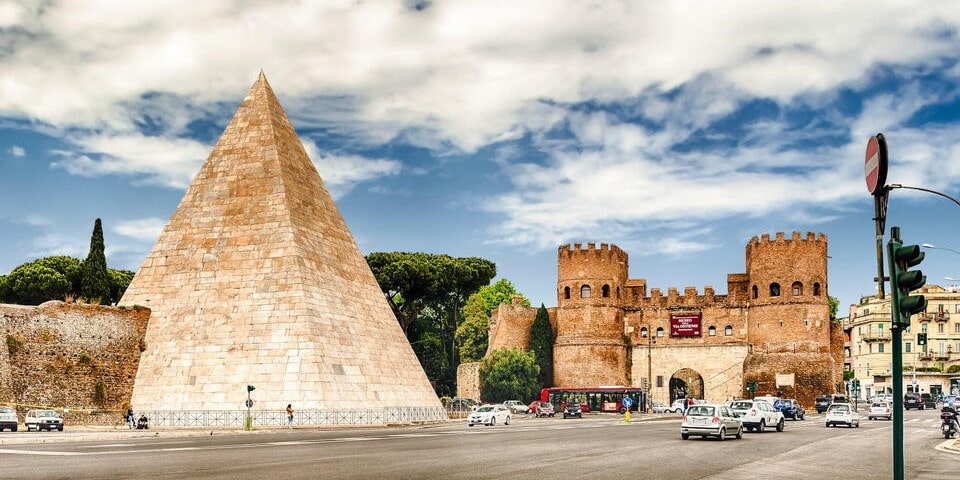
Pyramide des Caius Cestius in Rom
Tip The pyramid is near Piramide station. Check current access arrangements before planning to go inside.
Address Via Raffaele Persichetti, Roma

The Pyramid of Caius Cestius is the lone remaining structure from a group of monuments built in Rome around the first century B.C. when the style that emerged following the conquest of Egypt in 31 BC had an impact on tomb building.

Contents
  1. Things to Know Before Visit Pyramid of Caius Cestius
  2. History
  3. Interesting Facts

Things to Know Before Visit Pyramid of Caius Cestius

Why is the pyramid of Caius Cestius important?
The Pyramid of Cestius is one of the best-preserved buildings from the Imperial Period. It was built around 2000 years ago as a mausoleum for the magistrate and priest Caius Cestius and his family.
What is the pyramid of Caius Cestius made of?
The Pyramid of Cestius is constructed of brick and cement and covered in white marble.
What does Cestius mean?
Cestius refers to male members of the Cestia gens, an ancient Roman family.
Did the Romans build pyramids?
Yes, the Romans did build pyramids, and you can still see one in Rome today. It is called the Pyramid of Caius Cestius.

Who made the Pyramid of Cestius?
The Pyramid of Cestius was built around 2000 years ago as a mausoleum for the magistrate and priest Caius Cestius and his family. It also played an important role in protecting Rome from marauding tribes since it was incorporated into the Aurelian walls as a bastion when Rome grew.
Is it possible to get inside the Pyramid of Gaius Cestius in Rome?
Yes, it is possible to get inside the Pyramid of Gaius Cestius in Rome through guided tours, which typically allow access to the small burial chamber adorned with frescoes. However, today it is unfortunately impossible to get inside since guided tours are not currently conducted, and it is unknown when they will resume.

History

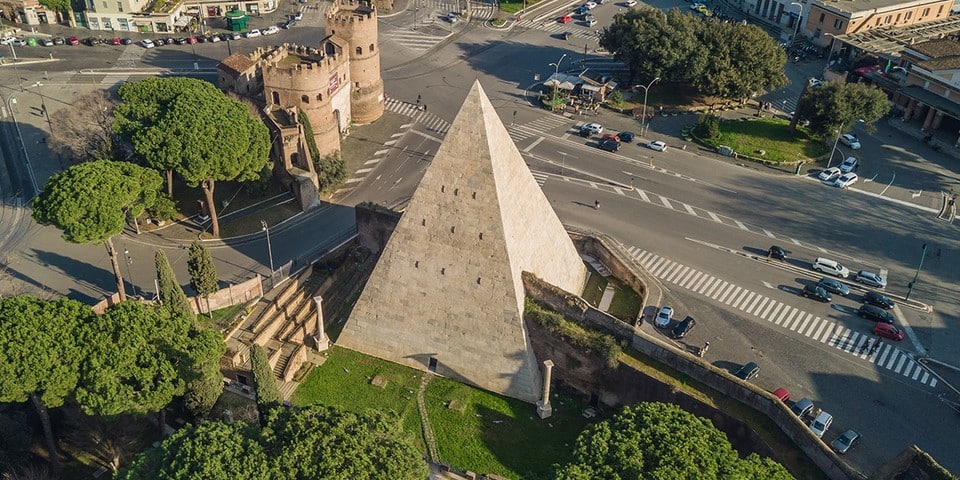
Rome’s sole remaining pyramid is situated on the edge of the Testaccio neighborhood, right across the Piramide train station, next to the city’s Non-Catholic Cemetery.
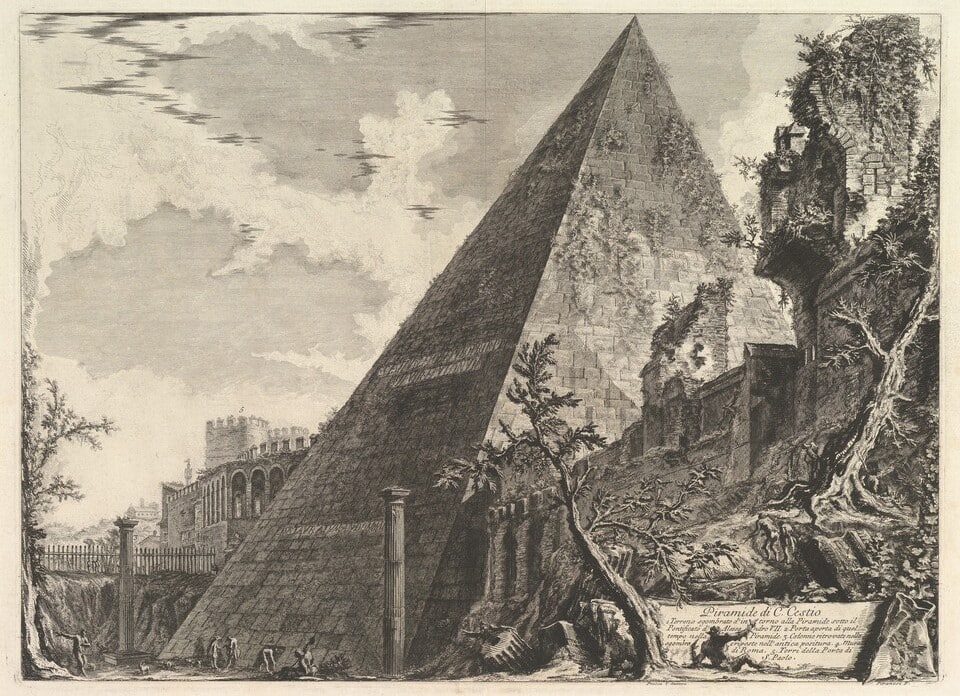
The Pyramid of Caius Cestius

The 36-metre-tall monument was erected in the first century BC as a tomb for Caius Cestius, a powerful Roman magistrate.

Caius Cestius, a Roman politician and member of the priestly college of epuloni, stipulated in his testament that his pyramid-shaped mausoleum should be built in 330 days. Between the years of the introduction of the law against the ostentation of luxury, which prevented the installation of some precious tapestries inside the cell, and that of the death of Agrippa, son-in-law of Augustus, who was listed among the beneficiaries of the bequest, the tomb was constructed along the Via Ostiense. This dates its construction between the years of 18 and 12 BC.

Later, the Pyramid was incorporated into the walls that the emperor Aurelian built between 272 and 279 on his initiative. The structure, which rises 36.40 metres high and has a square base of 29.50 metres on each side, is constructed of a brick curtain and cement work around the perimeter. Its exterior is covered in slabs of Luni marble.
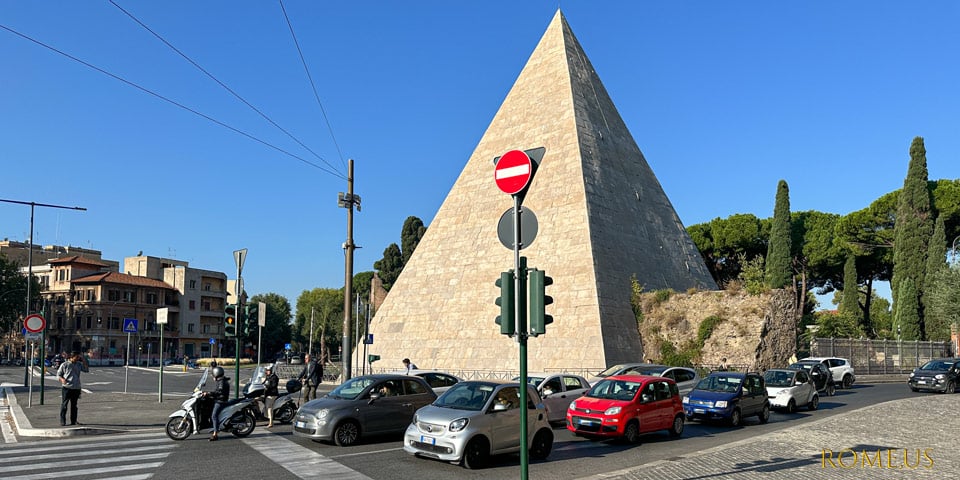
The Pyramid of Caius Cestius in Rome

According to Egyptian tradition, the burial chamber, which is around 23 square metres in size and has a barrel vault, was sealed up at the time of burial. The cinerary urn and a substantial piece of the decoration were lost as a result of the first violation of the tomb, which most likely occurred in the Middle Ages through a tunnel excavated on the northern side.

The walls are frescoed with a decorative pattern of panels, where figures of nymphs alternating with lustrous vases on a light background. Four winged Victories holding crowns and ribbons are depicted above, at the corners of the vault. In the middle, there must have previously been an apotheosis scene depicting the patron of the sepulcher.

The Archaeological Superintendency of Rome completed the restoration of the sepulchral cell in 2001. A subsequent renovation started in 2012 and was finished in 2015.
Interesting Facts

  1. The Pyramid of Cestius is built into the Aurelian Walls, and an inscription on its white marble façade states that its construction took 330 days.
  2. A restoration supported by Japanese benefactor Yuzo Yagi began in 2013.
  3. In addition to cleaning the exterior, the project included restoring the frescoes painted in the inner chambers of the pyramid whose grounds are nowadays home to a cat sanctuary.
    The Pyramid of Cestius in Rome
  4. There were other pyramids in Rome besides the Caius Cestius Pyramid. One was along Via Della Conciliazione, while the other was situated where the twin churches of Piazza del Popolo are now. It was considered the Meta Romuli. In 1499, it was demolished by Pope Alexander VI Borgia, on the occasion of the imminent Jubilee. It was in that period that the Pyramid of Cestius was mistakenly identified as the Meta Remi, the tomb of Remo, the twin brother of Romolo.
  5. The inscription on the southeast side of the pyramid reads: “Gaius Cestius Epulo, son of Lucius, of the Poblilian district, praetor, tribune of the people, an official of the public banquets. According to his will, this work was completed in three hundred and thirty days; it was executed by his heirs L. Pontus Mela, son of Publius, of the Claudian district, and his freedman Pothus”

Author: Kate Zusmann

Kate Zusmann

I’ve lived in the Eternal City for the past 12 years. They say every corner of Rome holds a story, and I’m here to share some of the most fascinating historical facts and local legends.

Dive Deeper into Rome's Stories

Vatican Museums Visitor Guide

992122 travellers read

The Vatican Museums

Rome Italy Tourist Attractions

29415 travellers read

Top 30 Attractions in Rome

Beste Hotels in Rom mit Aussicht

11418 travellers read

Best Hotels with Views in Rome

How to Book Vatican Museums & Sistine Chapel Tickets

16764 travellers read

How to Book Vatican Museums & Sistine Chapel Tickets

St. Peter's Basilica dome seen through the trees from the far side of Piazzale Garibaldi, Rome

12098 travellers read

Janiculum Hill (Gianicolo): Viewpoints and Walking Route

Largo di Torre Argentina archaeological site in Rome

18 travellers read

Largo di Torre Argentina and the Cat Sanctuary

Via Appia Antike Straße

17 travellers read

The Appian Way in Rome

Der Mund der Wahrheit in Rom

19 travellers read

Mouth of Truth in Rome

bridge of the angels

21 travellers read

Ponte Sant’Angelo: Bridge of Angels

Show more

About us

About us ROME.US Authors Kate Zusmann and Artur Jakucewicz
We're Kate and Artur, a duo bound by our shared fascination with the Eternal City – Rome. Our paths, driven by a mutual passion for its timeless stories and architectural marvels, converged in a way we had never imagined.

Explore Rome

  • galleria sciarra vaulted courtyard ceiling rome

    Galleria Sciarra, the Art Nouveau Courtyard Most Tourists Miss

  • Best Hostels in Rome Italy

    Best Hostels in Rome for Solo Travellers

  • The Colosseum in Rome

    Colosseum

  • Sphinx sculpture at the Fountain of Human Passions in Villa Sciarra, Rome

    Villa Sciarra

  • Eternal City – Why Is Rome Called This?

    Eternal City – Why Is Rome Called This?

RomeItaly.guide

This website uses cookies. For more info read the cookies policy

RomeItaly.guide © 2026. Created with love by Roman experts and guides.

  • American English
  • Español
  • Deutsch
  • Polski
  • Русский
  • Français