
RomeItaly.guide
  • About us
  • Where to Stay
    • Best 3-Star Hotels
    • Hostels for Solo Travellers
    • Hotels with Views
    • Near the Colosseum
    • Near Termini Station
  • Ancient Sites
    • Baths of Diocletian
    • Castel Sant’Angelo
    • Colosseum
    • Pantheon
    • Roman Forum
  • Visiting Vatican
    • Sistine Chapel
    • Vatican Museums
    • St Peter’s Basilica
    • St Peter’s Dome
  • Museums & Galleries
    • Ara Pacis Augustae
    • Borghese Gallery
    • Palazzo Farnese
  • Hills
    • Aventine
    • Capitoline
    • Janiculum
    • Pincian
  • Fountains & Squares
    • Acqua Paola
    • Altar of the Fatherland
    • Bernini’s Elephant
    • Four Rivers Fountain
    • Piazza Navona
    • Spanish Steps
    • Turtle Fountain
    • Trevi Fountain
  • Parks & Gardens
    • Knights of Malta Keyhole
    • Orange Garden
    • Rose Garden
    • Villa Doria Pamphilj
    • Villa Borghese
    • Villa Sciarra
    • Umbrella Pine Trees
  • How to Get
    • Fiumicino Airport ➡️ Rome
  1. Home /
  2. Ancient Roman Sites and Ruins

Ponte Sant’Angelo: Bridge of Angels

Written by: Kate Zusmann

bridge of the angels
Recommended tour
Address Ponte Sant'Angelo, 00186, Roma

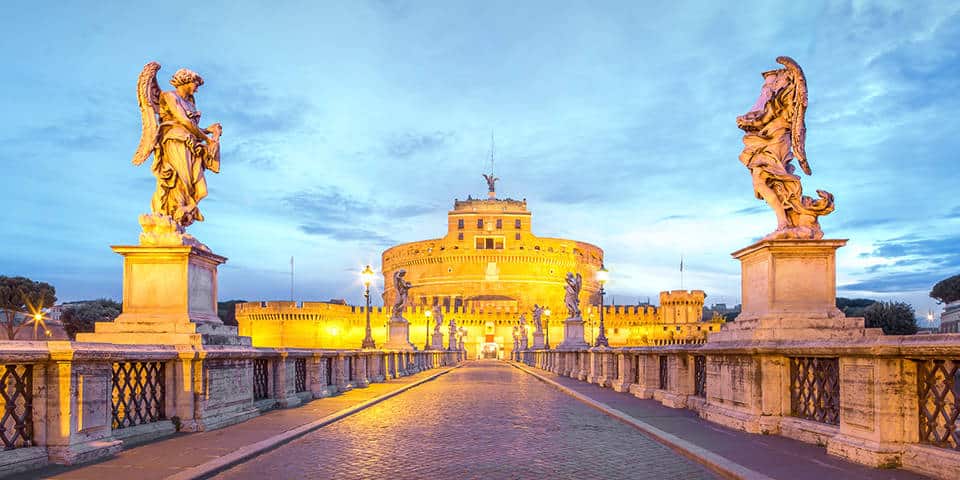
Sant’Angelo Bridge, Italian Ponte Sant’Angelo, is an ancient bridge built by Emperor Hadrian to link the left bank of the Tiber with the Castel Sant’Angelo.

There are seven stone arches and five main spans supported on piers. Moreover, you can journey along the Via Crucis and admire ten beautiful angel sculptures designed by Gian Lorenzo Bernini, which decorate the construction and statues of the saints Peter and Paul that watches over its entrance.

Contents
  1. History
  2. The Angels
  3. Interesting Facts about the Bridge of Angels in Rome
  4. Things to Know before Visit Bridge of Angels
  5. The Bridge Today
  6. How to Get

History

Sant’Angelo Bridge is one of the finest surviving in Rome nowadays. It was built by the emperor Hadrian (reigned 117-138 A.D.) to connect the Campus Martius with Castel Sant’Angelo (or The Mausoleum of Hadrian). At the time, the bridge was known as the “Aelian Bridge” or “Bridge of Hadrian.” The construction was completed about 135 A.D.

the Bridge of Angels in Rome

During the Middle Ages the bridge was important because it served as the only controlled passageway for pilgrims on their way to Saint Peter’s Basilica.

The current name of Sant’Angelo has been used since the 7th century because of the legend in which Archangel Michael was seen atop the castle Sant’Angelo while a sword was drawn to finish the plague of 590 A.D.
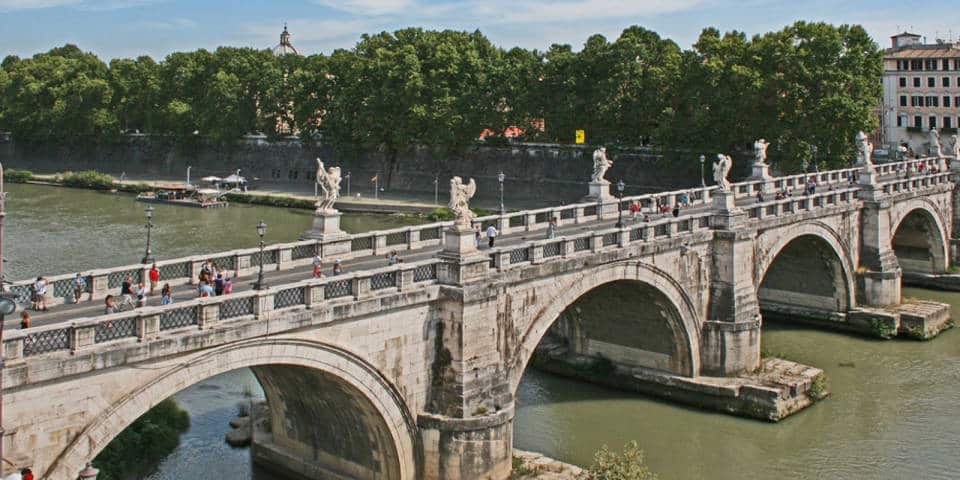
saint Angelo bridge in Rome aerial view

During the 16th century, Sant’Angelo Bridge was used as a place to show bodies of the executed to convey warning to the locals.

At the end of the bridge, you can see the statues of Saint Peter holding the keys of heaven sculpted by II Lorenzetto in 1534 and Saint Paul maintaining the sward by Paolo Romano in 1464. They are inscribed with the words “Hinc humilibus venia” (“Here forgiveness to the humble”) and “Hinc retribuito superbis” (Here punishment for the prideful”).

The Angels

In 1667, Pope Clement IX commissioned the creation of the sculptures along the bridge. The architect who made the design was Gian Lorenzo Bernini. However, he only finished the creation of two angels: the Angel with the Superscription “I.N.R.I.” and the Angel with the Crown of Thorns. In 1669, before his death, Clement IX saw these statues and decided that they were too magnificent for the bridge. Today, you can see these angles in the church of Sant’Andrea delle Fratte near Piazza di Spagna. However, Bernini’s ideas and design were brought to life by his successors.
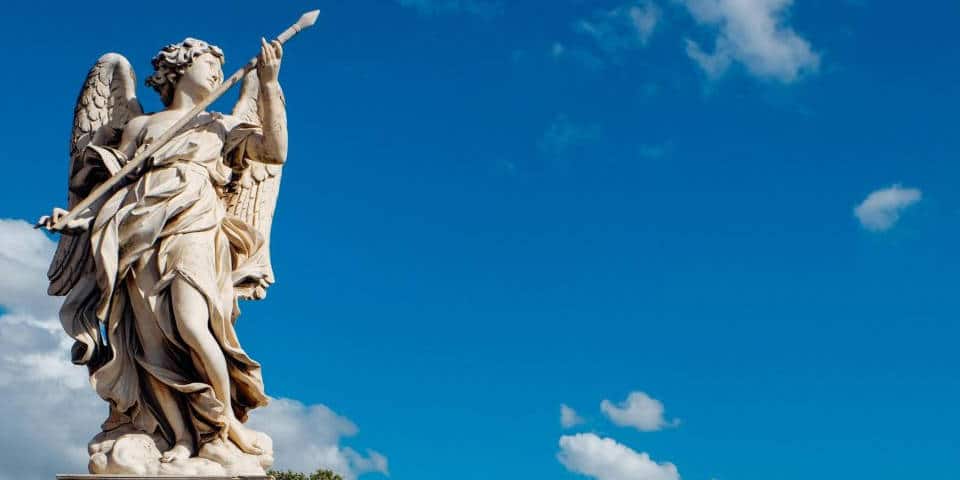
Angel statue on saint Angels Bridge in Rome

Each sculpture of angel symbolizes a part from the story of Jesus Christ’s suffering and death by crucifixion.

Each of the statues is made from white marble. The theme is the Passion of Christ. Each angel holds an instrument of the Passion: they present them to passersby, the same as along the Via Dolorosa in Jerusalem or on the Sacred Mountain of Varallo.
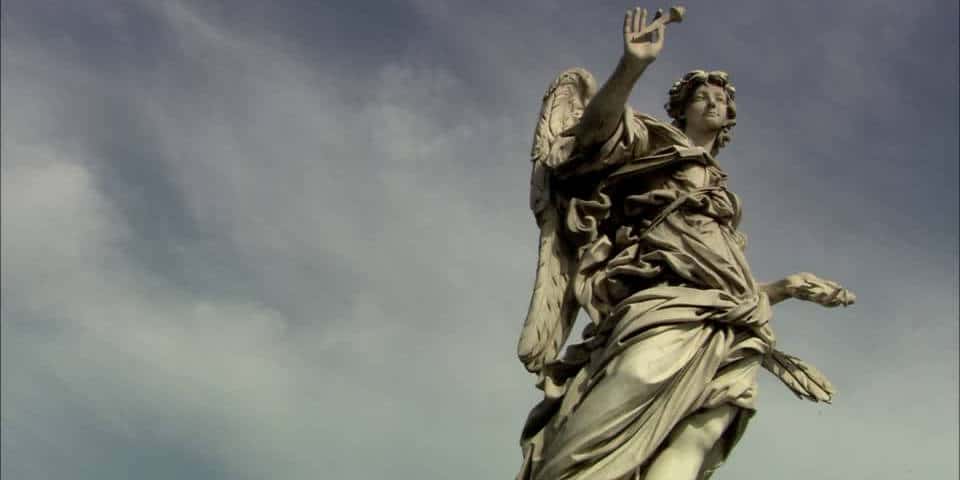
Sculpture of angel on Saint Angels Bridge in Rome

By 1670, all the sculptures were finished and placed to the bridge

The bases of the angels are inscribed with verses from the Bible. This sign transforms the instruments of the Passion into instances of Christ’s majesty and is a symbol of divine glory.

  1. The first Angel was sculpted by Antoni Raggi. The Angel holds up the flogging column to which Jesus was tied. You can also see the inscription: “My throne is upon a column.”
  2. The second Angel, a work of Lazzaro Morelli, with sadness, contemplates the whips that wounded the Lord. The inscription is: “I’m ready for the scourge.”
  3. The third Angel was sculpted by Paolo Naldini and finished by Bernini. The Angel represents a symbol of the vane blindness of the people who didn’t recognise Christ’s authority. The inscription reads: “The thorn is fastened upon me.”
  4. The fourth Angel, by Cosimo Fancelli, looks with pity on the face of Christ impressed in blood on the Veil of Veronica with the inscription: “Look upon the face of your Christ.”
  5. The fifth Angel was sculpted by Paolo Naldini and held the garment and dice with the inscription: “For my clothing they cast lots.”
  6. The sixth Angel, by Girolamo Lucenti, holds the nails that punctured the hands and feet of Jesus. The inscription reads: “They will look upon me whom they have pierced.”
  7. The seventh Angel was sculpted by Ercole Ferrata and held the cross as a symbol of the Passion and faith in “Him.” The inscription reads: “Dominion rests on his shoulders.”
  8. The eight’s Angel, officially entrusted to Giulio Cartari, is the replica of Bernini’s work with the “I.N.R.I.” superscription. The inscription read: “God has reigned from the tree.”
  9. The ninth Angel, by Antonio Giorgetti, notices the sponge added to the end of his stick with a feeling of deep sorrow. The inscription reads: “They gave me vinegar to drink.”
  10. The tenth Angel, sculpted by Domenico Guidi, reminds pilgrims of the pain men’s sins caused Jesus. The inscription is: “You have ravished my heart.”

All sculptures stand on marble clouds of different degrees of fullness. They allow you to make a journey along with the Via Crucis and admire the symbolic instruments and the chronological and narrative moments in the Passion of Christ.

Interesting Facts about the Bridge of Angels in Rome

Unveil the charm and allure of Rome’s Ponte Sant’Angelo with these five enthralling facts. Immerse yourself in the bridge’s history and artistic splendor, and share these fascinating insights with friends and fellow travellers as you marvel at this Roman bridge:

  1. The Bridge of Angels, known as Ponte Sant’Angelo in Italian, was originally named Pons Aelius after Emperor Hadrian’s family name. Its construction was completed in 134 AD and was intended to connect the city centre with Hadrian’s newly built mausoleum, now known as Castel Sant’Angelo.
  2. The bridge is adorned with ten angel statues designed by the renowned Baroque sculptor Gian Lorenzo Bernini, and his students in the 17th century. Each angel holds an instrument of the Passion of Christ. The bridge also became a religious landmark.
  3. According to legend, during the 590 AD plague, Pope Gregory I saw the Archangel Michael sheathing his sword atop the mausoleum, signifying the end of the plague. This vision led to the renaming of both the mausoleum and bridge as “Sant’Angelo.”
  4. In the 16th century, Ponte Sant’Angelo was used as a public display site for the bodies of executed criminals. The display was intended as a warning. This somber practice was discontinued in the 19th century.
  5. The Bridge of Angels offers stunning views of the Tiber River, St. Peter’s Basilica, and the Vatican. People stop there for photographs and views over the Tiber. People continue to gather on the bridge.

Things to Know before Visit Bridge of Angels

Why was the Ponte Sant Angelo built?
Emperor Hadrian built Ponte Sant’Angelo in 134 AD to connect Rome’s city centre with his newly constructed mausoleum, now known as Castel Sant’Angelo. Its original name, Pons Aelius, reflects Hadrian’s family name. The bridge remains an important example of Roman bridge building.
What is the oldest Roman bridge still in use?
The Pons Fabricius (Ponte Fabricio), constructed in 62 BC, is the oldest Roman bridge still in use today. It connects Tiber Island to Campus Martius. It remains an example of Roman engineering.
How long did it take the Romans to build the bridge?
Julius Caesar’s Roman army demonstrated incredible efficiency and skill by constructing a bridge over the Rhine River in just 10 days. With over 40,000 soldiers at his disposal, they utilized local lumber to build the bridge. The bridge was completed with local timber.
How old is Ponte Sant Angelo?
Ponte Sant’Angelo, completed around 136 AD, is approximately 1,887 years old. Its longevity highlights the remarkable engineering and craftsmanship of ancient Rome. It remains a landmark in Rome.
What is the oldest covered bridge in Europe?
The Chapel Bridge, also known as Kapellbrücke, in Lucerne, Switzerland, is widely considered Europe’s oldest covered bridge. Constructed in 1333, this iconic wooden bridge spans the Reuss River, measuring approximately about 204 metres in length. The bridge’s unique design includes a series of triangular gable paintings dating back to the 17th century, which depict significant events in Swiss history. The Chapel Bridge also features the octagonal Water Tower, a central landmark in Lucerne, which predates the bridge itself, having been built around 1300. This historically significant structure showcases medieval European engineering and remains an enduring symbol of the city of Lucerne.
What is the oldest covered bridge in Italy?
The oldest covered bridge in Italy is the Ponte Vecchio (Old Bridge) in Bassano del Grappa, a town in the Veneto region. The bridge was originally built in the 13th century, and its current design is attributed to Andrea Palladio, a renowned Italian architect, who reconstructed the bridge in 1569 after a flood destroyed the original structure. The wooden bridge spans the Brenta River and is characterized by its unique architecture, with a central section supported by three arches and a covered walkway on either side.
How many bridges are there in Rome?
Rome has more than 30 bridges along the Tiber River. They were built in different periods. Notable examples include Ponte Sant’Angelo, Ponte Fabricio, Ponte Rotto, and Ponte Garibaldi. These bridges span various historical periods, from ancient Rome to the 20th century. They show how the city changed over time.
Can I swim near Ponte Sant’Angelo in Rome?
Swimming near Ponte Sant’Angelo in the Tiber River is strongly discouraged due to the river’s strong currents, pollution levels, and potential legal issues. Do not enter the river: currents and water conditions make it unsafe. To enjoy water activities in Rome, visitors are advised to explore the city’s numerous fountains, parks, and public pools, which offer a safer and more refreshing alternative to escape the city’s heat.

The Bridge Today

Sant’Angelo Bridge is the most beautiful bridge in the world even nowadays because it is symmetrical, regular, open to light, and has a perfect distance between water and arches. Moreover, the bridge connects Rome to Saint Peter’s Basilica in the Vatican. Nevertheless, the main feature of the construction is the charming statues of the angels. Also, the bridge’s three central arches originate from the ancient Roman era.
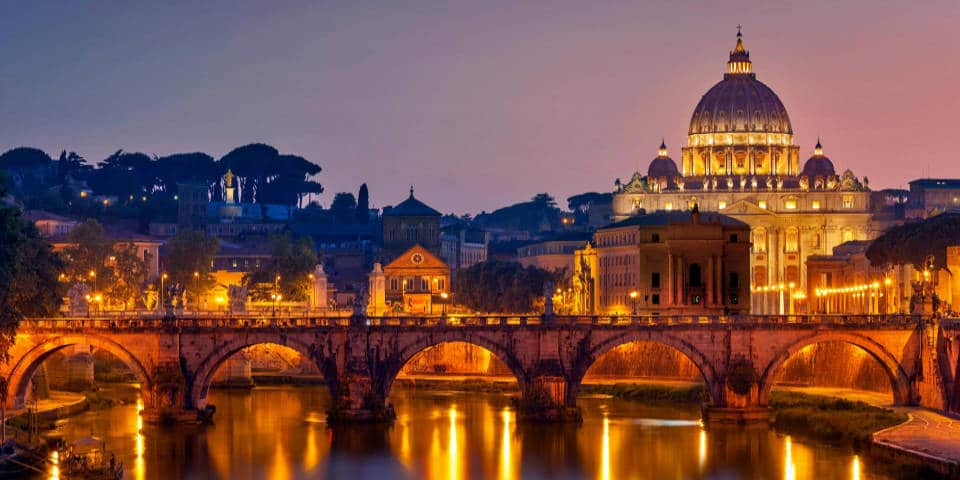
the Bridge of Angels in Rome, Tiber and the Vatican City night view

The Bridge of Angels is a pedestrian area

How to Get

You can get bus 87 from the Colosseum or 46 from Piazza Venezia. Also, you can take a metro from Termini station (Line A, Battistini) and travel to the Lepanto stop. The bridge is located in the historical centre of Rome, near the Vatican, so it is pretty easy to find.

The church with two original angel sculptures by Bernini:

  • Sant’Andrea della Fratte Church:  Via di Sant’Andrea delle Fratte, 1
  • check the church’s current hours before visiting.

Sant’Angelo Bridge is unique and magnificent construction. It is one of the main historic sites in Rome. Tell us about your emotions after visiting the bridge in the comments!

Author: Kate Zusmann

Kate Zusmann

I’ve lived in the Eternal City for the past 12 years. They say every corner of Rome holds a story, and I’m here to share some of the most fascinating historical facts and local legends.

Dive Deeper into Rome's Stories

Vatican Museums Visitor Guide

992122 travellers read

The Vatican Museums

Rome Italy Tourist Attractions

29415 travellers read

Top 30 Attractions in Rome

Beste Hotels in Rom mit Aussicht

11418 travellers read

Best Hotels with Views in Rome

How to Book Vatican Museums & Sistine Chapel Tickets

16764 travellers read

How to Book Vatican Museums & Sistine Chapel Tickets

St. Peter's Basilica dome seen through the trees from the far side of Piazzale Garibaldi, Rome

12098 travellers read

Janiculum Hill (Gianicolo): Viewpoints and Walking Route

Largo di Torre Argentina archaeological site in Rome

15 travellers read

Largo di Torre Argentina and the Cat Sanctuary

Via Appia Antike Straße

15 travellers read

The Appian Way in Rome

Der Mund der Wahrheit in Rom

19 travellers read

Mouth of Truth in Rome

Pyramide des Caius Cestius in Rom

15 travellers read

Pyramid of Cestius

Show more

About us

About us ROME.US Authors Kate Zusmann and Artur Jakucewicz
We're Kate and Artur, a duo bound by our shared fascination with the Eternal City – Rome. Our paths, driven by a mutual passion for its timeless stories and architectural marvels, converged in a way we had never imagined.

Explore Rome

  • View across Vatican City

    What Is the Capital of Vatican City?

  • New Year's Eve in Rome

    Rome New Year’s Eve 2026/27

  • St Peter’s Square in Vatican City

    Where Is Vatican City?

  • Santa Maria in Trastevere

    Santa Maria in Trastevere

  • Rome 3 Day Itinerary

    Rome 3 Day Itinerary – Highlights & Travel Tips

RomeItaly.guide

This website uses cookies. For more info read the cookies policy

RomeItaly.guide © 2026. Created with love by Roman experts and guides.
  • American English
  • Español
  • Polski
  • Русский
  • Français