
RomeItaly.guideRomeItaly.guide
Get the app
  • Taxi fares calculator
  • About us
Rome Italy GuideGet it on Google Play ›
  • Plan your trip
    • Weather
      • January
      • February
      • March
      • April
      • May
      • June
      • July
      • August
      • September
      • October
      • November
      • December
    • Neighbourhoods
      • Quartiere Coppedè
      • Trastevere
    • Day Trips
      • To Ostia Antica
      • Beaches near Rome
      • To Tivoli
  • Getting around
    • Fiumicino Airport
    • Termini Railway Station
    • Public Transport
    • To Ostia Antica
    • To Milan
    • Ciampino Airport
    • To Florence
    • To Naples
  • Sights
    • Ancient Sites
      • Castel Sant’Angelo
      • Colosseum
      • Mamertine Prison
      • Mouth of Truth
      • Pantheon
      • Roman Forum
      • Arch of Constantine
      • Catacombs
      • Theatre of Marcellus
    • Museums
      • Ara Pacis Augustae
      • Borghese Gallery
      • Caravaggio’s Paintings
      • Great Synagogue
      • Palazzo Farnese
      • Capitoline Museums
      • Spada Gallery
    • Churches
      • Capuchin Crypt
      • Holy Stairs
      • Sant’Agnese in Agone
      • San Giovanni in Laterano
      • Santa Maria Maggiore
      • Saint Paul Outside the Walls
      • St Peter in Chains
      • St. Ignatius of Loyola
    • Fountains & Squares
      • Navona Square
      • Spanish Steps
      • Trevi Fountain
      • Altar of The Fatherland
      • Fontana della Barcaccia
      • Fountain of the 4 Rivers
      • Fountain of the Pantheon
      • Piazza del Popolo
      • Piazza Venezia
      • Turtle Fountain
      • Triton Fountain
    • Hills
      • Aventine
      • Capitoline
      • Janiculum
      • Palatine
      • Pincian
    • Parks
      • Appian Way
      • Orange Garden
      • Pincio Terrace
      • Vatican Gardens
      • Villa Borghese
      • Villa Torlonia
      • Park of the Aqueducts
      • Villa Ada
      • Villa Celimontana
      • Zoo
    • Emperors
      • Good Emperors
      • Marcus Aurelius
      • Gaius Julius Caesar
      • Nero
      • Octavian Augustus
      • Caligula
      • Hadrian
      • Vespasian
      • Trajan
      • Commodus
  • Vatican City
    • St Peter’s Basilica
    • Sistine Chapel
    • Vatican Museums
    • Raphael’s Rooms
    • Michelangelo’s Pieta
    • St Peters Dome
    • St Peter’s Square
    • Swiss Guard
    • Pilgrims of Hope Jubilee
  • Where to stay
    • How to Choose a Hotel in Rome
    • Hotels with Best Views
    • Hotels near Termini
    • Hotels near the Colloseum
    • Best Hostels
    • Hotels near Navona Square
    • 3 Star Hotels
    • 4 Star Hotels
    • 5 Star Hotels
    • Apartments For Rent
  • Food & shopping
    • Where to Eat
      • Best Pizza Places
      • Best Pasta Places
      • Local Italian Food
      • Best Gelato Places
      • Best Rooftop Bars
    • Shopping
      • Castel Romano Outlet
      • Farmers Markets
      • Souvenirs from Rome
  • Tips & FAQ
    • Free Things to Do
    • TOP Attractions
    • Tickets to Vatican museums
    • Rome Three Day Itinerary
    • Renting a Car in Rome
    • Apps for Tourists
    • Instagram
    • Rainy Days in Rome
    • Buying a Sim Card in Italy
    • Unusual Things to do
    • Information About Rome – FAQ
  1. Home ›
  2. Fountains and Squares

Fountain of the Pantheon

Written by: Artur Jakucewicz

Fountain of the Pantheon Rome
Recommended tour
Closest bus stops
Argentina5 min 271 m: 30 40 46 62 64 70 81 87 190F 492 628 916
Corso7 min 375 m: 62 63 83 85 119 160 492 C3
Closest subway stations
Barberini24 min 1.2 km: A
Address Piazza della Rotonda, Roma

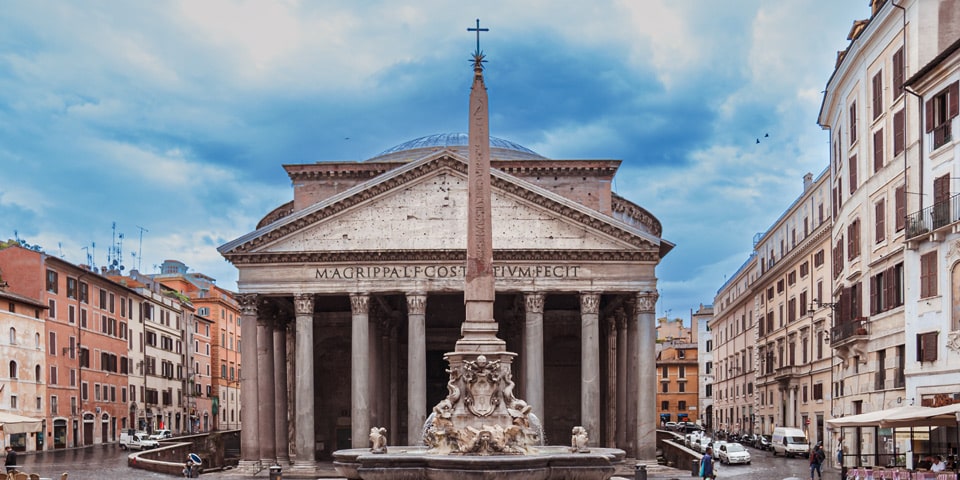
Directly in front of the Pantheon, the Fontana del Pantheon combines work from several periods. Giacomo della Porta designed the first fountain in 1575. Pope Clement XI added the Macuteo Obelisk during a major redesign in 1711, placing an Egyptian monument carved for Ramesses II above a Renaissance basin in Piazza della Rotonda.

Contents6 sections · ~5 min read
  1. From the 1575 Fountain to the 1711 Redesign
  2. Reading the Inscriptions and Papal Emblems
    1. The Dolphins and Their Classical Model
  3. The Companion Obelisk behind the Pantheon
  4. How to See the Fountain in the Square
  5. Best‑value hotels near Fountain of the Pantheon
  6. Nearby Attractions

From the 1575 Fountain to the 1711 Redesign

Pope Gregory XIII commissioned the fountain in 1575 as part of a broader urban renewal programme. The same initiative produced the Fountain of the Moor in Piazza Navona.

Giacomo della Porta designed it, and Leonardo Sormani carved the original marble basin. The fountain had no obelisk at this stage. It consisted of a basin with masks, supplied by the restored Aqua Virgo aqueduct, and served as a public water source.

The present composition dates largely from 1711, when Pope Clement XI commissioned architect Filippo Barigioni to redesign it with a larger stone basin and four dolphins supporting a central plinth. Papal coats of arms decorate the base, while the Macuteo Obelisk rises above it.

The obelisk is much older than the fountain beneath it. It was carved during the reign of Pharaoh Ramesses II of the 19th Dynasty, between 1279 and 1213 BC, and originally stood at the Temple of Ra in Heliopolis. Two cartouches of Ramesses II remain visible near the top.
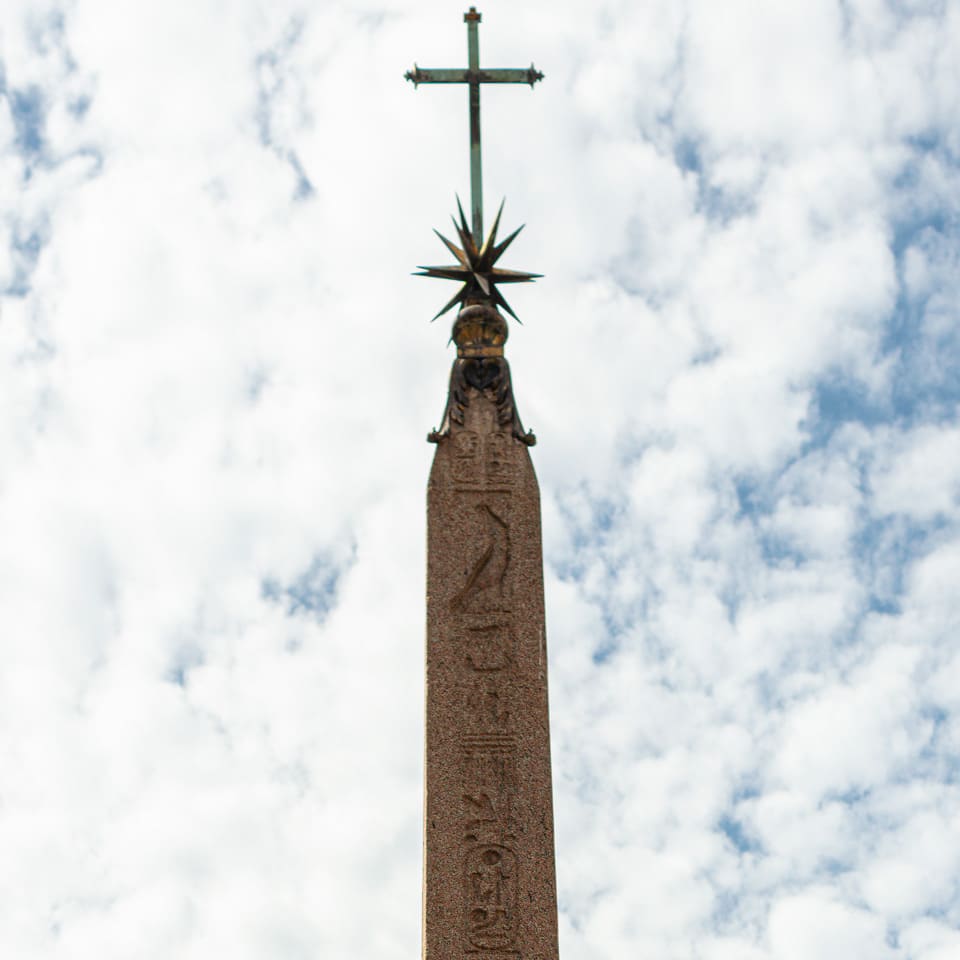
Pantheon obelisk Ramesses II cartouches Rome

The obelisk was brought to Rome in antiquity and reused in the Iseum Campense, a sanctuary of the Egyptian goddess Isis south-east of the Pantheon. After the sanctuary fell into ruin, the stone disappeared beneath rubble for centuries. It was rediscovered in 1374 under the apse of the nearby Basilica of Santa Maria sopra Minerva.

For a time, the obelisk stood on simple blocks outside the nearby church of San Macuto, the source of its name Macuteo. Clement XI later transferred it to the fountain.

The obelisk measures 6.34 metres; together with the fountain base, the monument reaches just over 14 metres. A dove crowns the top. It represents the Holy Spirit and gives a Christian conclusion to the ancient Egyptian monument below.

Reading the Inscriptions and Papal Emblems
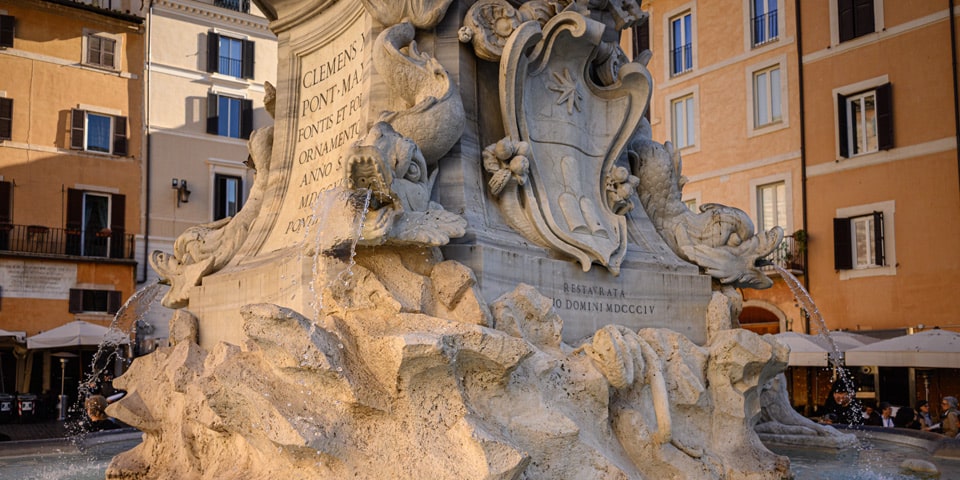
Latin inscription of Clement XI on the Fountain of the Pantheon in Rome

The stone plinth directly below the obelisk carries a Latin inscription: Clemens XI Pont. Max. Fontis et Fori Ornamento Anno Sal. MDCCXI. It translates as “Clement XI, Supreme Pontiff, for the adornment of the fountain and the square, in the year of salvation 1711.” The wording publicly records the pope who commissioned the work.

Each face of the plinth displays the papal coat of arms of Clement XI. A star appears above an open book, the heraldic device of the Albani family, to which the pope belonged. The emblem repeats on all four sides and records the patronage behind the fountain.
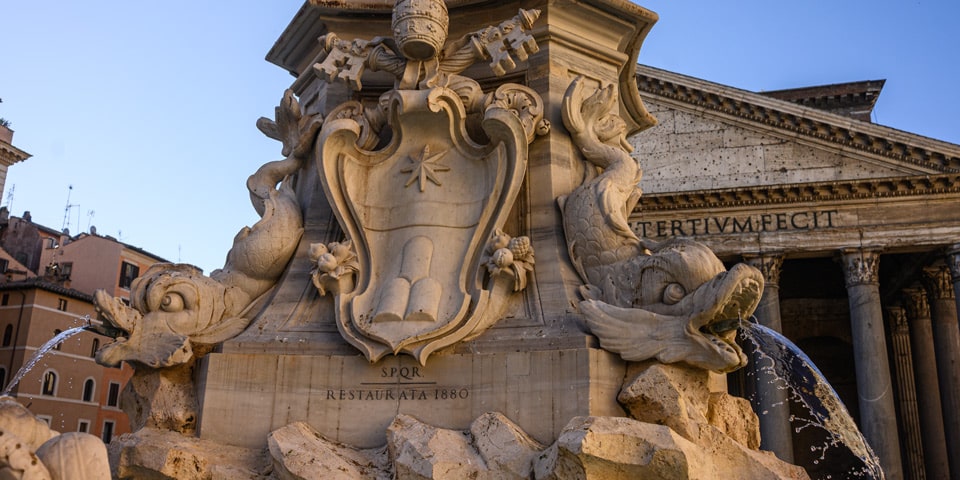
Fountain of the Pantheon Clement XI coat of arms SPQR restaurata 1880

Farther down the base is another inscription: SPQR Restaurata 1880. It marks a restoration financed by Rome’s municipal government 15 years after Italian unification.

SPQR abbreviates Senatus Populusque Romanus, “the Senate and People of Rome.” The new Italian state revived the ancient formula as a sign of civic continuity, and it still appears on Rome’s manhole covers. During the 1880 restoration, the deteriorating marble masks carved by Sormani in 1575 were replaced with copies by Luigi Amici. The originals entered the Museum of Rome.

The Dolphins and Their Classical Model

The four creatures supporting the obelisk’s plinth represent dolphins, although their gaping jaws, protruding eyes, and scaled bodies have little in common with real animals.
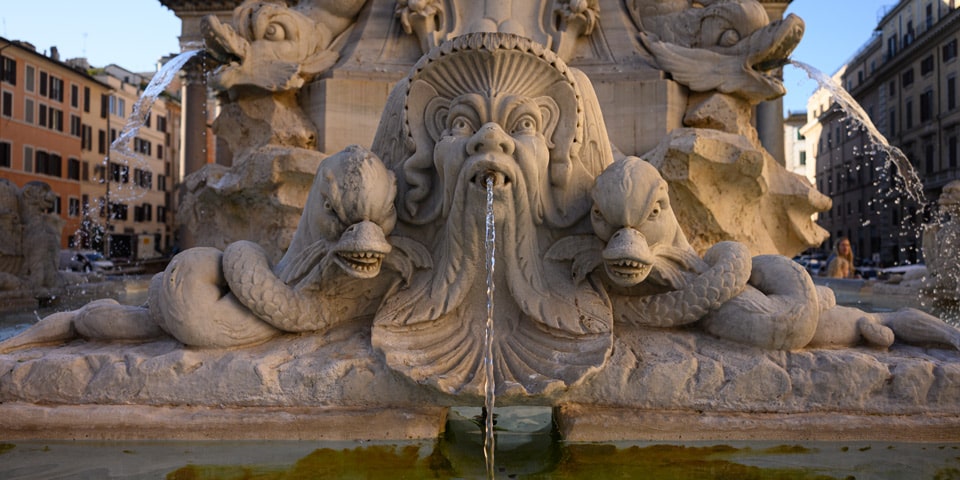
Fountain of the Pantheon fantasy dolphins detail

Their strange anatomy is deliberate. Renaissance and Baroque artists copied the dolphin imagery inherited from classical antiquity instead of working from living animals. Della Porta used similar creatures on the Fountain of the Moor, and the convention spread through Rome’s papal fountains.

The present dolphins are replacements rather than Barigioni’s originals. In 1928, sculptor Francesco Sicciardi made copies of the deteriorating Baroque figures, which then entered the Museum of Rome. Several visible components are therefore later restorations of earlier designs.
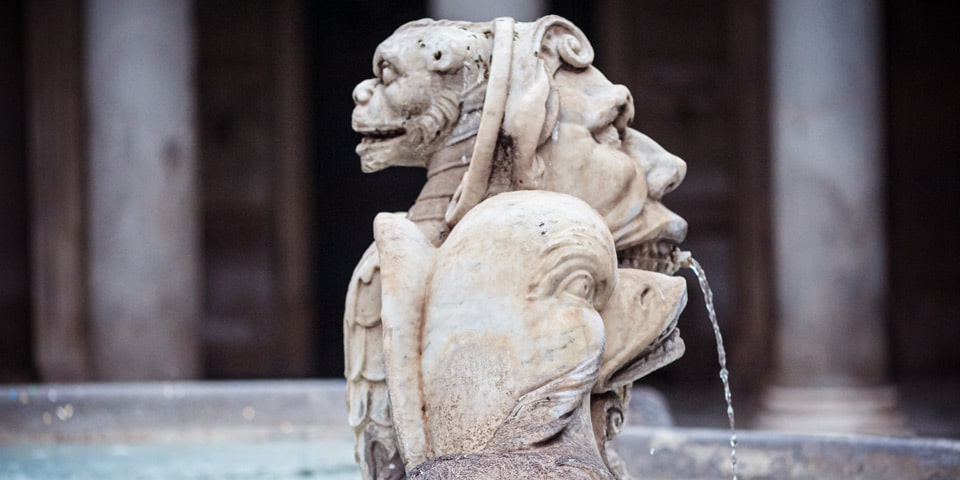
Fountain of the Pantheon dolphin water spouts detail

The choice of dolphins also carried meaning. Greco-Roman art associated them with Neptune, sailors, and rescue at sea. Christian artists later connected the dolphin with Christ as saviour. On this fountain, the water creatures support a papal monument crowned by the dove of the Holy Spirit.

The masks between the dolphins are human faces with water flowing from their open mouths. This type of waterspout comes from the same classical tradition seen on many public fountains in Rome. The present masks are Luigi Amici’s 1880 copies of della Porta’s 1575 originals.

The Companion Obelisk behind the Pantheon

The Macuteo Obelisk has a companion. The Minerva Obelisk originally stood beside it in Heliopolis and was later brought to Rome.
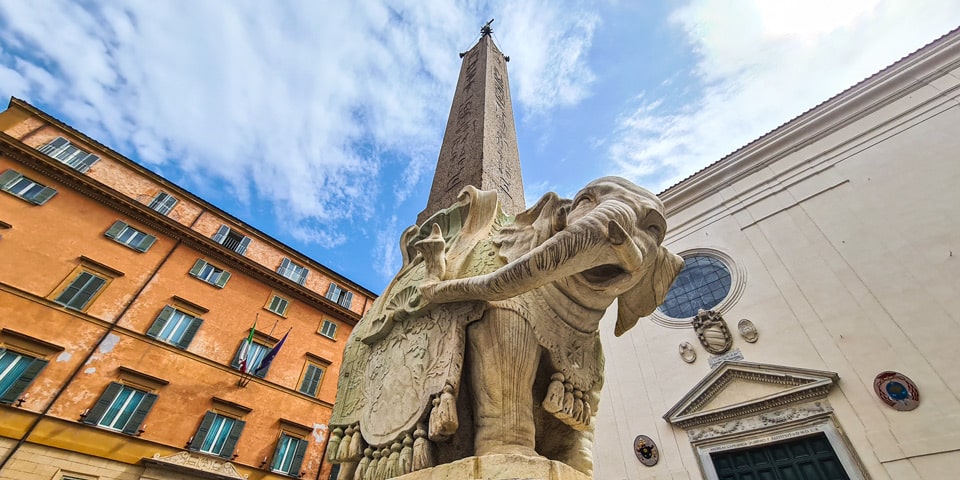
Minerva Obelisk on Bernini's elephant in Piazza della Minerva, Rome

You can see it about 200 metres behind the Pantheon in Piazza della Minerva, balanced on Bernini’s famous marble elephant. The short detour places two monuments made for the same Egyptian setting side by side in a Roman walk. One now rises from a Baroque fountain; the other rests on an elephant.

How to See the Fountain in the Square

The fountain occupies the centre of Piazza della Rotonda, directly in front of the Pantheon.
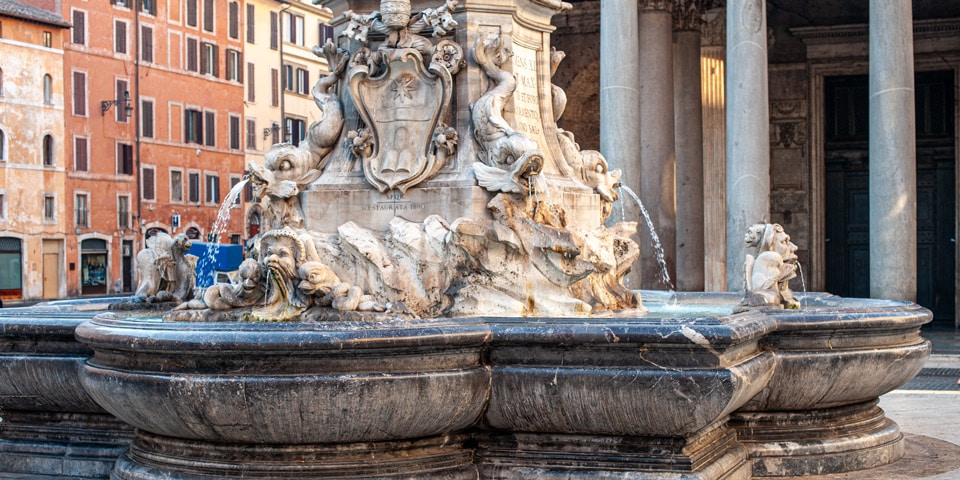
Fountain of the Pantheon stone basin Piazza della Rotonda

The present basin is stone, installed during the 1711 redesign in place of della Porta’s marble basin. Four dolphins support the central plinth and obelisk. The masks along the edge recall the 1575 composition and use the same decorative language as the Fountain of the Moor in Piazza Navona.
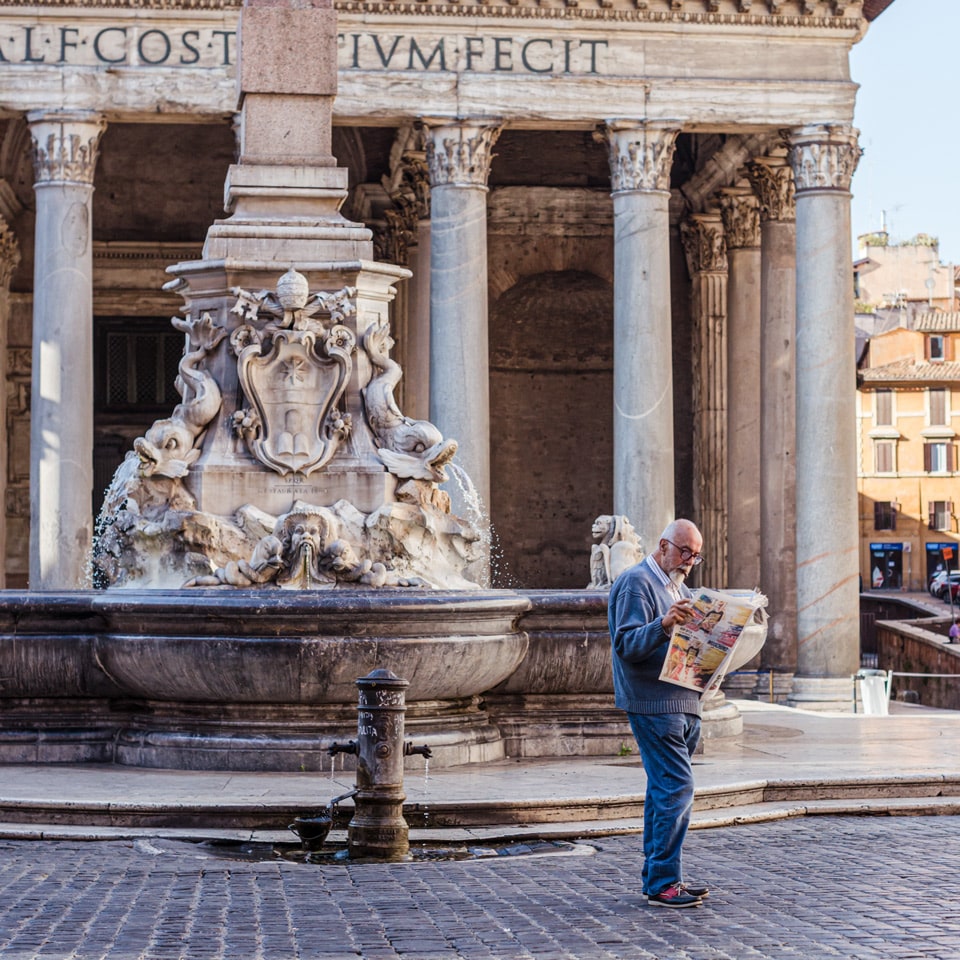
Fountain of the Pantheon in Piazza della Rotonda early in the morning

I prefer seeing the fountain before 9 am. The eastern light reaches the obelisk at a low angle, and there is usually enough room to inspect the inscriptions and coats of arms. By mid-morning, café seating and tour groups occupy much more of the square.

Water still reaches the fountain through the Aqua Virgo, the aqueduct first built under Agrippa in 19 BC. From Piazza della Rotonda, the Trevi Fountain is about 850 metres away. The route makes it easy to compare two very different monuments supplied by the same ancient water system.

Best‑value hotels near Fountain of the Pantheon

Albergo Abruzzi
0 min
66 ft
20 m
Antico Albergo del Sole al Pantheon
0 min
66 ft
20 m
Best Suites Pantheon
1 min
98 ft
30 m
Albergo del Senato
1 min
164 ft
50 m

Nearby Attractions

Pantheon
1 min 100 ft 30 m
Bernini’s Elephant
3 min 520 ft 160 m
Piazza Navona
6 min 920 ft 280 m
Fountain of the Moor
6 min 950 ft 290 m
Fountain of the Four Rivers
6 min 980 ft 300 m
The Fountain of Neptune
6 min 1020 ft 310 m
Via del Corso
10 min 1670 ft 510 m
Turtle Fountain
12 min 1970 ft 600 m
Victor Emmanuel II Monument
13 min 2170 ft 660 m
Palazzo Farnese
14 min 2230 ft 680 m
Artur Jakucewicz
Rome travel writer & expert Artur Jakucewicz
years in Rome
10+
guides published
83
article updated
Aug 2026
I’ve lived in Rome for over a decade and am delighted to share my knowledge and experience. Passionate about ancient history and architecture, I’m the author of travel guides to Italy designed especially for independent travellers.
All guides by Artur →

More Rome guides

Vatican Museums Visitor Guide

The Vatican Museums

Rome Italy Tourist Attractions

Top 30 Attractions in Rome

Rome hotels with a view

Rome hotels with a view and the rooms to book

How to Book Vatican Museums & Sistine Chapel Tickets

How to Book Vatican Museums & Sistine Chapel Tickets

St. Peter's Basilica dome seen through the trees from the far side of Piazzale Garibaldi, Rome

Janiculum Hill (Gianicolo): Viewpoints and Walking Route

Column of the Immaculate Conception

Column of the Immaculate Conception

Fountain of the Naiads in Rome

Fountain of the Naiads in Rome

Piazza della Repubblica in Rome

Piazza della Repubblica in Rome

Piazza Barberini in Rome

Piazza Barberini in Rome

Show more

About us

About us ROME.US Authors Kate Zusmann and Artur Jakucewicz
We're Kate and Artur. Rome has been our home for more than ten years, and we write about the streets, churches and museums we know first-hand.

Explore Rome

  • Two pizzas alongside glasses of spritz on a restaurant table

    The best pizza in Rome, from thin Roman bases to puffy crusts

  • A street in Trastevere, Rome

    Trastevere Neighbourhood Guide

  • Archaeological remains on Palatine Hill in Rome

    Palatine Hill

  • Three-star hotels in Rome city centre

    Best three-star hotels in Rome city centre

  • Rome Italy Tourist Attractions

    Top 30 Attractions in Rome

RomeItaly.guide

This site uses cookies

RomeItaly.guide © 2026. Created with love by Roman experts and guides.

  • American English
  • Español
  • Deutsch
  • Polski
  • Русский
  • Français