
991228 travellers read
Most visitors to Piazza Navona walk straight past the Fountain of the Moor on their way to Bernini’s famous Four Rivers centrepiece. That’s worth reconsidering. The southern fountain, Fontana del Moro, is older, carries a genuine art-historical controversy, and tells the story of how one powerful family reshaped the face of Rome’s most celebrated square.
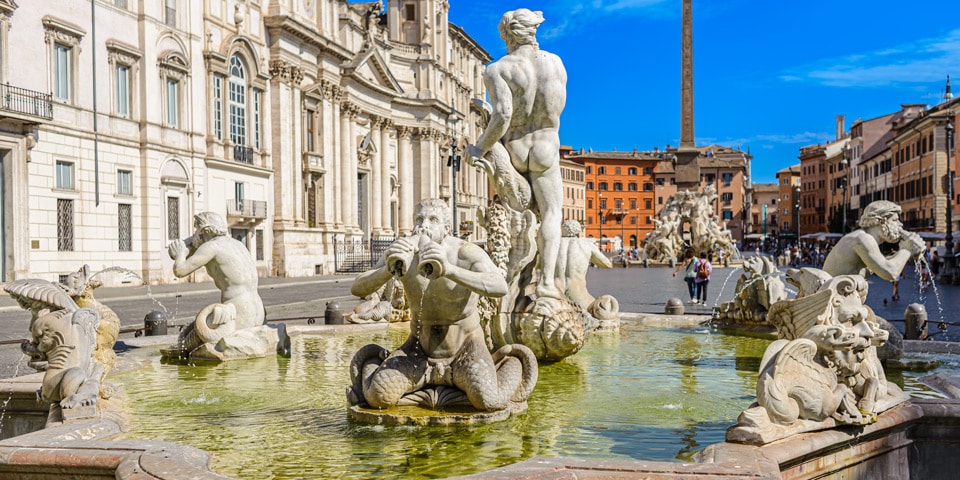
Giacomo della Porta designed the original fountain in 1575, under Pope Gregory XIII. The structure had a basin, four Tritons, mythological sea creatures from Greek legend and sons of Poseidon, and decorative masks, but no central figure. It stood incomplete for nearly 80 years.
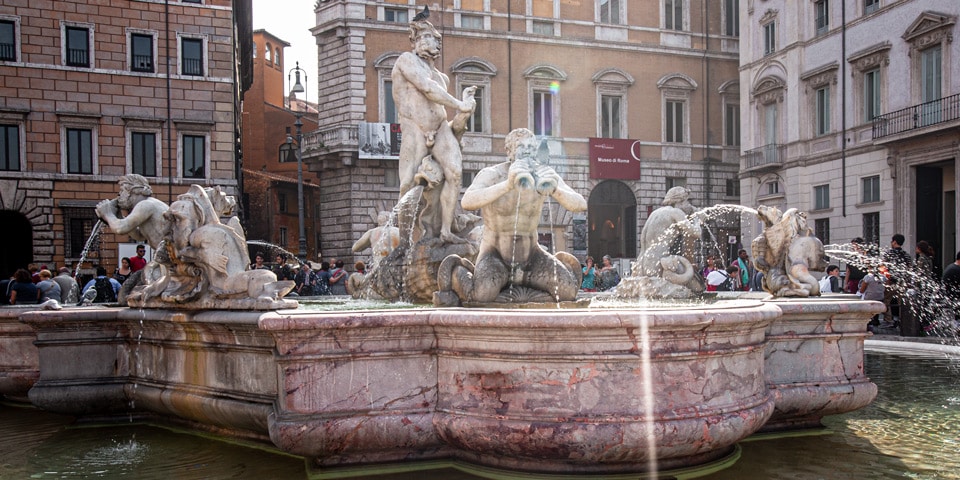
In 1651, Pope Innocent X commissioned Bernini to renovate both end fountains in Piazza Navona, fresh from the success of the Fountain of the Four Rivers (Fontana dei Quattro Fiumi). Bernini’s first design for the southern fountain was unconventional: three fish supporting a shell. The idea was rejected, reportedly at the insistence of the Pope’s influential sister-in-law, Donna Olimpia Maidalchini, who held considerable sway over Vatican commissions. A muscular triton figure replaced it.
One detail worth knowing: Bernini created a terracotta model of the central figure to present to the Pope. That model, 80.5 cm tall and his largest known terracotta, is today on display at the Kimbell Art Museum in Fort Worth, Texas. The actual marble figure was carved by sculptor Giovanni Antonio Mari working from Bernini’s design.
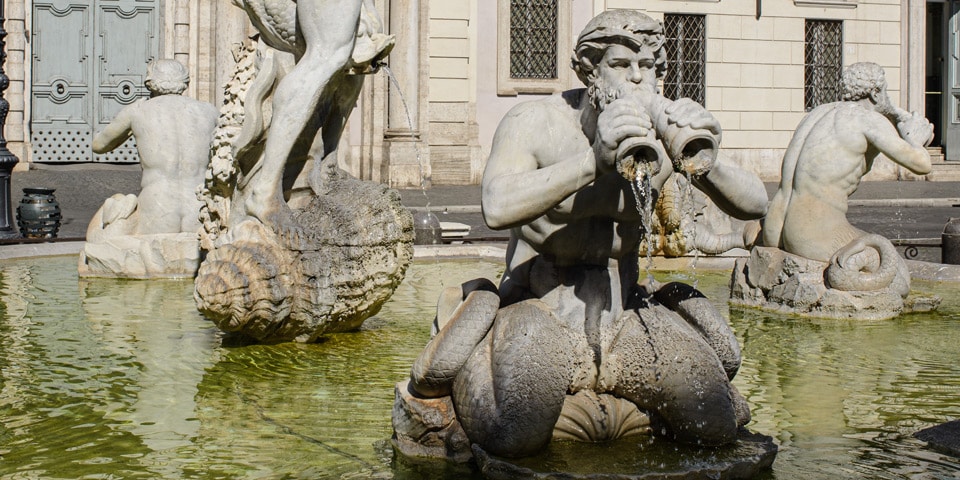
In 1874, the original Tritons and masks designed by della Porta were removed during restoration. What you see in the piazza today are 19th-century copies by sculptor Luigi Amici. The fate of the originals is genuinely uncertain. They reportedly exist somewhere in Rome’s municipal storage, but their exact location remains unconfirmed.
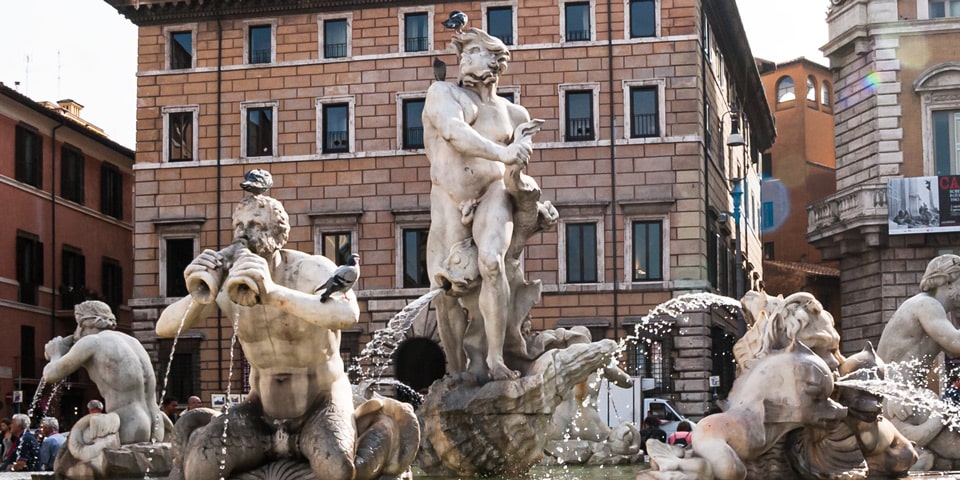
The name Fontana del Moro is more ambiguous than it appears. The word moro in Italian derives from the Latin maurus, originally denoting people from the Roman province of Mauretania in North Africa. By the 17th century, the term had become a loose catch-all in European usage: it could mean Muslim, North African, dark-skinned, or simply foreign. Shakespeare’s Othello is a Moor in exactly this vague sense.
Art historians note there are no contemporary sources recording Bernini referring to the central figure as a Moor. The “Moorish” reading developed through popular use, not artistic intent. That said, the figure’s facial features do closely resemble those of the Rio de la Plata in the Four Rivers fountain, a figure widely understood to depict a North African. Whether the resemblance was deliberate or coincidental remains an open question.
What is clear: depicting a Moor in 17th-century Roman public art was not unusual.
Borghese Gallery and other major Roman collections of the period included sculptural representations of Africans as exotic, powerful figures, part of the Baroque fascination with dramatic contrast and the theatrical expression of physical force. The Moor on this fountain fits squarely within that visual tradition, regardless of what Bernini may or may not have intended.
Della Porta worked with assistant Bartolomeo Gritti and a team of sculptors and stonecutters. The decorative programme, dolphins and masks with human and animal faces, draws directly from classical antiquity, the standard visual vocabulary for Roman public fountains of the period. The basin itself is carved from portasanta, a pink Portuguese marble that shifts tone depending on the light. Early morning gives it a warm, almost amber cast; midday sun flattens it to pale rose.
The fountain is part of Rome’s Aqua Virgo network, the ancient aqueduct built by Agrippa in 19 BC and reactivated in the 16th century under Gregory XIII. The same aqueduct feeds the Trevi Fountain. Before this infrastructure was restored, Romans drew their drinking water directly from the Tiber River.
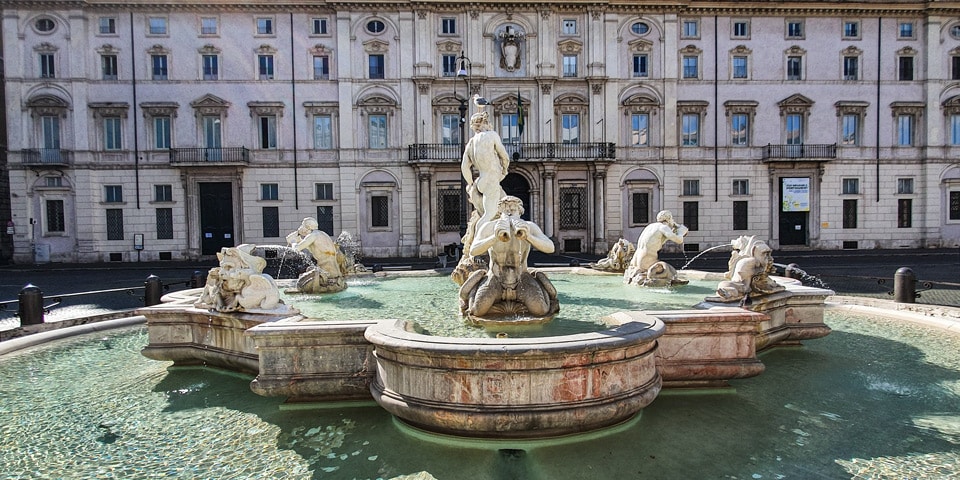
The construction timeline ran into delays from the start: della Porta entrusted execution to sculptor Ludovico Rossi, who failed to finish on time, and in 1576 a new contract was signed to complete two parapets in travertine. The fountain’s design also shares visual DNA with the Fountain of the Pantheon, with the same mixed basins, alternating masks and tritons, and classical repertoire applied to a different piazza.
In the early hours of 3 September 2011, a man climbed into the fountain and used a large stone to damage one of the figures, breaking off part of an ear. Police identified him hours later from security camera footage, recognising him by his shoes. The same individual threw a cobblestone at the Trevi Fountain the same morning, though without causing damage. He told authorities he wanted attention. Restoration was delayed until October: summer temperatures prevent the adhesive used in stone repair from bonding correctly.
The fountain sits in the open piazza, with no ticket or reservation required, and is accessible around the clock. The best time to see it is before 9 am, when the square is quiet and the morning light catches the pink marble at a low angle. By mid-morning in high season, Piazza Navona fills quickly, and the fountain loses its room to breathe.
RomeItaly.guide © 2026. Created with love by Roman experts and guides.