RomeItaly.guide
  • About us
  • Where to Stay
    • Best 3-Star Hotels
    • Hostels for Solo Travellers
    • Hotels with Views
    • Near the Colosseum
    • Near Termini Station
  • Ancient Sites
    • Baths of Diocletian
    • Castel Sant’Angelo
    • Colosseum
    • Pantheon
    • Roman Forum
  • Visiting Vatican
    • Sistine Chapel
    • Vatican Museums
    • St Peter’s Basilica
    • St Peter’s Dome
  • Museums & Galleries
    • Ara Pacis Augustae
    • Borghese Gallery
    • Palazzo Farnese
  • Hills
    • Aventine
    • Capitoline
    • Janiculum
    • Pincian
  • Fountains & Squares
    • Acqua Paola
    • Altar of the Fatherland
    • Bernini’s Elephant
    • Four Rivers Fountain
    • Piazza Navona
    • Spanish Steps
    • Turtle Fountain
    • Trevi Fountain
  • Parks & Gardens
    • Knights of Malta Keyhole
    • Orange Garden
    • Rose Garden
    • Villa Doria Pamphilj
    • Villa Borghese
    • Villa Sciarra
    • Umbrella Pine Trees
  • How to Get
    • Fiumicino Airport ➡️ Rome
  1. Home ›
  2. How to Get Around

How to Book Italo Train Tickets in Italy

Written by: Kate Zusmann

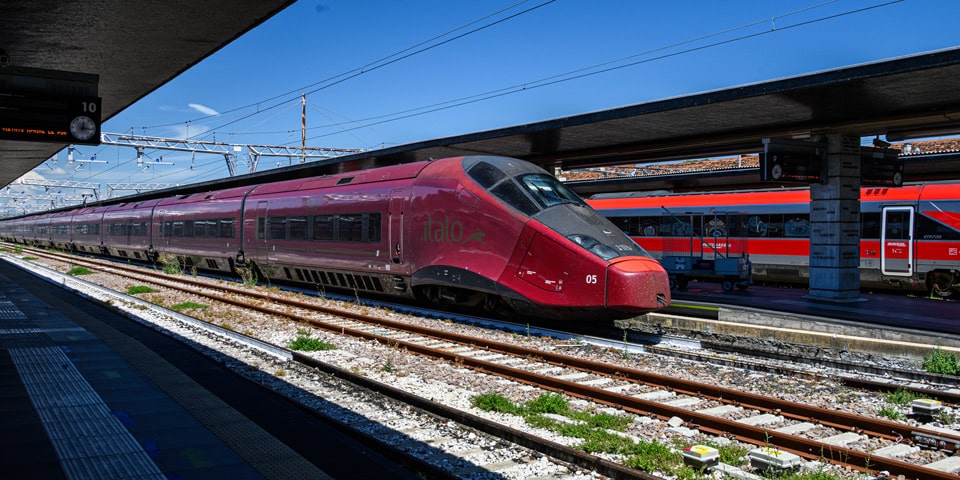
Italo high-speed train in Italy

The official italotreno.com website is available in English and Italian. Italo is a private high-speed train operator in Italy and a genuine alternative to Trenitalia on major city-to-city routes. I always compare the two before booking, because the better option changes with the route, the departure time, the price, the station, and the ticket conditions.

If you’re travelling between Rome, Florence, Milan, Venice, Naples, Bologna, Turin, Verona, or Salerno, Italo is worth a look. On many of the busiest high-speed routes it’s fast, comfortable, and priced competitively.

Contents8 sections · ~7 min read
  1. Where to Go
  2. Registration
  3. Buying a Ticket
  4. Travel Classes and Fare Types
  5. Special Offers
  6. How to Return or Change Tickets
  7. Tips
  8. Things to Know About ItaloTreno and Travelling on High-Speed Trains in Italy

Where to Go

Italo runs to most of Italy’s main high-speed destinations, including Rome, Milan, Florence, Naples, Venice, Bologna, Turin, Verona, Padua, Reggio Emilia, Brescia, and Salerno. If you’re based in Rome, the routes you’ll use most are Rome to Florence, Rome to Naples, Rome to Milan, and Rome to Venice. Depending on the specific train, current Italo timetables run roughly 1 hour from Rome to Naples, about 1 hour 30 minutes from Rome to Florence, around 3 hours from Rome to Milan, and about 4 hours from Rome to Venice.

Some itineraries combine Italo high-speed trains with Itabus coaches, ferries, or regional rail. Before you pay, check whether your trip is direct or involves a transfer.
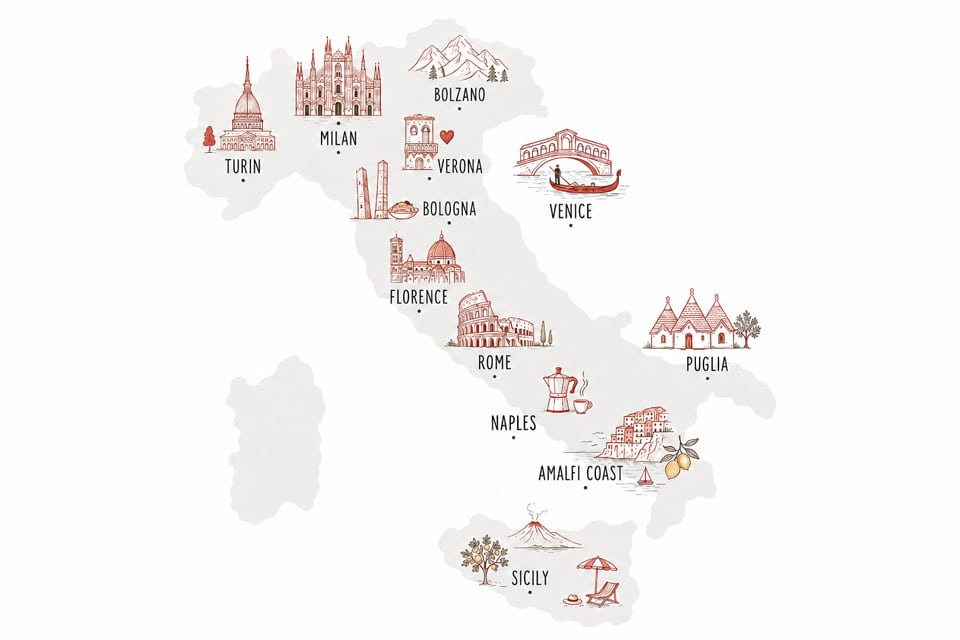
Cities served by Italo high speed trains in Italy

Registration

You don’t need to register to buy a ticket. You can book as a guest by entering your passenger details and an email address at checkout. An account only pays off if you travel in Italy often: it saves your details, keeps your tickets in one place, and makes changes easier to manage later.

To create one, open the official website, switch to the English version if needed, and select the login or sign-up option in the upper-right corner. The layout shifts from time to time, but the process is straightforward.
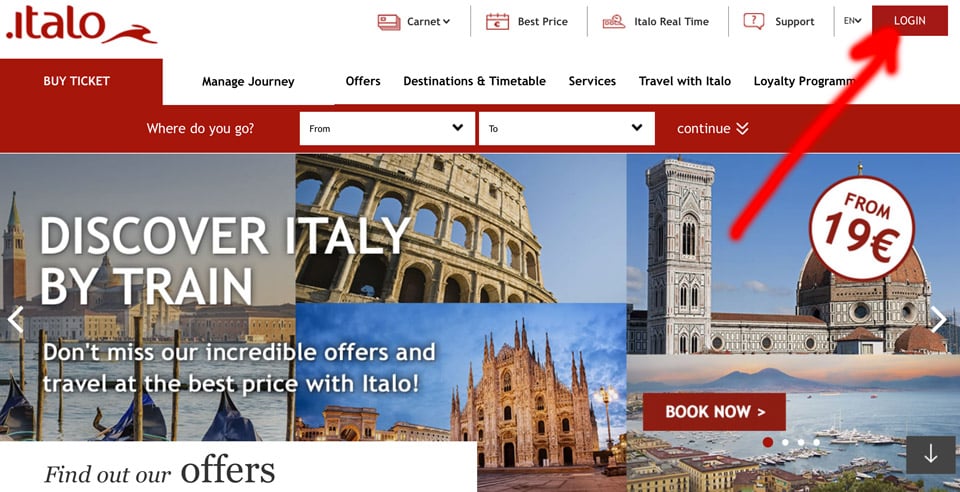
ItaloTreno registration page

After choosing sign-up, fill in the required details and confirm your account. Once it’s set up, you can log in and buy or manage high-speed tickets from your profile.
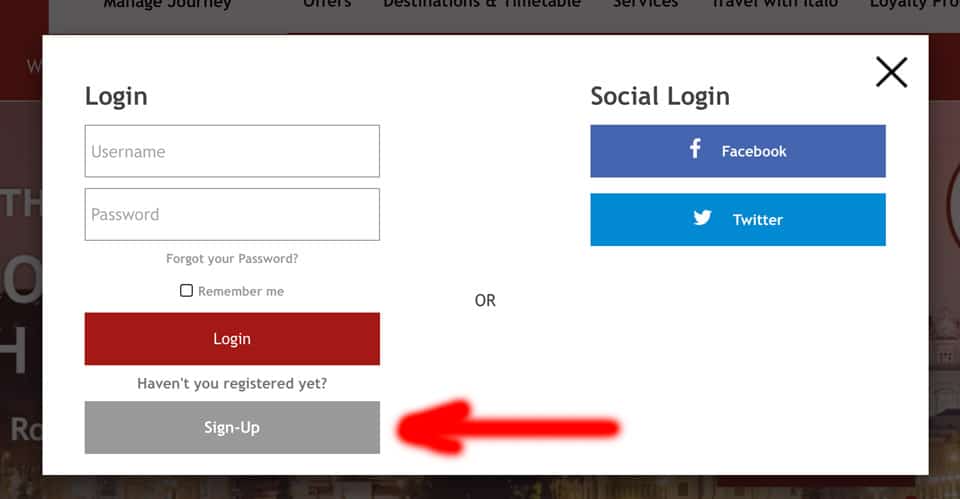
ItaloTreno login window

Tip: Italo publishes discounts and promotional fares regularly. Check the official offers page, the app, or the newsletter before booking, especially if you’re planning well ahead.

Buying a Ticket

Let’s take a Rome to Venice trip as an example. On the Italo website, pick one-way or return, then enter the departure city, arrival city, date, and number of passengers.

The results show several departures at different prices and journey times. Compare the departure station, arrival station, duration, number of stops, travel class, and fare conditions before committing to one. Note the currency switcher in the upper-right corner. You can display prices in US dollars, British pounds, or euros.
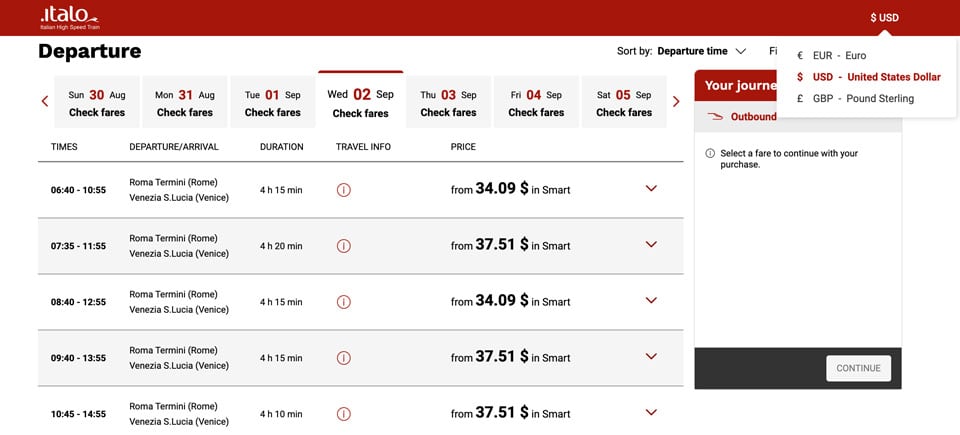
Comparison of Italo Rome Venice tickets by time and fare

Two choices matter most here: the travel class and the fare type. The class sets your onboard comfort and services; the fare type decides how freely you can change or cancel the ticket. They’re independent of each other, and people often confuse them.
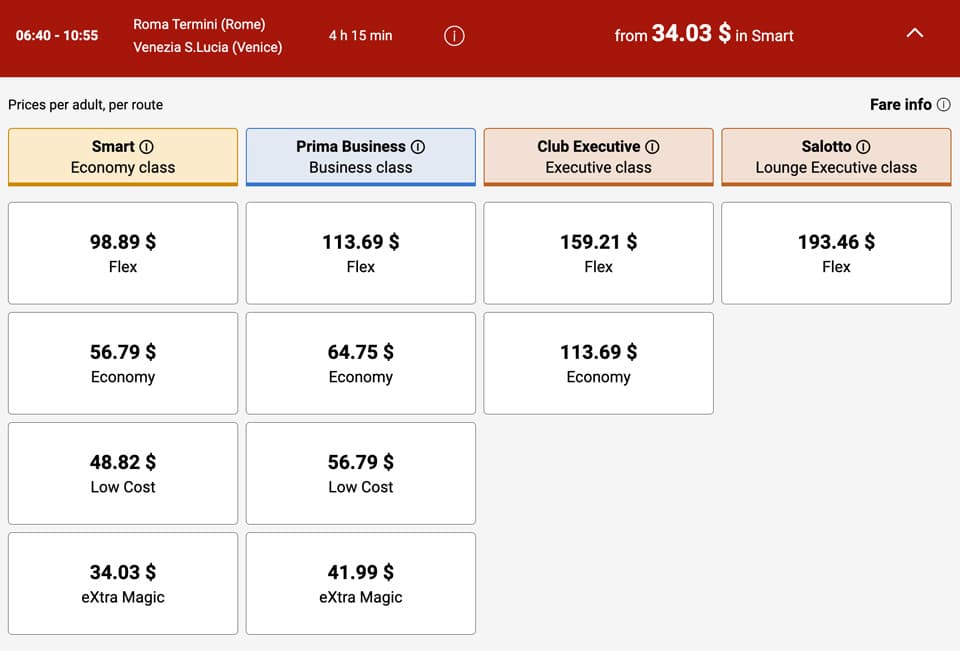
Ticket prices for different classes on the Italotreno high speed trains

Occasionally Prima Business or even Club Executive turns up at a surprisingly good price during a promotion, so it’s worth checking the upgrade before defaulting to the cheapest seat. Book close to your travel date, though, and prices climb. The lowest fares are usually gone first.

Once you’ve picked a train, enter the passenger details and move to payment. If seat selection is available for your train and fare, you can choose your seat during booking. Booking early gives you the widest choice of departure times, fares, and seats.
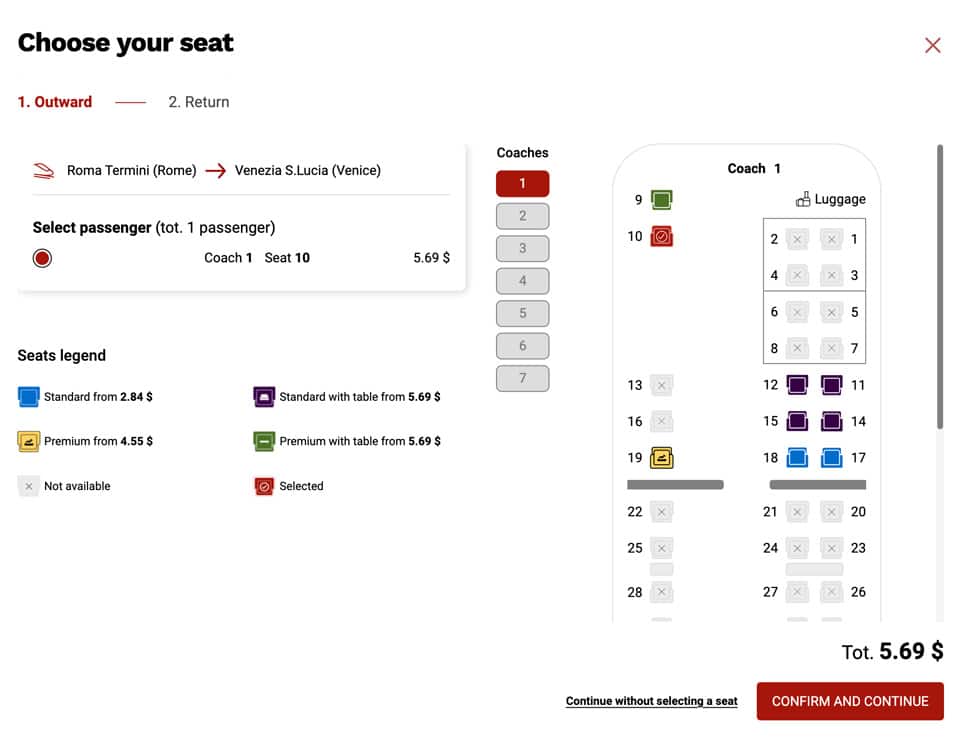
Choosing a seat on an Italo train

At some stations you can also buy a lounge access card on the day. The lounge can be worth paying for if you have a long wait.
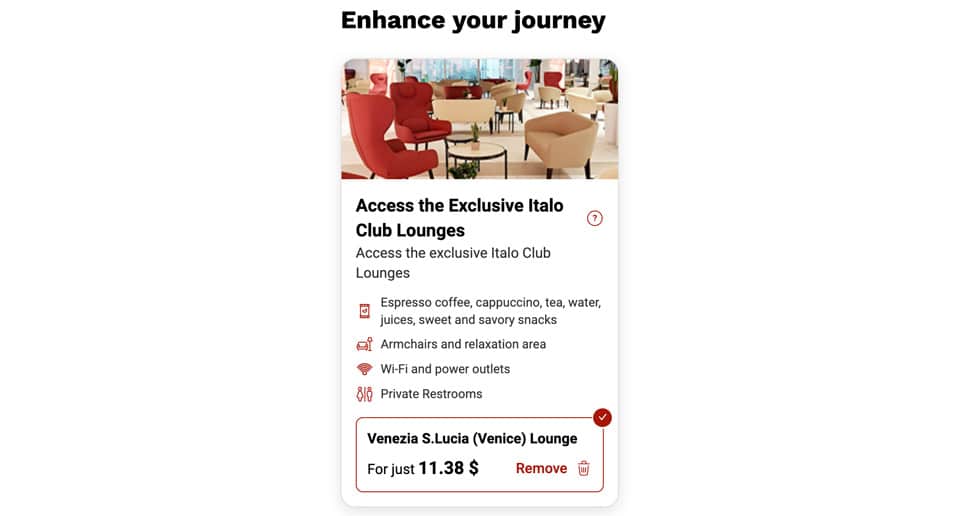
access the exclusive Italo Club Lounges

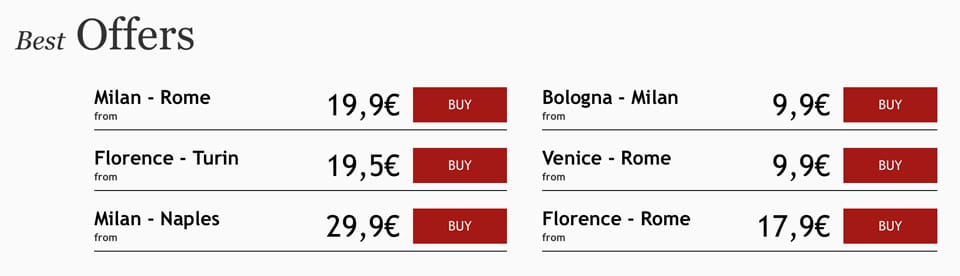
Italo prices are dynamic, so headline examples like “Rome to Milan for €19.90” or “Venice to Rome for €9.90” are occasional promotional fares, not the norm. The real price depends on the route, the date, demand, the travel class, the fare type, and how early you book.

Travel Classes and Fare Types

Before you pay, it’s worth being clear on the difference between the onboard classes and the ticket conditions.
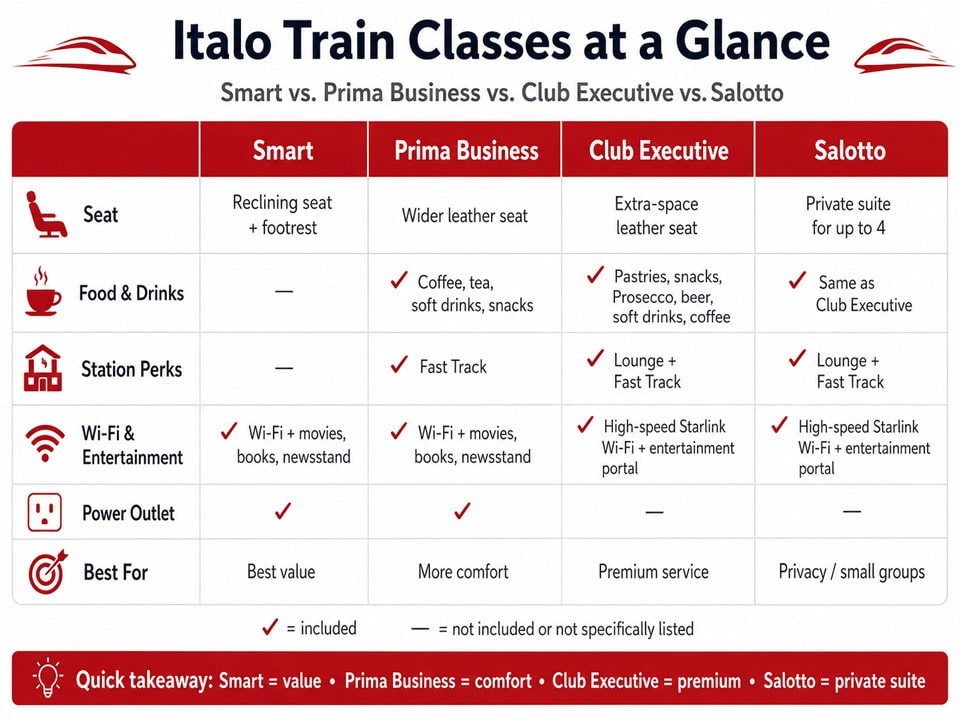
The difference between the different seating classes on ItaloTreno trains

  • Smart is the standard and usually the most affordable class. You get reclining seats with a footrest, free Wi-Fi, the onboard entertainment portal, and individual power outlets. Food, drinks, Fast Track, and lounge access are not included.
  • Prima Business is the comfort step up: wider reclining leather seats, individual power outlets, free Wi-Fi and entertainment, plus coffee, tea, soft drinks, and a sweet or savoury Italian snack served at your seat. Fast Track boarding is included.
  • Club Executive is the premium class: extra-space leather seats, Italo Club Lounge access, Fast Track, and dedicated at-seat service with Italian pastries, snacks, Prosecco, beer, soft drinks, and coffee, alongside high-speed Wi-Fi and onboard entertainment.
  • Salotto is an enclosed four-seat suite within the Club Executive carriage, bookable for an extra charge. It carries all the Club Executive benefits, including lounge access, Fast Track, and at-seat food and drinks, in a private compartment ideal for a family or a small group.

Fare types are a separate matter from the class. A Smart ticket, for instance, can be sold as Low Cost, Economy, or Flex depending on availability. Low Cost is the cheapest but least flexible; Economy balances price and flexibility; Flex costs more but is the easiest to change or partially refund. Whatever the class, open the fare conditions before you pay.
Special Offers

ItaloTreno special offers for train tickets

The most reliable way to save is simple: book early, and compare Italo against Trenitalia on the same route. Beyond that, Italo runs temporary offers tied to specific dates, routes, age groups, day-return trips, families, and small groups. These change often, so check the official offers section or the app before buying.

If you travel in Italy regularly, the newsletter is worth subscribing to. Promo codes help when they’re available, but they’re less dependable than simply booking ahead.

How to Return or Change Tickets

Whether you can change or refund an Italo ticket comes down to the fare type you chose at booking. To manage a ticket, go to the Manage bookings page and enter the passenger’s name, surname, and ticket code. If you booked while logged in, you can manage it from your account or the app instead.
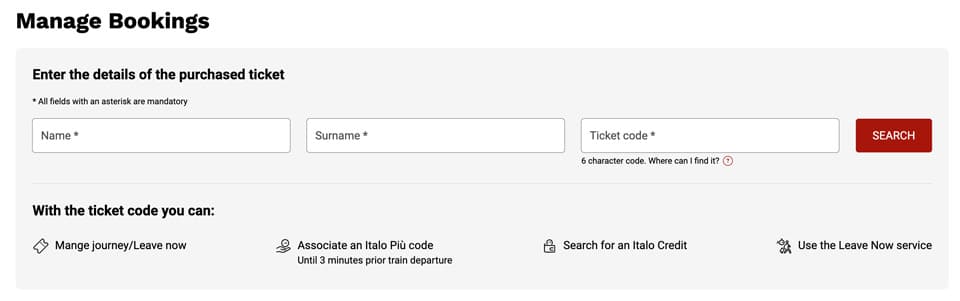
Italoteno Manage bookings Enter the details of the purchased ticket

As a rule, Low Cost tickets are the least flexible, Economy allows changes for a fee, and Flex gives you the most room to manoeuvre. Italo lists free changes on Flex up to three minutes before departure. Economy and Low Cost changes generally involve a fee or fare difference. Check the official fare conditions before buying. If your plans are at all uncertain, don’t reach for the cheapest fare on autopilot. read the conditions first.

Tips

  1. Buy through the official Italo website, the Italo app, station ticket offices, or another authorised channel.
  2. Compare Italo and Trenitalia before booking. Italo is often the better deal on major routes, but Trenitalia may run more departures or reach stations Italo doesn’t.
  3. For Rome, check whether your train leaves from Roma Termini or Roma Tiburtina. Turning up at the wrong one can cost you the train.
  4. Book ahead when you can. Prices rise on busy dates, weekends, holidays, and as departure approaches.
  5. Check both the class and the fare type before paying. A cheap ticket can lock you in if your plans shift.
  6. There’s no need to validate an Italo ticket at a station machine. Keep the ticket code or QR code on your phone, and carry a photo ID matching the passenger name.
  7. Luggage is included within the rules for your class. Check suitcase dimensions before buying a Smart ticket and put larger bags in the coach racks.

Things to Know About ItaloTreno and Travelling on High-Speed Trains in Italy

Which high-speed train in Italy is best?
For most visitors, the best choice is the train with the most convenient departure time, station, price, and fare conditions. Italo and Trenitalia’s Frecciarossa are both strong options on major routes such as Rome to Florence, Rome to Milan, Rome to Venice, and Rome to Naples. I usually compare both before booking.
What is the difference between Trenitalia and Italo?
Italo is a private operator focused mainly on high-speed routes between major Italian cities. Trenitalia is the national rail operator and runs a much wider network, including Frecciarossa high-speed trains, Intercity trains, and regional services. Italo can be very competitive on popular city-to-city routes, while Trenitalia is often necessary for smaller towns and regional travel.
Is Italo cheaper than Trenitalia?
Sometimes. Prices are dynamic, so Italo may be cheaper on one date while Trenitalia is better on another. Book early, check current promotions, and compare the same route, travel time, and ticket conditions before paying.
Do I need to print or validate an Italo ticket?
No. Italo tickets are issued with a ticket code, and you can show the ticket electronically on your phone. You do not need to validate it in a station machine before boarding. However, carry a valid photo ID, because the passenger name on the ticket should match your identification document.
Can I take luggage on Italo trains?
Yes. Luggage is generally included in the ticket price. Smaller bags can go on the overhead racks, while larger suitcases should be placed in the luggage areas at the end of the coach. In Smart Class, the limit is 75 × 53 × 30 cm. Check the official luggage rules for your class before travelling.
Can I change or refund an Italo ticket?
It depends on the fare selected during booking. Low Cost, Economy, and Flex tickets have different change and refund rules. Flex is usually the most flexible option, while Low Cost is normally the cheapest and least flexible. Always open the fare conditions before paying, especially if your travel plans may change.

Planning a trip to Rome?

Google may show you more of our updates about tickets, opening hours, and visiting Rome.

Add as a preferred source on Google

Kate Zusmann
Rome travel writer & expert Kate Zusmann
years in Rome
12
guides published
117
article updated
Nov 2026
I’ve lived in the Eternal City for the past 12 years. They say every corner of Rome holds a story, and I’m here to share some of the most fascinating historical facts and local legends.
All guides by Kate →

More Rome guides

Vatican Museums Visitor Guide

The Vatican Museums

Rome Italy Tourist Attractions

Top 30 Attractions in Rome

Beste Hotels in Rom mit Aussicht

Best Hotels with Views in Rome

How to Book Vatican Museums & Sistine Chapel Tickets

How to Book Vatican Museums & Sistine Chapel Tickets

St. Peter's Basilica dome seen through the trees from the far side of Piazzale Garibaldi, Rome

Janiculum Hill (Gianicolo): Viewpoints and Walking Route

from Venice to Rome

How to Get from Venice to Rome

Travel from Naples to Rome

How to Get from Naples to Rome

Travel between Paris and Rome

How to Travel Between Paris and Rome

Travel from Rome to Milan

How to Get from Rome to Milan

Show more

About us

About us ROME.US Authors Kate Zusmann and Artur Jakucewicz
We're Kate and Artur, a duo bound by our shared fascination with the Eternal City – Rome. Our paths, driven by a mutual passion for its timeless stories and architectural marvels, converged in a way we had never imagined.

Explore Rome

  • The Colosseum in Rome

    What Did the Colosseum Look Like?

  • Fiumicino Airport Terminal 3

    How to Get from Fiumicino Airport to Rome City Centre?

  • Gaius Iulius Caesar

    Julius Caesar: Life and Legacy

  • Roman monument associated with the Five Good Emperors

    The Five Good Emperors of Rome

  • Basilica of Santa Maria degli Angeli e dei Martiri in Rome

    Basilica of Santa Maria degli Angeli e dei Martiri

RomeItaly.guide

This website uses cookies. For more info read the cookies policy

RomeItaly.guide © 2026. Created with love by Roman experts and guides.

  • American English
  • Español
  • Polski