991228 travellers read
Written by: Artur Jakucewicz
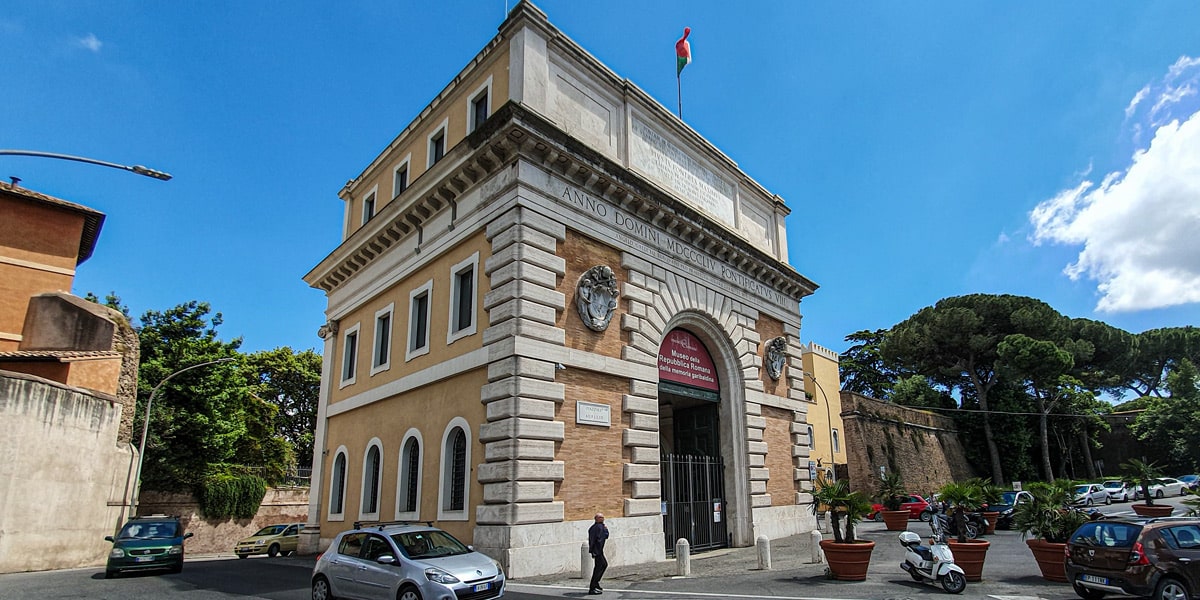
Porta San Pancrazio is easy to mistake for a monumental traffic island. Cars circle its nineteenth-century façade, while people walking between Villa Doria Pamphilj and the Janiculum pass without necessarily noticing the museum inside.
The galleries recount the Roman Republic of 1849 through portraits, maps, weapons, red shirts, and multimedia reconstructions, while the address gives the collection unusual force. The museum occupies the replacement for a gate destroyed by French artillery during the siege it explains.
Outside, inscriptions celebrate the pope restored to power after the Republic fell. Inside, the displays commemorate its defenders. The conflict is built into the building.
The route through Rome’s Aurelian Walls once crossed the Janiculum through the ancient Porta Aurelia. It later became known as Porta San Pancrazio after the nearby basilica. In the seventeenth century, Urban VIII replaced the older defences with the larger Janiculum Walls and commissioned a new gate here in 1642.
That gate stood directly in the path of the French assault on the Roman Republic. Fighting concentrated on the high ground west of the city, around Villa Pamphilj, the Vascello, the former Villa Corsini, and Porta San Pancrazio. Sustained cannon fire damaged the gate beyond repair in June 1849.
After papal government returned, Pius IX commissioned Virginio Vespignani to design its replacement. Construction began in 1854 and continued until 1857. The present building has two lateral wings, four internal levels, and a central hall. Republican defenders never fought through this structure; it is the papal reconstruction of their ruined battlefield.
The upper façade condenses the building’s history into heraldry and Latin. The shield on the viewer’s right bears three bees, the Barberini emblem of Urban VIII, who built the 1642 gate. The more weathered coat of arms on the left belongs to Pius IX of the Mastai-Ferretti family, who ordered the reconstruction after the siege. Papal tiaras and crossed keys crown both shields.
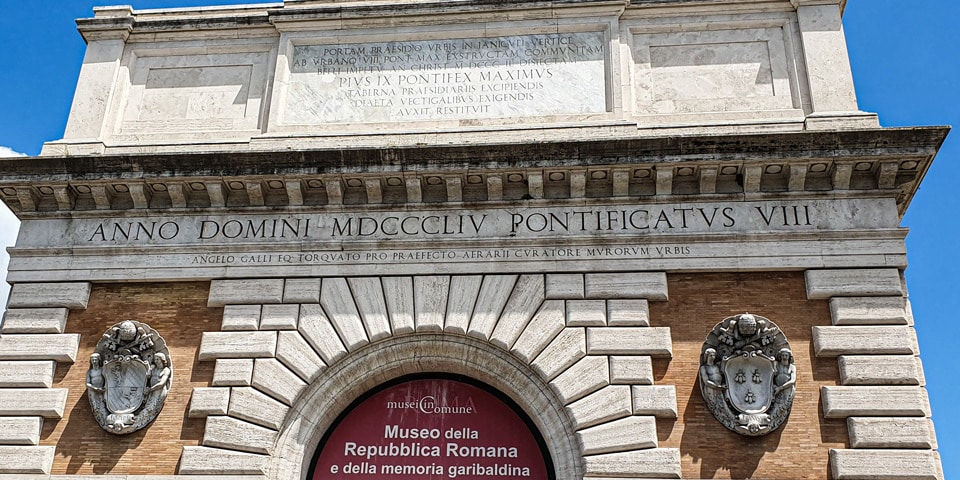
The main inscription uses monumental spelling, with V in place of U:
PORTAM PRAESIDIO VRBIS IN IANICVLI VERTICE
AB VRBANO VIII PONT MAX EXSTRVCTAM COMMVNITAM
BELLI IMPETV AN CHRIST M DCCC IL DISIECTAM
PIVS IX PONTIFEX MAXIMVS
TABERNA PRAESIDIARIIS EXCIPIENDIS
DELETA VECTIGALIBVS EXIGENDIS
AVXIT RESTITVIT
In English, it says: “The gate built and fortified by Urban VIII, Supreme Pontiff, on the summit of the Janiculum for the defence of the city was shattered by the violence of war in the year of Christ 1849. Pius IX, Supreme Pontiff, enlarged and restored it, removing the quarters used to accommodate the garrison and adapting the building for the collection of duties.”
The stone writes 1849 as M DCCC IL. Its final IL is an unusual compact subtractive form; the normalised Roman numeral would be MDCCCXLIX. The phrase belli impetu, translated as “by the violence of war,” avoids identifying the army responsible. French forces sent to restore Pius IX had destroyed the gate while attacking Roman republicans.
The larger line below reads ANNO DOMINI MDCCCLIV PONTIFICATVS VIII: “In the year of Our Lord 1854, in the eighth year of the pontificate.” The date is 1854. The numeral MDCCCLIV ends in 54, while 1864 would require MDCCCLXIV. Pius IX had been elected in June 1846, so the two dating systems agree.
A smaller line credits the official who supervised the work: ANGELO GALLI EQ TORQVATO PRO PRAEFECTO AERARII CVRATORE MVRORVM VRBIS. It means “Under Angelo Galli, decorated knight, acting prefect of the Treasury and superintendent of the city walls.” The named official oversaw the project; Vespignani was the architect.
The museum begins with the revolutions that spread across Europe in 1848. Pius IX had encouraged liberal hopes through early reforms in the Papal States, then refused to support the Italian war against Austria. His prime minister, Pellegrino Rossi, was assassinated in November 1848. The pope fled Rome for Gaeta.
An elected constituent assembly ended papal temporal government and proclaimed the Roman Republic on 9 February 1849. Giuseppe Mazzini served as one of its three governing triumvirs. The new regime pursued representative government, secular civil authority, and reforms to taxation and education.
Its existence lasted only five months. Pius IX appealed to Catholic powers, and the French Republic sent an expedition under General Nicolas Oudinot to restore him. Republican troops led by Giuseppe Garibaldi repelled the first French attack on 30 April. Reinforcements arrived, the assault resumed on 3 June, and the siege continued through the rest of the month.
The museum’s multimedia reconstruction makes the battle easier to follow. A model and projected panorama identify the city, the Janiculum villas, and the positions contested during the French advance. Control of the ridge gave artillery a line of fire towards Trastevere and central Rome.
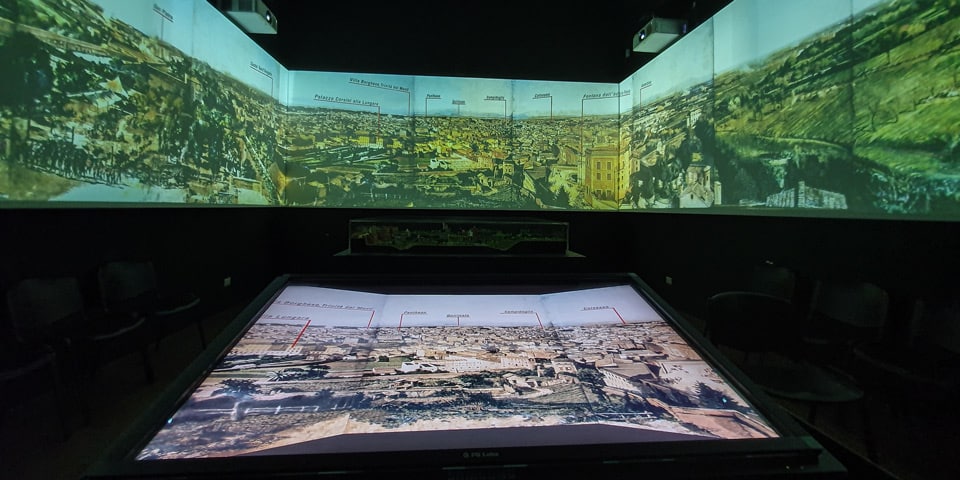
The four floors proceed chronologically from the revolutions of 1848 to the Constitution proclaimed in July 1849. Paintings, films, maps, and printed material carry much of the explanation. The collection contains relatively few famous artworks, but its sequence clarifies why the Janiculum is crowded with Garibaldian memorials.
Garibaldi does not dominate every room. Mazzini shaped the political project, while Carlo Pisacane contributed to military organisation and volunteers arrived from across the Italian states. Several prominent defenders died in their twenties, including Goffredo Mameli, Luciano Manara, Emilio Morosini, and Enrico Dandolo.
A large painting shows Giuseppe Garibaldi beside the dying Anita during the retreat from Rome. Anita lies at the centre, attendants bend over her, and Garibaldi gestures from the edge of the room.
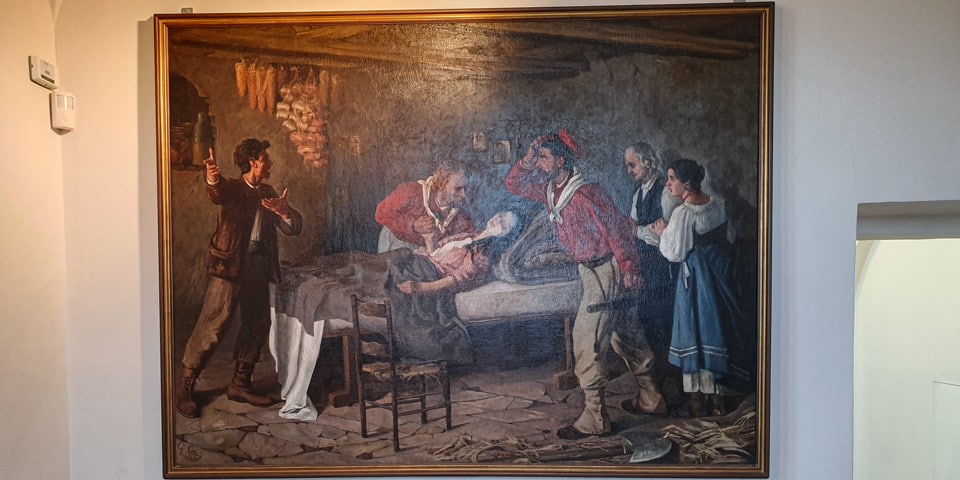
The painting belongs to the language of memorial art rather than eyewitness documentation. Anita joined the retreat while pregnant and gravely ill, dying near Ravenna on 4 August 1849. Later images absorbed her death into Italy’s national story. The nearby monument and tomb of Anita Garibaldi presents the same transformation in bronze.
Red shirts provide the strongest colour in the exhibition. Garibaldi’s followers had adopted them during his South American campaigns, before the garment became associated with volunteers fighting for Italian unification. A red shirt identified an irregular soldier and later served as a preserved record of participation.
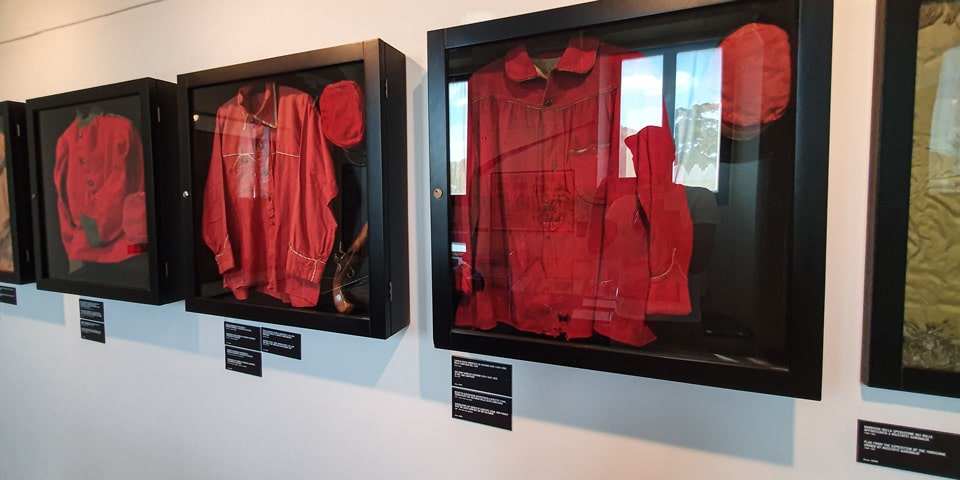
Portraits and personal objects move the final rooms beyond the short-lived Republic towards memoria garibaldina, the culture of Garibaldian remembrance, with weapons displayed beside letters and other personal relics. The museum’s full name reflects that division: one part documents the political experiment of 1849, while the other follows its people and symbols through later Italian history.
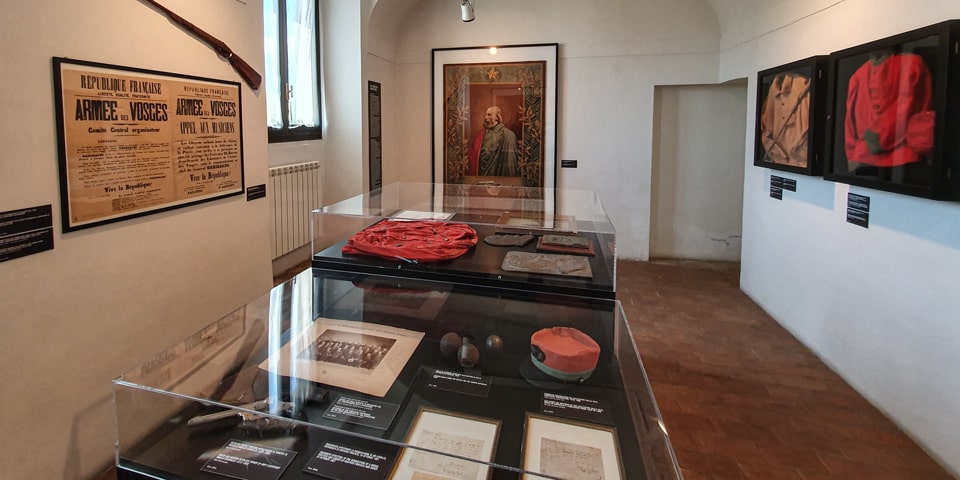
The Constitution of the Roman Republic was proclaimed on Capitoline Hill on 3 July 1849. French troops had already entered Rome. The Republic could no longer enforce it.
The document grounded political authority in popular sovereignty and declared citizens equal before the law. It assigned the state a responsibility to improve their material and moral conditions, while distinguishing civil government from religious authority. Those principles explain why a five-month republic occupies such a large place in Italian democratic memory.
The exterior and interior tell the outcome from opposing sides. The façade records a gate damaged by war and restored by a pope, while the galleries preserve the constitutional project defeated during that restoration.
The gate appears at the beginning of the Rome sequence in Spectre (2015). James Bond’s Aston Martin DB10 travels along Via di San Pancrazio towards it. The film opens in Mexico City. Here, the gate introduces Bond’s Rome.
Paolo Sorrentino used the same landscape in The Great Beauty, whose opening takes place at the nearby Fontana dell’Acqua Paola. A tourist collapses there after looking across the city, and both films treat the Janiculum as a theatrical threshold.
The museum is compact and admission is free. The façade tends to leave the stronger visual impression, while the galleries reward an interest in political history and Garibaldian material. Its position on the walking route from Villa Doria Pamphilj to the Janiculum makes entry an easy addition.
The Ciceruacchio statue is a few minutes from the gate. Continuing along the promenade leads to Piazzale Garibaldi, while the Acqua Paola stands in the other direction. After the exhibition, the gate’s inscriptions and papal coats of arms become part of the story rather than architectural decoration.
RomeItaly.guide © 2026. Created with love by Roman experts and guides.