
991228 travellers read
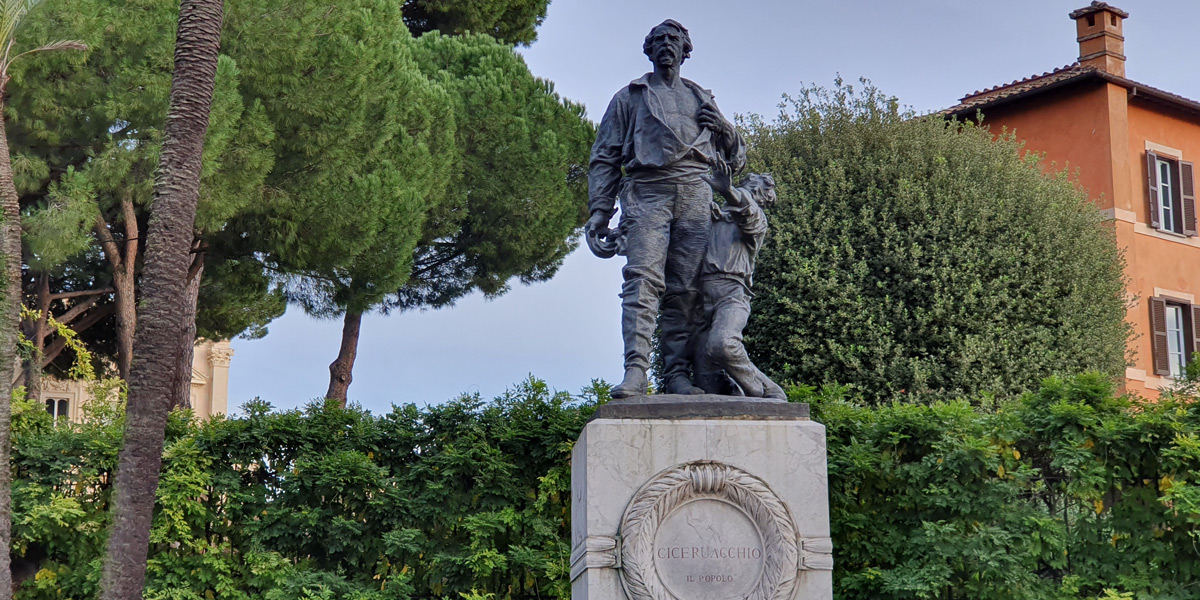
The bronze man is not shielding the boy behind him. He is pulling open his shirt and offering his chest to a firing squad; the boy, Lorenzo, is thirteen and about to die beside him. This is the Ciceruacchio statue, one of the most emotionally direct monuments on Janiculum Hill.
Unlike the rows of marble patriots along the promenade, this is not a formal portrait. Sculptor Ettore Ximenes built the final moments of two lives into the pose. The artwork then acquired a political story of its own, moving around Rome for more than a century before reaching the Janiculum in 2011.
Ciceruacchio was the nickname of Angelo Brunetti, a Roman born into a working-class family in Campo Marzio in 1800. His father was a blacksmith, and Brunetti began as a carter carrying wine from the Castelli Romani into the city. He eventually built a successful transport business and gained unusual influence in Rome’s working-class neighbourhoods, especially after helping people during the cholera epidemic of 1837.
His politics were more complicated than the label “revolutionary” suggests. When Pius IX was elected in 1846, Brunetti organised popular demonstrations in support of the new pope’s promised reforms. Only as those hopes collapsed did he move towards open opposition. During the Roman Republic of 1849, he was given responsibility for internal barricades and food supplies, unglamorous work, but essential in a city under siege.
After French troops defeated the republic, Brunetti joined Garibaldi’s retreat from Rome and tried to reach Venice. He never made it.
Even his nickname has no single accepted origin. One explanation connects Ciceruacchio to Cicero and Brunetti’s ability to speak to a crowd. Another treats it as a childhood nickname formed from Roman words referring to his round, stocky appearance. The honest answer is that both traditions survive.
Brunetti’s group was captured near the Po and taken to Ca’ Tiepolo. On the night of 10 August 1849, Austrian soldiers shot Angelo, his sons Luigi and Lorenzo, and five companions. Lorenzo was only thirteen.
The sculpture shows just Angelo and the younger boy. Brunetti plants one foot forward, bares his chest, and looks directly at the unseen rifles. Lorenzo presses close behind him, one hand raised beside his father’s shoulder. From the front, the adult figure dominates the bronze; from below, the frightened child changes its entire meaning.
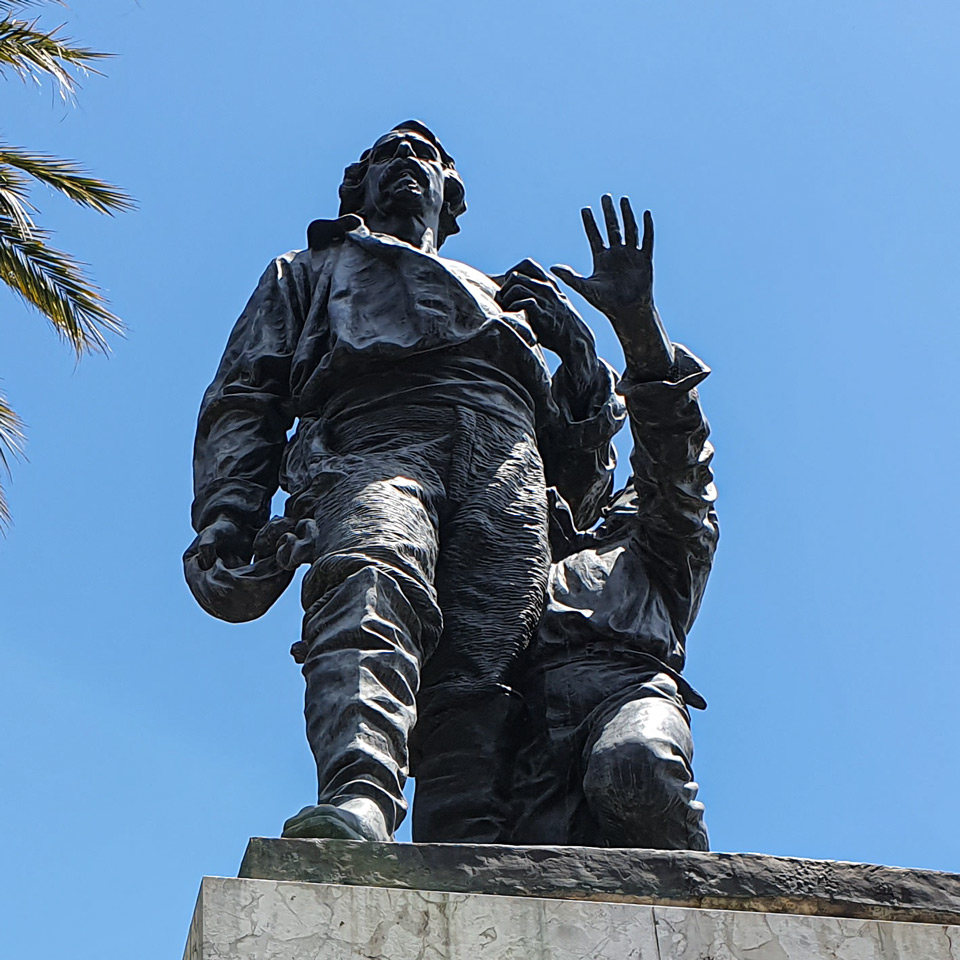
Luigi died with them but does not appear. Surviving documentation does not give a certain reason for Ximenes’s decision, so it is safer to see the group as a deliberately concentrated image of a father and his youngest son, not a complete record of everyone executed that night.
Ximenes created the original plaster group in Florence in 1879 under the title Ciceruacchio col figlio Lorenzo, Ciceruacchio with his son Lorenzo. It was intended for a funerary monument at Rome’s Verano Cemetery, but that project was never completed. The model was exhibited and awarded at the National Fine Arts Exhibition in Turin in 1880.
More than a decade later, the Società dei Carrettieri and the Circolo Angelo Brunetti revived the idea of a public memorial. A popular committee opened a public subscription in 1892. That origin still feels present on the pedestal: beneath the bronze, the spare inscription pairs “CICERUACCHIO” with “IL POPOLO”, “the people.”
The committee wanted the monument placed where Ciceruacchio could face the Vatican, deliberately setting the Roman popular leader against papal authority. The bronze was cast in 1900, but when it was finally installed near Ponte Margherita in 1907, the figure looked towards the city instead. It was a visible political compromise.
The memorial moved to Lungotevere in Augusta in 1959–1960 and was then turned towards the Vatican, belatedly fulfilling the committee’s intention. Its last transfer came in March 2011. After restoration, the seven-metre-high monument was installed on the Janiculum for the 150th anniversary of Italian unification, joining the hill’s larger landscape of Garibaldian memory.
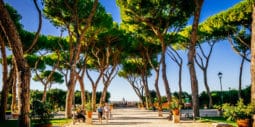
From Piazzale Garibaldi, follow the tree-lined Passeggiata del Gianicolo south towards Porta San Pancrazio. The monument appears a few minutes later on the right, set back among the trees beside Viale Lorenzo Brunetti. It stands outdoors and requires no ticket.
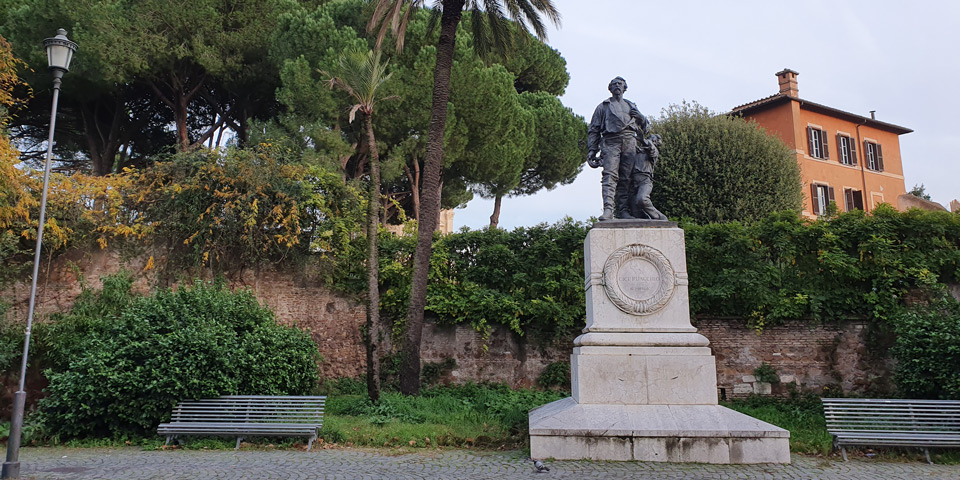
View it first from across the path, where Angelo reads as a defiant public hero. Then walk to the base and look up at Lorenzo. The smallest figure in the group is the one that turns a political monument into a human tragedy.
RomeItaly.guide © 2026. Created with love by Roman experts and guides.