991228 travellers read
Written by: Artur Jakucewicz
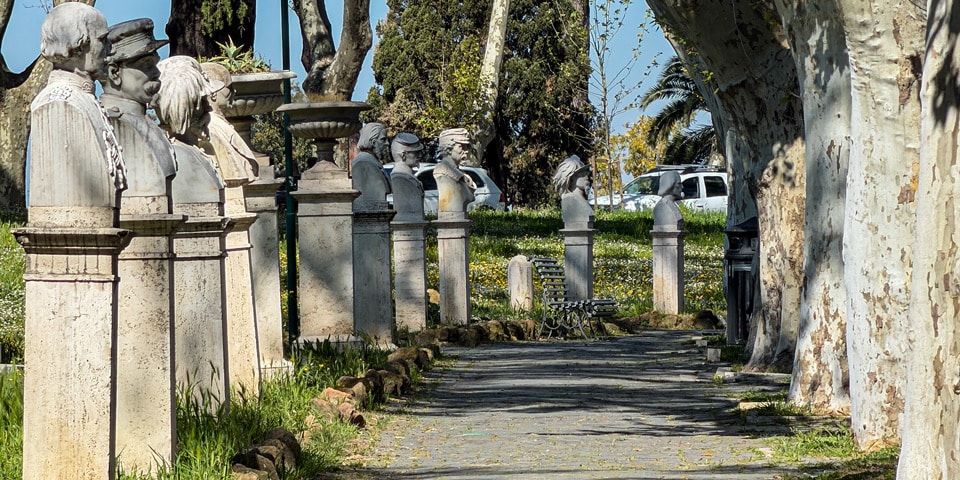
The marble portraits along the promenade on Janiculum Hill represent patriots associated with the defence of Rome and the movement for Italian unification. Most are soldiers and political activists, but the rows also include an actor, a poet, a mathematician, a priest, and one woman.
Some of these people fought on the hill during the siege of 1849. Others took part in later campaigns or promoted the same political cause through writing, organising, and public life. The avenue records a broader movement than Garibaldi’s army alone.
In 1849, the Janiculum became the main battlefield in the defence of the short-lived Roman Republic. Republican volunteers held the ridge against French troops sent to restore the temporal rule of Pope Pius IX. The fighting around Porta San Pancrazio, Villa Corsini, and the Vascello devastated the area and killed many of its defenders.
The Republic fell in July, but its defence became a major episode in the history of Italian unification. After Rome joined the Kingdom of Italy and became its capital, the former battlefield was reshaped as a public memorial landscape, while the nearby Museum of the Roman Republic at Porta San Pancrazio now explains the siege and identifies many of its participants.
On 26 July 1884, Rome’s municipal government accepted a proposal to dedicate the Janiculum promenade to patriots who had distinguished themselves in the defence and liberation of the city. Numerous busts were installed from 1885 to 1888. Further additions followed during the twentieth century.
The enormous monument to Giuseppe Garibaldi, created by Emilio Gallori and inaugurated in 1895, dominates the summit. The smaller marble portraits bring individual participants closer to eye level.
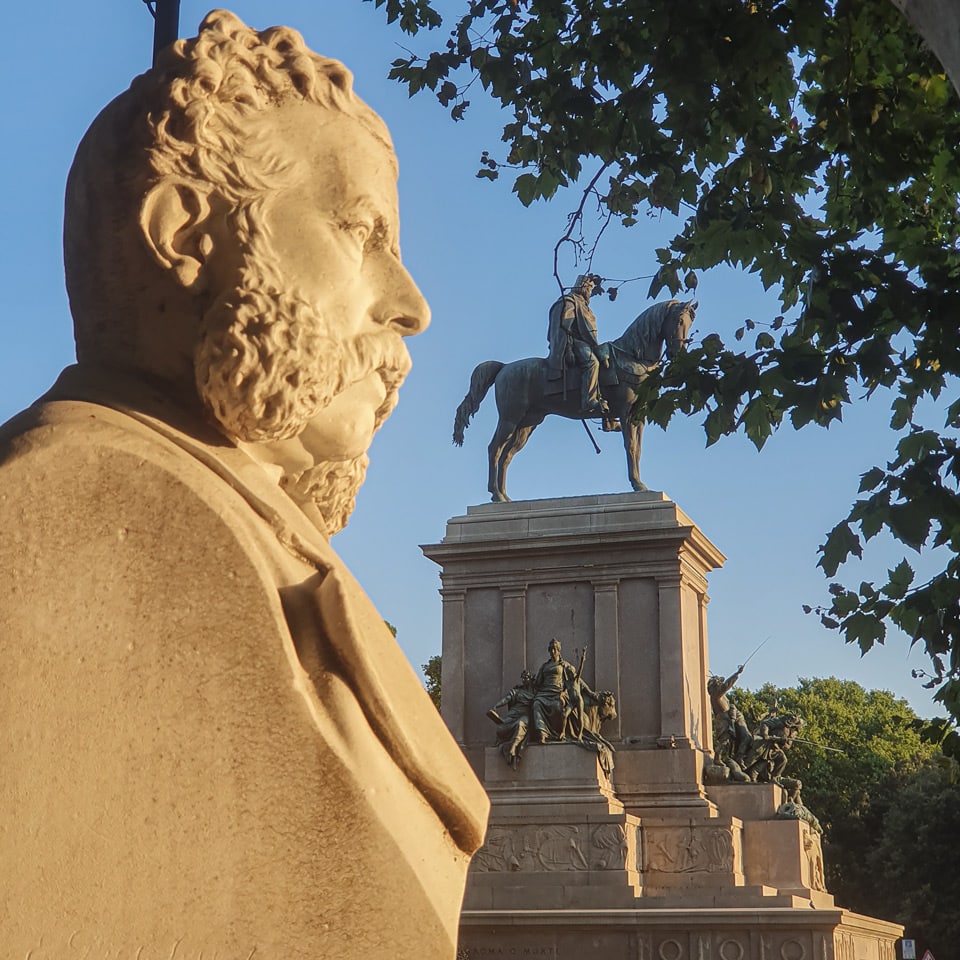
The photograph above makes that relationship clear. Nicola Fabrizi stands in the foreground while Garibaldi rises behind him. Fabrizi had his own career as a revolutionary organiser and politician. He worked with Giuseppe Mazzini, organised networks from exile, and later joined campaigns in southern Italy.
The differences between the busts are useful clues. Some figures wear decorated uniforms or military caps. Others appear in civilian coats or clerical dress. The selection recognised several forms of service to the national cause, including political work and cultural influence.
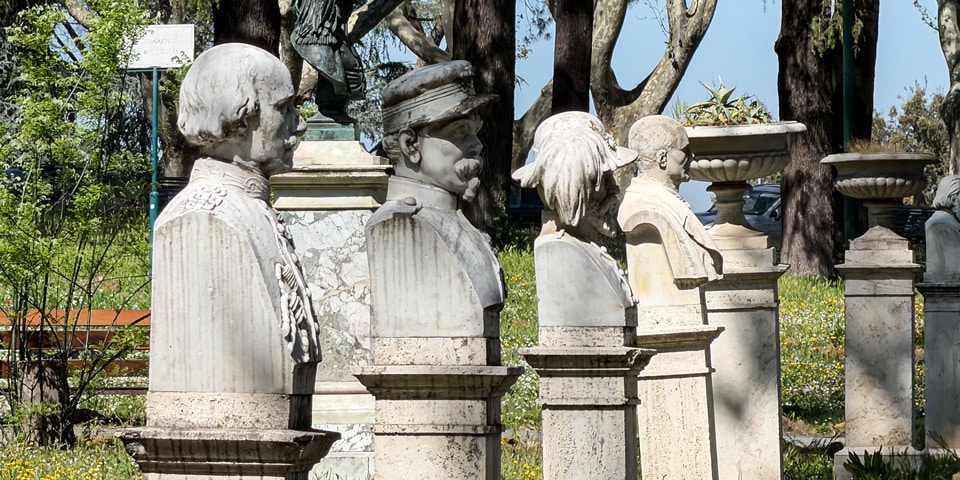
Tommaso Salvini is a good reason to stop and read the inscriptions. He became an internationally known Shakespearean actor, particularly celebrated for his portrayal of Othello. At the age of twenty, he fought alongside Garibaldi in defence of the Roman Republic. His civilian appearance makes more sense once that part of his biography is known.
Goffredo Mameli followed a different path. He fought with Garibaldi and died at twenty-one from complications after being wounded during the defence of Rome. He had already written the words of Il Canto degli Italiani, which later became Italy’s national anthem.
Other portraits broaden the picture further. Quirico Filopanti was a mathematician and writer. He also served as secretary of the Roman Republic’s Constituent Assembly. Alessandro Gavazzi had been a Barnabite priest and supported the republican cause as a military chaplain and preacher.
Colomba Antonietti is the sole woman represented among the historic busts. She cut her hair, wore military clothing, and fought beside her husband, Luigi Porzi. She died during the French bombardment on 13 June 1849. Her portrait complements the much larger monument to Anita Garibaldi farther along the hill.
The memorial also extends beyond Italy. Volunteers from other European countries joined the defence of the Roman Republic, while later additions honoured foreign figures connected with Garibaldi and the wider struggle for national independence. In 2004, a bust of the Bulgarian commander Petko Voyvoda brought the officially recorded collection to 84 portraits.
The number 84 still appears on municipal pages and tourist guides. That changed in 2024. On 21 May, Rome added a bust of Andrés Aguyar. His surname also appears as Aguiar in historical accounts.
Aguyar was an Afro-Uruguayan who had been born into slavery and later gained his freedom. He fought with Garibaldi in South America before following him to Italy and serving in the defence of the Roman Republic, where a French shell mortally wounded him in Trastevere on 30 June 1849.
Roman accounts often referred to him as Andrea il Moro, or “Andrea the Moor,” and as Garibaldi’s loyal attendant. The new portrait restores his own name and likeness to the group. Turkish sculptor Işık Özçelik created the bust, which was installed 175 years after Aguyar’s death.
You do not need to inspect every pedestal. A useful short route begins at Porta San Pancrazio and follows the busts towards Piazzale Garibaldi. Look for Tommaso Salvini, Colomba Antonietti, and Andrés Aguyar. Those three portraits are enough to show how widely the Janiculum definition of a patriot has expanded.
RomeItaly.guide © 2026. Created with love by Roman experts and guides.