
RomeItaly.guide
  • Taxi fares calculator
  • About us
  • Plan your trip
    • Weather
      • February
      • April
    • Neighbourhoods
      • Quartiere Coppedè
      • Trastevere
    • Day Trips
      • To Ostia Antica
      • Beaches near Rome
  • Getting around
    • Fiumicino Airport
    • Termini Railway Station
    • Public Transport
    • To Ostia Antica
    • To Milan
  • Sights
    • Ancient Sites
      • Castel Sant’Angelo
      • Colosseum
      • Mamertine Prison
      • Mouth of Truth
      • Pantheon
      • Roman Forum
    • Museums
      • Ara Pacis Augustae
      • Borghese Gallery
      • Caravaggio’s Paintings
      • Great Synagogue
      • Palazzo Farnese
    • Churches
      • Capuchin Crypt
      • Holy Stairs
      • Sant’Agnese in Agone
      • San Giovanni in Laterano
      • Santa Maria Maggiore
      • Saint Paul Outside the Walls
      • St Peter in Chains
    • Fountains & Squares
      • Navona Square
      • Spanish Steps
      • Trevi Fountain
      • Altar of The Fatherland
      • Fontana della Barcaccia
      • Fountain of the 4 Rivers
      • Fountain of the Pantheon
      • Piazza del Popolo
      • Piazza Venezia
      • Turtle Fountain
    • Hills
      • Aventine
      • Capitoline
      • Janiculum
      • Palatine
      • Pincian
    • Parks
      • Appian Way
      • Orange Garden
      • Pincio Terrace
      • Vatican Gardens
      • Villa Borghese
      • Villa Torlonia
    • Emperors
      • Good Emperors
      • Marcus Aurelius
      • Gaius Julius Caesar
      • Nero
      • Octavian Augustus
      • Caligula
      • Hadrian
      • Vespasian
      • Trajan
  • Vatican City
    • St Peter’s Basilica
    • Sistine Chapel
    • Vatican Museums
    • Raphael’s Rooms
    • Michelangelo’s Pieta
    • St Peters Dome
    • St Peter’s Square
    • Swiss Guard
  • Where to stay
    • How to Choose a Hotel in Rome
    • Hotels with Best Views
    • Hotels near Termini
    • Hotels near the Colloseum
    • Best Hostels
    • Hotels near Navona Square
    • 3 Star Hotels
    • 4 Star Hotels
    • 5 Star Hotels
    • Apartments For Rent
  • Food & shopping
    • Where to Eat
      • Best Pizza Places
      • Best Pasta Places
      • Local Italian Food
      • Best Gelato Places
      • Best Rooftop Bars
    • Shopping
      • Castel Romano Outlet
      • Farmers Markets
      • Souvenirs from Rome
  • Tips & FAQ
    • Free Things to Do
    • TOP Attractions
    • Tickets to Vatican museums
    • Rome Three Day Itinerary
    • Renting a Car in Rome
    • Apps for Tourists
    • Instagram
  1. Home ›
  2. Fountains and Squares

Fountain of the Goddess Roma

Written by: Kate Zusmann

Fountain of the Goddess Roma
Recommended tour
Closest bus stops
Capolinea7 min 342 m: 85 87
Cavour/Ricci19 min 932 m: 46
Closest subway stations
Colosseo15 min 751 m: B
Circo Massimo20 min 986 m: B
Address Piazza del Campidoglio, Roma

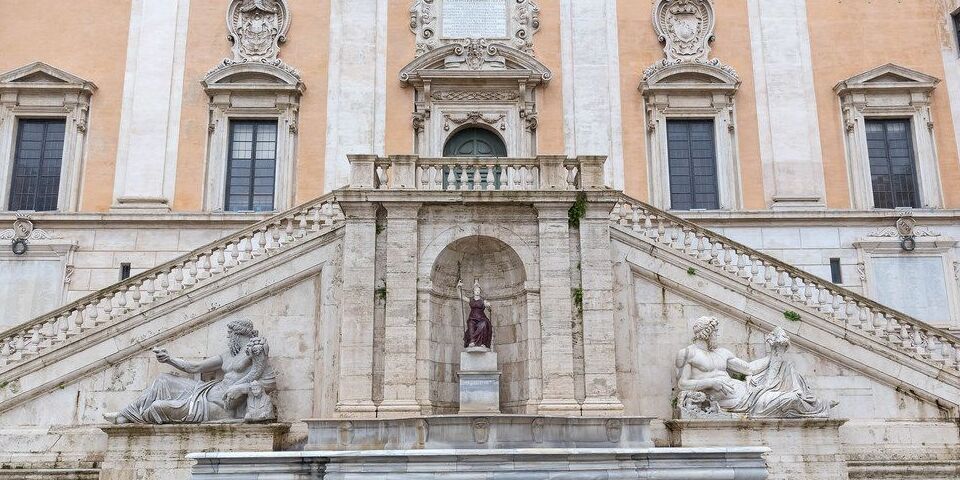
The Fountain of the Goddess Roma stands in front of the Palazzo Senatorio on the Capitoline Hill. The figure in the central niche is flanked by two reclining river figures. See it from Piazza del Campidoglio, then walk around the civic buildings to find the viewpoints over the Roman Forum.

The grand fountain of Dea (Fountain of Rome’s Goddess; Fontana della Dea) is on the top of the famous Capitoline Hill, right on Capitoline Square. It enhances the front of Palazzo Senatorio, a monumental backdrop in Piazza del Campidoglio.

Contents4 sections · ~3 min read
  1. History
    1. Michelangelo’s design
  2. Interesting Facts
  3. How to Visit The Fountain of Dea
  4. Things to Know about The Fountain of Dea

History

Initially conceived by Michelangelo, the central niche was intended for a statue of Jupiter, later replaced by a towering figure of Minerva, initially situated in the Palazzo dei Conservatori’s courtyard during the era of Paul III Farnese.

Michelangelo’s design

During the square’s redesign in 1538, Michelangelo incorporated colossal marble statues, initially representing the Nile and the Tigris but transformed into the Tiber with the addition of the she-wolf and twins, sourced from the Baths of Constantine on the Quirinal Hill.

In 1588, to commemorate the Felice Aqueduct’s construction, Matteo Bartolini da Castello designed a fountain with two stacked white Greek marble basins adorned with coats of arms, seamlessly integrating with Michelangelo’s overall square design.
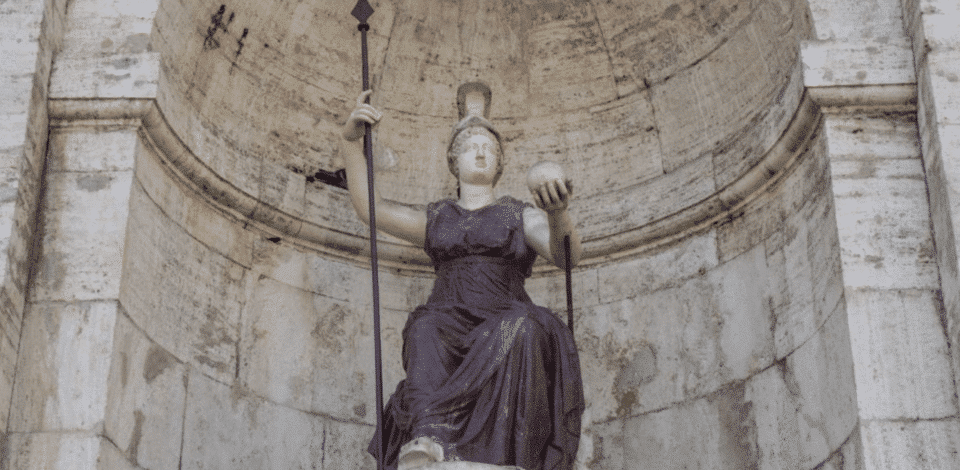
The fountain of Dea in Rome

Finally, in 1593, during the time of Clement VIII Aldobrandini, the original standing Minerva statue within the niche was replaced with a smaller porphyry and marble version. This new depiction showed Minerva, later reinterpreted as the Goddess Roma, seated and holding a spear in her left hand and a sphere in her right, positioned on three successive bases.

Read also about Michelangelo’s Pieta in Saint Peter’s Basilica in the Vatican.

Interesting Facts

  1. The Dea Roma Fountain adorns the façade of Palazzo Senatorio, an exquisite feature in the historical palace constructed on the remains of the tabularium from the first century BC. This palace is a central point in the magnificent square crafted by Michelangelo, bordered on the right by Palazzo dei Conservatori and the left by Palazzo Nuovo.
  2. The only element of the palace by Michelangelo consists of the monumental stairway that leads to the Senatorial Room, built between 1547 and 1554.
  3. The external façade is decorated with a very high central niche (14 feet high) with pairs of supporting pilasters on its sides. In the original project, the niche was supposed to be occupied by a Jupiter that was then replaced with a giant standing statue of Minerva that had been placed at the time of Paul III Farnese (1534-1549) in the courtyard of Palazzo dei Conservatori.
  4. Matteo Bartolini, hailing from Città di Castello, was entrusted with constructing a fountain in 1588 following the arrival of Acqua Felice on Capitol Hill. His design incorporated two stacked Greek marble basins against the staircase. In 1593, during the reign of Pope Clement VIII Aldobrandini (1592-1605), a seated porphyry statue from the Domitian era depicting Minerva, later reinterpreted as the Goddess Roma, was installed in the niche.
  5. The small statue rests on a triple base and is flanked by a pair of barbarians, probably made of stucco, placed in the courtyard of Palazzo dei Conservatori in 1720.

How to Visit The Fountain of Dea

  • Address: Piazza del Campidoglio
  • Metro: The closest metro station to Piazza del Campidoglio is the Colosseo station on Line B (Blue Line). You can walk to the square or take a bus from there.
  • Bus: Various bus lines serve the area around the Capitoline Hill. You can check the public transportation map or use a navigation app to find the most convenient bus route.
  • The Capitoline Square is located on top of the Capitoline Hill. Once you reach the square, you’ll find the Capitoline Museums and the iconic equestrian statue of Marcus Aurelius.

Things to Know about The Fountain of Dea

Where is the Fountain of Dea located?
The fountain of Dea is located on the top of the famous Capitoline Hill, right on the Capitoline Square.
What was the initial design of the Fountain of Dea?
Initially conceived by Michelangelo, the central niche of the Fountain of Dea was intended for a statue of Jupiter, later replaced by a towering figure of Minerva, originally situated in the Palazzo dei Conservatori’s courtyard during the era of Paul III Farnese.
What are the statues near the fountain of Dea on the Capitoline hill?
During the square’s redesign in 1538, Michelangelo incorporated colossal marble statues, originally representing the Nile and the Tigris but transformed into the Tiber with the addition of the she-wolf and twins, sourced from the Baths of Constantine on the Quirinal Hill.
Kate Zusmann
Rome travel writer & expert Kate Zusmann
years in Rome
12
guides published
190
article updated
Nov 2026
I’ve lived in the Eternal City for the past 12 years. They say every corner of Rome holds a story, and I’m here to share some of the most fascinating historical facts and local legends.
All guides by Kate →

More Rome guides

Vatican Museums Visitor Guide

The Vatican Museums

Rome Italy Tourist Attractions

Top 30 Attractions in Rome

Rome hotels with a view

Rome hotels with a view and the rooms to book

How to Book Vatican Museums & Sistine Chapel Tickets

How to Book Vatican Museums & Sistine Chapel Tickets

St. Peter's Basilica dome seen through the trees from the far side of Piazzale Garibaldi, Rome

Janiculum Hill (Gianicolo): Viewpoints and Walking Route

Column of the Immaculate Conception

Column of the Immaculate Conception

Fountain of the Naiads in Rome

Fountain of the Naiads in Rome

Piazza della Repubblica in Rome

Piazza della Repubblica in Rome

Piazza Barberini in Rome

Piazza Barberini in Rome

Show more

About us

About us ROME.US Authors Kate Zusmann and Artur Jakucewicz
We're Kate and Artur. Rome has been our home for more than ten years, and we write about the streets, churches and museums we know first-hand.

Explore Rome

  • Full front view of the Giuseppe Garibaldi equestrian monument in Rome with the ITALIA E VITTORIO EMANUELE dedication inscription on the base

    Monument to Giuseppe Garibaldi — Rome’s Bronze General on the Janiculum

  • Kaiser Trajan

    Emperor Trajan

  • A saxophone resting on a piano beside a glass

    Live jazz in Rome, from an upstairs club to a vintage tram

  • Rome’s 2025 Jubilee: the Holy Year and its basilicas

    Rome’s 2025 Jubilee: the Holy Year and its basilicas

  • Sculpture collection at the Capitoline Museums in Rome

    Capitoline Museums

RomeItaly.guide

This website uses cookies. For more info read the cookies policy This site uses cookies

RomeItaly.guide © 2026. Created with love by Roman experts and guides.

  • American English
  • Español
  • Deutsch
  • Polski
  • Français