991228 travellers read
Written by: Artur Jakucewicz
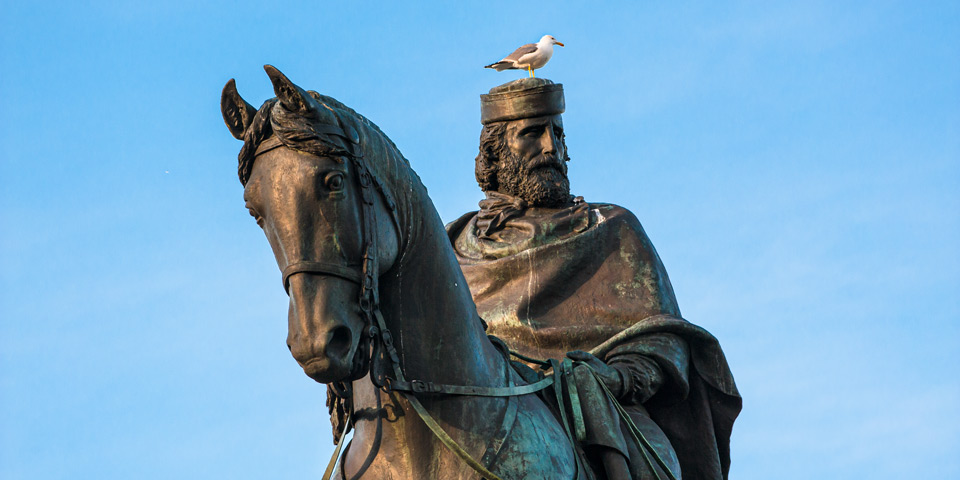
On the highest point of the Janiculum Hill, at the centre of a large gravel piazza, a bronze general on a bronze horse looks south across the whole of Rome. He wears a Hungarian fez, an American poncho, and the calm expression of a man who has finished his work. This is Giuseppe Garibaldi, the guerrilla fighter who did more than any other single person to make Italy a country, and this hilltop is where, in 1849, he lost the siege that made him famous.
The monument is one of the largest and most politically loaded pieces of public sculpture in Rome. Almost none of the tourists who come up here for the noon cannon or the view actually stop to read it. This is a guide to what it is, why it was built where it was built, and the details on it that most visitors walk past without noticing.
Garibaldi was the strangest kind of national hero, a professional revolutionary who won his most decisive campaigns with volunteers in red shirts, refused every title and reward offered to him, and retired to farm on a small rocky island. He fought for republics in Brazil, Uruguay and France, defended Rome from a French army in 1849, invaded Sicily with a thousand men in 1860, and by the end of that year had personally handed the southern half of Italy to a king he privately despised. Italians nicknamed him l’Eroe dei Due Mondi, the Hero of Two Worlds, because his battles ran from the pampas of South America to the mountains of Sicily.
The sculptor put those two worlds directly on the statue. Look at Garibaldi’s head: he wears the small stiff cap called a berretto magiaro, a Hungarian-style fez picked up during his republican campaigns. His shoulders are covered by the long South American cavalry poncho he adopted in Montevideo in the 1840s. It is the only equestrian statue in Rome where the hero is dressed as a foreign volunteer.
The choice of the Janiculum was not decorative. On 30 April 1849, French troops sent by Louis-Napoleon Bonaparte attacked Rome to restore the pope, who had fled the short-lived Roman Republic. Garibaldi, commanding a mixed force of Italian volunteers, held them off for two months on the slopes of this exact hill. On 30 June, after some of the bloodiest street fighting Rome had seen since antiquity, the Republic surrendered. Garibaldi escaped east across the peninsula in a legendary retreat. The pope came back. It looked like the end.
It wasn’t. Twenty-one years later, on 20 September 1870, Italian troops broke through the Aurelian Walls at Porta Pia and finally took Rome from the papacy. Twenty-five years after that, on 20 September 1895, the anniversary of the day, the newly unified kingdom unveiled this monument on the exact ridge where Garibaldi had lost his siege. The site is a deliberate rebuke: Rome eventually became what he had fought for it to be, and the country put his statue on the ground he had failed to hold.
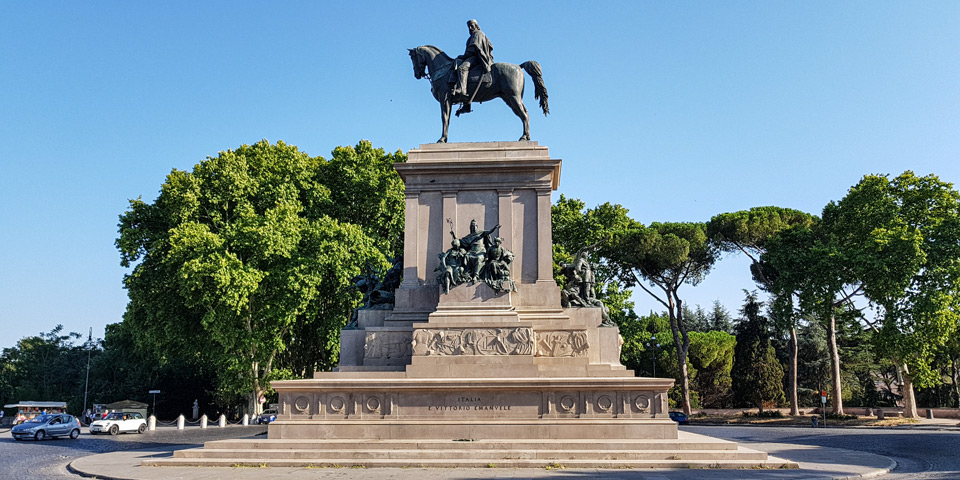
The monument was the result of a national design competition. Thirty-seven models were displayed at the newly opened Palazzo delle Esposizioni. The jury included the sculptor Giulio Monteverde, the architect Camillo Boito, the painter Domenico Morelli, a group of parliamentarians and the prime minister of the day, Agostino Depretis. The winning design was by a Florentine sculptor named Emilio Gallori (1846-1924), a relatively conservative Academic figure whose only major public monument before this was to the poet Metastasio near Chiesa Nuova.
The site was granted on 15 May 1892. The foundation stone was laid on 19 March 1895 in the presence of the royal family. On 20 September of that year, in front of enormous crowds and with considerable ceremony, the monument was unveiled.
Gallori’s later career had a quiet postscript. When another sculptor, Enrico Chiaradia, died in 1902 leaving unfinished the huge bronze equestrian statue of King Victor Emmanuel II for the Vittoriano, Gallori was called in to help finish it. So the same hand shaped both of Rome’s great equestrian monuments, the republican general on the Janiculum and the king on the Altar of the Fatherland, separated by twenty years and by the width of the historic centre. From this hilltop, on a clear day, you can see the other.
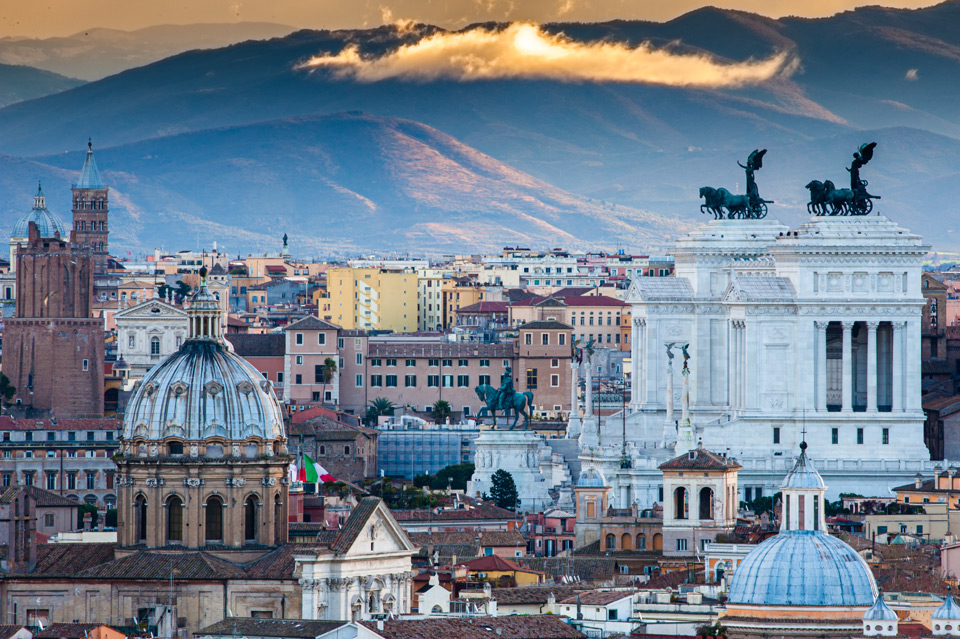
Now look at the front of the pedestal, at the small carved words on the plinth:
ITALIA E VITTORIO EMANUELE.
It is the strangest political inscription in Rome. Garibaldi conquered Naples and Sicily in 1860, then rode to Teano and personally handed the whole territory over to King Victor Emmanuel II of Piedmont. Two years later, in 1862, when Garibaldi tried a private march on Rome, the same king’s army wounded him in the leg at Aspromonte and put him under arrest. In 1867 he tried again; the Italian army stopped him at Mentana. The general who had made the king’s Italy possible was treated as a public danger by the resulting state every time he tried to finish the job.
The dedication on this monument, “to Italy and Victor Emmanuel”, was written by the unified state, which needed both figures in its foundation myth: the republican hero and the constitutional king, side by side, with the tension quietly filed away. Stand in front of the plinth and read those four words, and you are looking at Italian nation-building as compromise, cut in stone.
Here is the part of the visit that even most guidebooks skip.
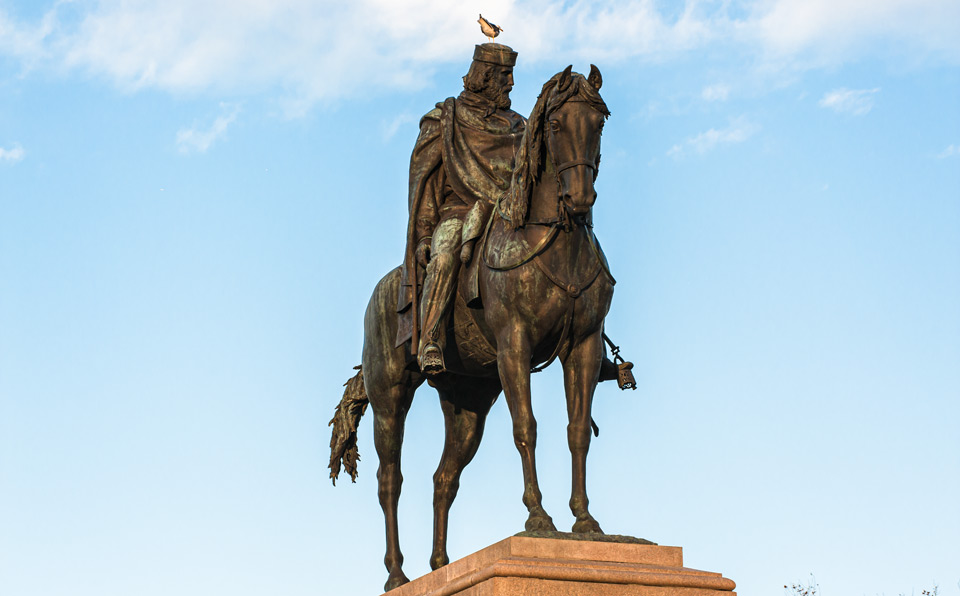
When the monument was unveiled in 1895, according to several sources, Garibaldi and his horse were oriented differently from today, with the general’s gaze fixed towards the north-west, towards the Vatican. The Kingdom of Italy and the papacy had not spoken to each other for twenty-five years, since Italian troops had entered Rome in 1870. The pope had declared himself a “prisoner in the Vatican.” Putting an anticlerical general on the Janiculum with his eyes on Saint Peter’s was not a subtle piece of political theatre.
That stand-off ended on 11 February 1929, when Mussolini signed the Lateran Pacts with the Vatican. As part of the accompanying negotiations, the Church reportedly asked that both the statue of Giordano Bruno on Campo de’ Fiori (a burnt heretic) and the Garibaldi monument on the Janiculum (a burnt reputation) be removed as insults. On 13 May 1929 Mussolini gave a speech in parliament refusing: Bruno stays. Garibaldi stays. He would give the Vatican peace but not the retreat of the Risorgimento.
Sometime after that speech, however, the monument was rotated. Today Garibaldi looks south, the horse’s body runs east-west, and the Vatican is off to the north, no longer in his direct line of sight. Stand behind the horse’s tail (looking west) and Saint Peter’s dome is well to your right. Stand in front of the general and look up at his face, and he is looking away from the Vatican entirely. There is an old Roman line that puts it more sharply than any guidebook does: ora il cavallo mostra il sedere a San Pietro, “now the horse shows its rear end to Saint Peter’s.” The exact geometry is not quite that clean, but the political point, Garibaldi’s eyes are no longer on the pope, is undeniable.
How and exactly when the rotation happened is one of those pieces of Roman history that lives more clearly in oral tradition than in the archives; the official monument records are quiet about it. But the physical evidence is on the hill, and it does not match the original 1895 photographs.
The pedestal was designed as a programme of images. Gallori carved four sides, each with a bronze group and a stone bas-relief, that spell out Garibaldi’s life without a single word.
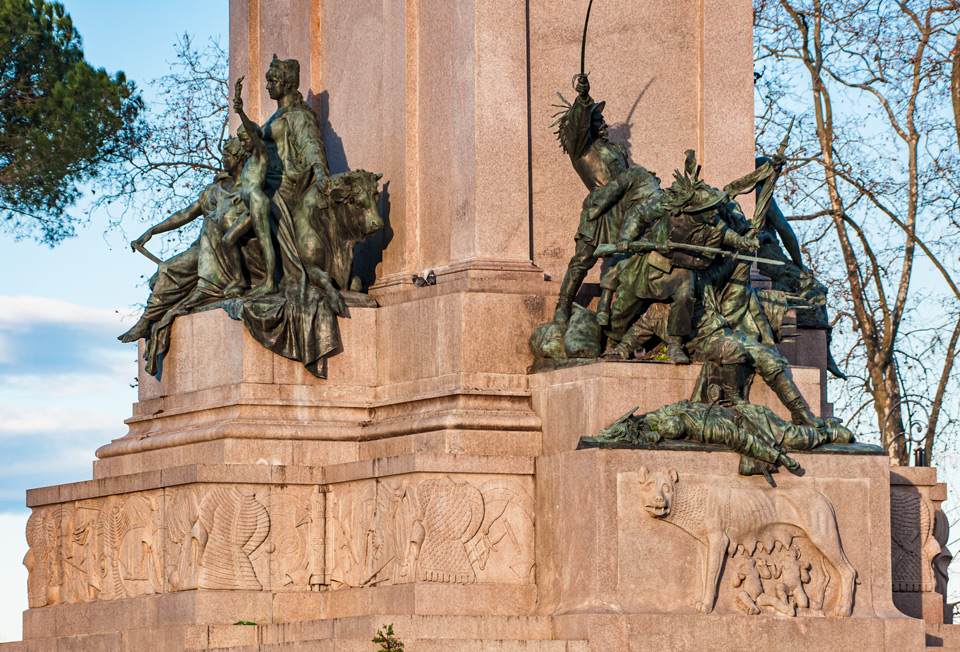
At the front corners, on either side of the dedication, sit two large allegorical figures of continents: Europe, a seated woman with a bull, a scholar and a small child, and America, on the opposite corner, a woman with a Native headdress and a lion at her feet. Between them, a bas-relief of the Capitoline she-wolf nursing Romulus and Remus is cut into the stone, as if to say: the she-wolf approves.
At the back corners are the two combat groups. One shows a defence of Rome, with Garibaldi’s men firing from a barricade and a fallen comrade at their feet. The other shows the landing at Marsala in Sicily in May 1860, the beginning of the campaign that took the Kingdom of the Two Sicilies for Italy. Circling the whole pedestal, along the plinth, runs a frieze carved with the weapons of ancient Rome, including helmets, shields, bundled spears and laurel wreaths, as if to insist that Garibaldi’s war was a continuation of Rome’s original one.
The lion crouching at the foot of the American allegory is not decorative either. It is the Lion of Caprera, the small rocky island off Sardinia where Garibaldi retired, farmed sheep, and eventually died in 1882. The whole geography of his life is on this pedestal: Europe, America, Rome, Caprera. Four corners, a biography spanning two continents.
Walk around to one side of the pedestal and you will find the single most quoted phrase Garibaldi ever spoke, cut into the stone:
ROMA O MORTE.
Rome or death. He said it on 19 July 1862, at a rally in Marsala, launching an unauthorised march north to take Rome from the pope. He was not authorised by the Italian government to go. The Italian government sent an army to intercept him and shot him in the leg near Aspromonte in Calabria a month later. The country he had helped create arrested its own hero for trying to complete it.
The irony of finding those three words carved on the same monument that reads Italia e Vittorio Emanuele around the front is exact and deliberate. Italy needed both stories in stone: the loyal soldier and the illegal patriot. So both are here.
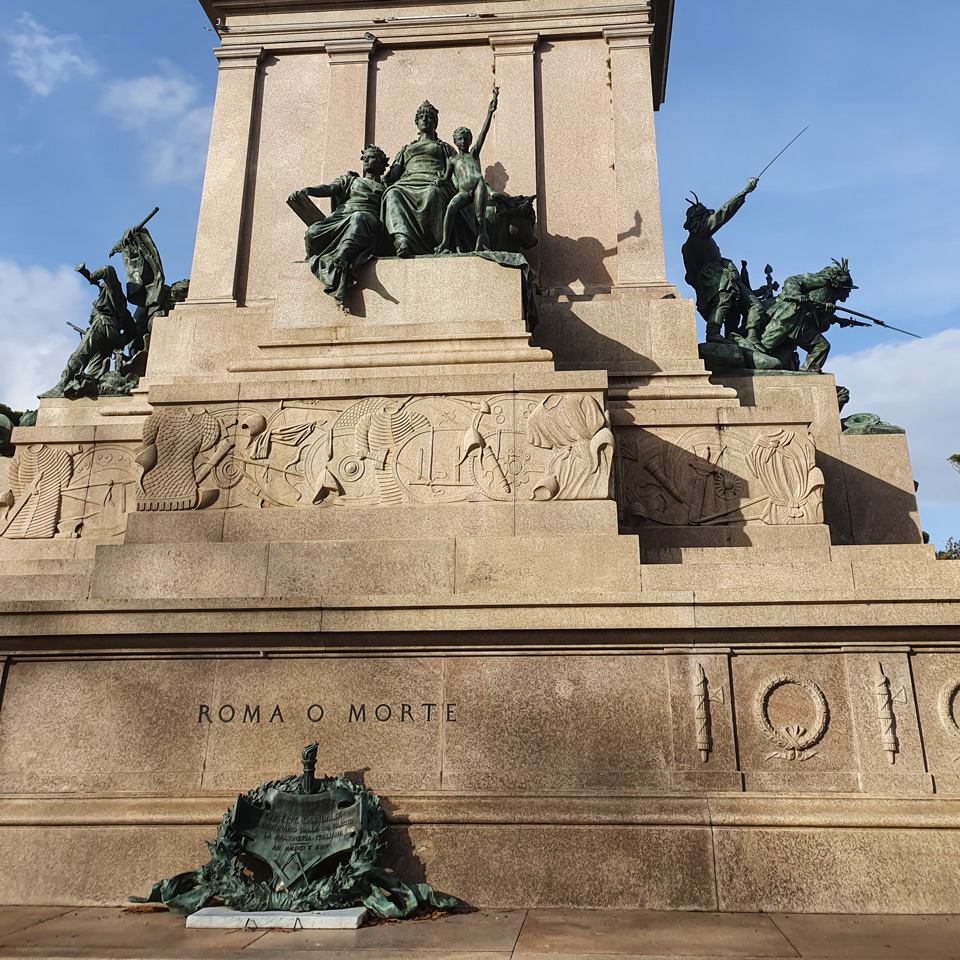
At the base of the ROMA O MORTE inscription sits a battered bronze wreath. Read the ribbon: A Giuseppe Garibaldi nel centenario della sua nascita, la Massoneria Italiana. AN. MDCCCCVII A.V.L., “To Giuseppe Garibaldi on the centenary of his birth, Italian Freemasonry. Year 1907 of the True Light.” The dating is a giveaway: it uses the Masonic calendar. The wreath is a gift to Garibaldi, a Freemason and the first Grand Master of unified Italian Freemasonry, from his own lodge on the hundredth anniversary of his birth. It was placed by Ettore Ferrari, the sculptor who also made the statue of Giordano Bruno on Campo de’ Fiori, another figure the Fascist regime and the Church both wanted removed.
During Fascism the original wreath was pulled off the monument and replaced with Fascist symbols. The Masonic wreath you see today is a copy, restored to its original position only in 1943, as the regime was falling. This small dark object at the foot of an inscription is a physical scar of the twentieth century. It was placed in 1907, destroyed in the 1930s and reinstated in 1943, yet almost no one who visits the monument realises what they are looking at.
The monument’s twentieth-century troubles were not only political. Standing on the highest point in Rome, holding up nine metres of bronze on a granite base, it has been hit by lightning three separate times: in September 1944, in July 1963, and, most seriously, on 7 September 2018, when a strike caused considerable damage to the pedestal itself. The 2018 hit closed the monument for years. Restoration by the city’s cultural authority finally reopened it in autumn 2022, with a lightning-protection system now discreetly fitted so that a fourth strike does less damage. If the pedestal looks unusually crisp compared with other nineteenth-century Roman monuments, that is why.
Most tourists photograph the horse and the general from twenty metres away and move on. That misses the point of the whole thing. This monument is one of the few in Rome where every side tells a different story: the front is the compromise between Garibaldi and the king; the sides carry Rome or death and the reasons the country arrested him for saying it; the general himself no longer looks towards the Vatican, but once did; the corners represent the principal geographies of his life. It easily rewards thirty slow minutes spent walking around it.
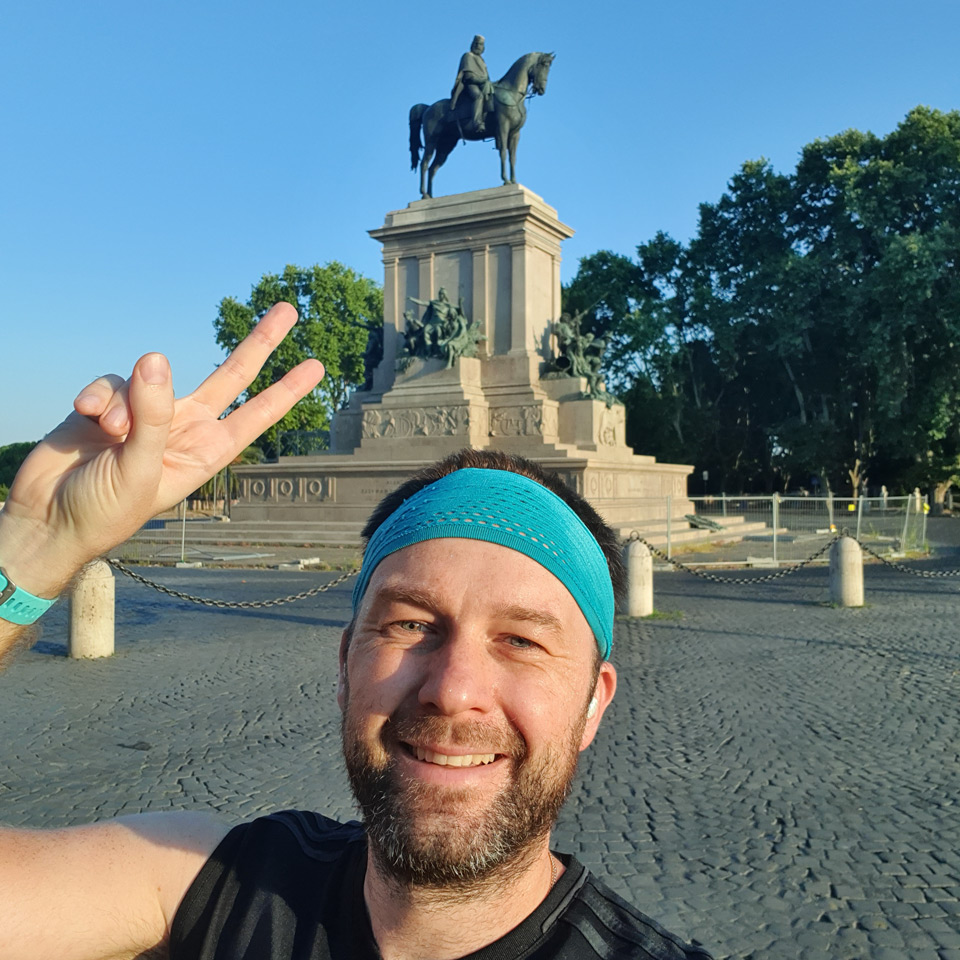
The other reason to come back to it is that Piazzale Garibaldi is one of the real social anchors of the city, a place Romans actually use. Runners loop past it at dawn, secondary school classes meet on its steps in the afternoon, and half of a certain kind of Roman conversation ends with ci vediamo da Garibaldi, “see you at Garibaldi.”
I have been up here at every hour of the day for years. It looks different at each of them. Early, empty and pink, the monument reads as an object of stone and bronze. In the late afternoon, with dozens of people scattered across the piazza and a Vespa parked at the base, it reads as a piece of ordinary city furniture. Late at night, when the noon cannon is a memory and the panorama is a spread of lights, it reads as something older than either.
Come once for the story on the pedestal. Come back later for the wreath at the base of ROMA O MORTE and the way the general no longer looks towards the Vatican. Come a third time at sunrise, when the whole hill is yours and the Fontana dell’Acqua Paola two minutes downhill is empty of everyone but joggers, and you begin to understand why Romans have kept this general on his hilltop, quietly turned this way and that, for a hundred and thirty years without ever thinking of tearing him down.
RomeItaly.guide © 2026. Created with love by Roman experts and guides.