
991228 travellers read
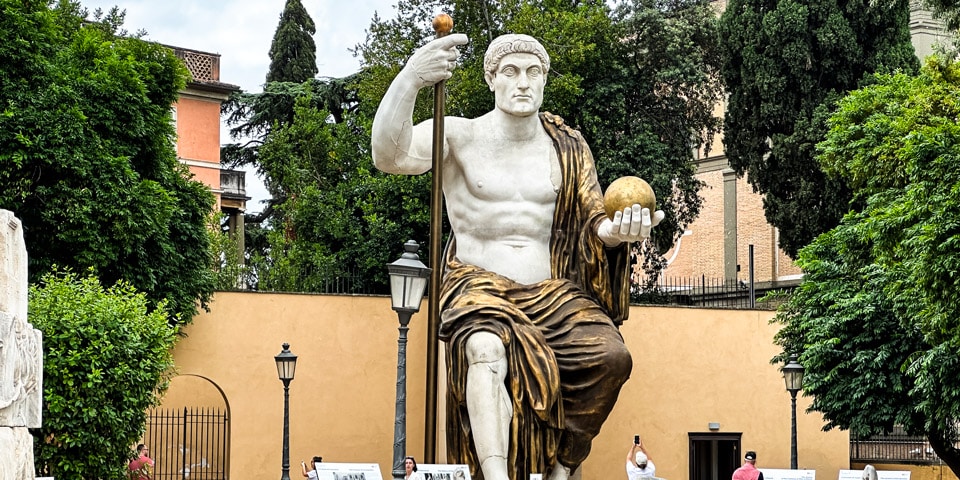
The seated Colossus of Constantine stood about 13 metres high, roughly the height of a four-storey building. Only its monumental marble fragments survived antiquity. Visitors can now compare those originals in the Palazzo dei Conservatori with a full-size reconstruction in the garden of Villa Caffarelli, both within the Capitoline Museums complex.
The reconstruction has stood on the Capitoline Hill since February 2024 and restores the relationship between the famous fragments and the enormous body they once belonged to. The ancient pieces remain in their historic courtyard display.
Constantine ruled from AD 306 to 337. His reign included the legal recognition of Christianity and the foundation of Constantinople as an imperial capital. The colossus is generally dated to AD 313-324, the years after his victory over Maxentius and before he became sole ruler of the Roman Empire.
The statue occupied the western apse of the Basilica of Maxentius beside the Roman Forum. Scholars reconstruct it as a seated acrolith. Its exposed flesh was represented in white marble, while the clothed parts were probably made from metal or gilded stucco over an internal framework.
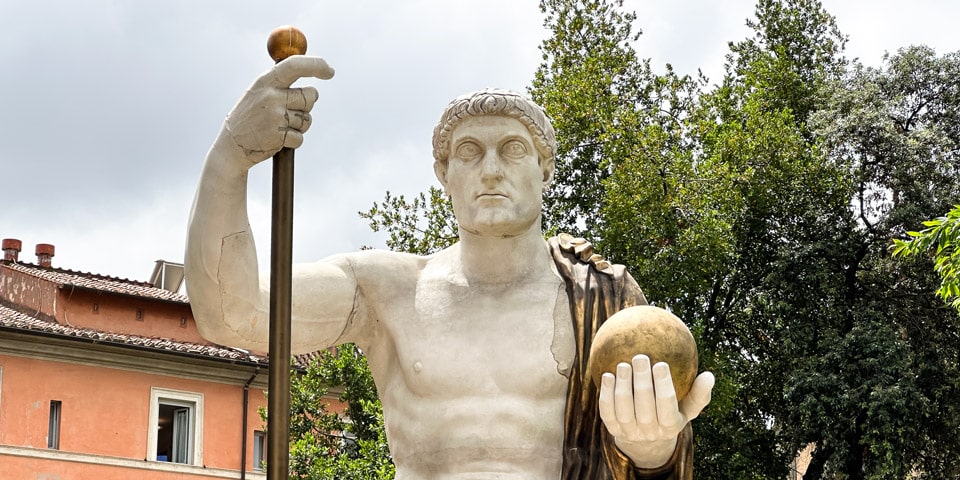
Constantine appears through the visual language of Jupiter: the upper body partly uncovered, a cloak resting on one shoulder, a long sceptre in his right hand, and a globe in his left. This divine imagery presented imperial power in a form Roman viewers already understood. Archaeologists also consider the possibility that an earlier pagan statue was adapted for Constantine.
The marble pieces were found in 1486 in the apse of a building then believed to be Vespasian’s Temple of Peace. The structure was correctly identified as the Basilica of Maxentius only in the early nineteenth century.
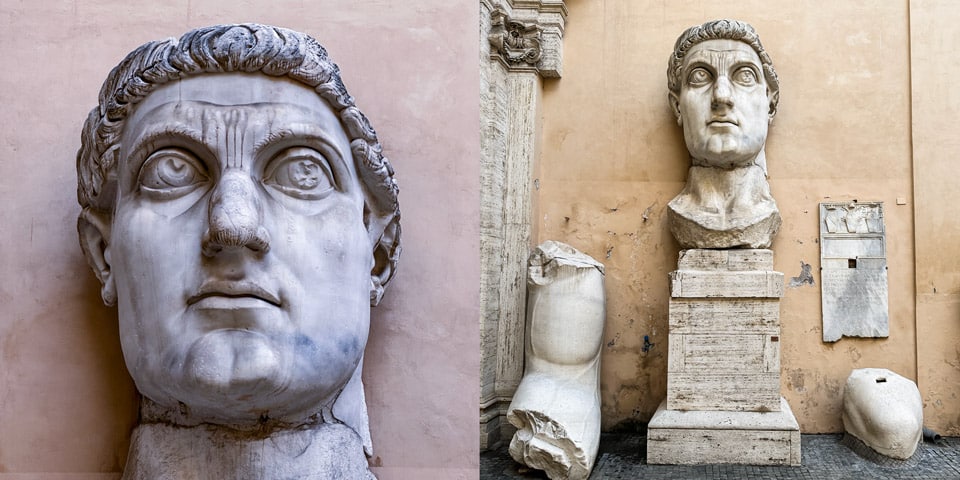
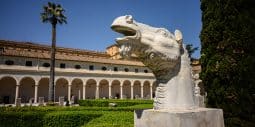
The fragments were initially attributed to Emperor Commodus. They were installed in the courtyard of the Palazzo dei Conservatori during renovation work carried out in 1567-1569 according to Michelangelo’s design. Scholars identified the portrait as Constantine only at the end of the nineteenth century.
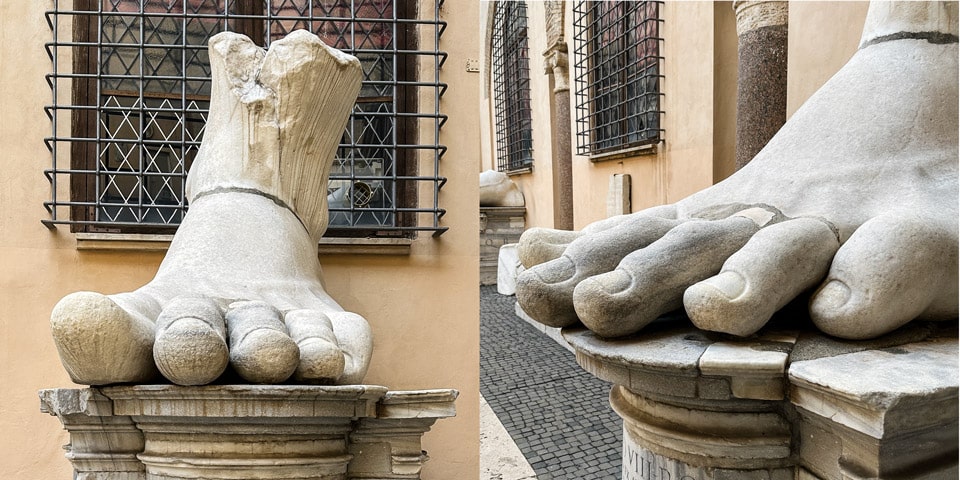
The surviving group includes the head, arm, wrist, hand, knee, shin, and both feet. Their scale is easiest to grasp beside another person: the head alone is more than twice life-size, while each foot is about two metres long. A further fragment from the chest was discovered in 1951.
The reconstruction was developed by the Capitoline Superintendency, Fondazione Prada, and Factum Foundation under the scientific supervision of Claudio Parisi Presicce. It was first assembled for the Recycling Beauty exhibition in Milan in 2022 and moved to Villa Caffarelli in 2024.
In March 2022, the team recorded the surviving pieces with photogrammetry and LiDAR. A separate scan captured the chest fragment held by the Parco Archeologico del Colosseo. The resulting high-resolution models established the position and proportions of the ancient marble elements.
Missing sections required comparison with other Roman statues. The principal references included a seated Jupiter in the State Hermitage Museum, a Hercules in the National Roman Museum, and a plaster copy of Claudius portrayed as Jupiter in the Ara Pacis Museum. These works helped the team reconstruct the pose and the fall of the military cloak, or paludamentum.
[https://vimeo.com/768529729](https://vimeo.com/768529729)
Copies of the surviving marble fragments were cast in reinforced resin and finished to reproduce their weathered surfaces. Newly reconstructed areas use polyurethane, resin, marble powder, mica, plaster, and gilded finishes. An aluminium framework supports the figure and allows its sections to be assembled or moved. The surface treatment makes the copied ancient fragments visibly distinct from the reconstructed body and cloak.
The Factum Foundation project record documents the scanning, modelling, casting, and assembly in detail.
I first saw the original fragments in the Capitoline Museums more than a decade before the reconstruction arrived in Rome. The head and feet were already memorable because their scale overwhelmed the surrounding courtyard.
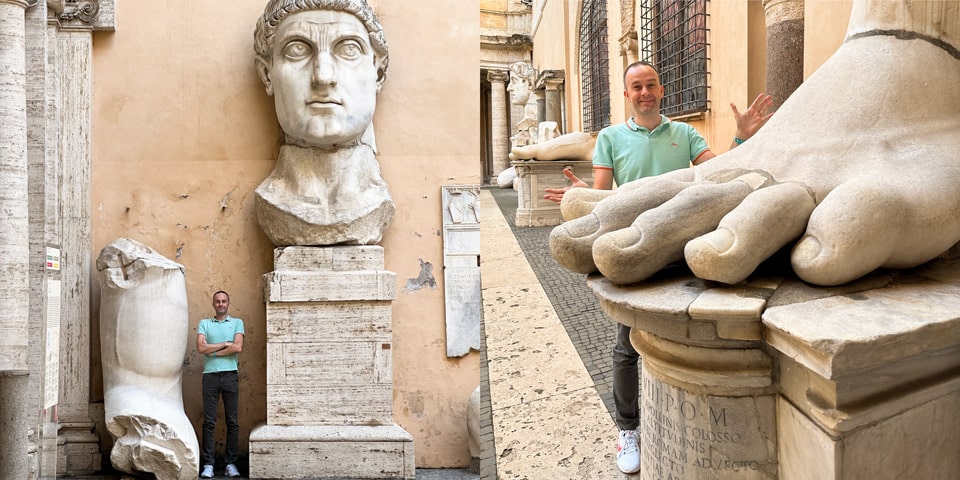
The complete figure changes how those pieces read. Its seated posture, raised sceptre, and enormous draped body reveal the carefully staged image of authority that once filled the basilica’s apse. The reconstruction supplies the missing scale and pose; the courtyard preserves the ancient marble surfaces.
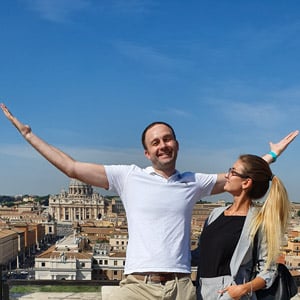
I later visited the Villa Caffarelli display with Rome.us co-author Kate Zusman. Seeing a person beside the reconstructed figure provides the clearest measure of its height.
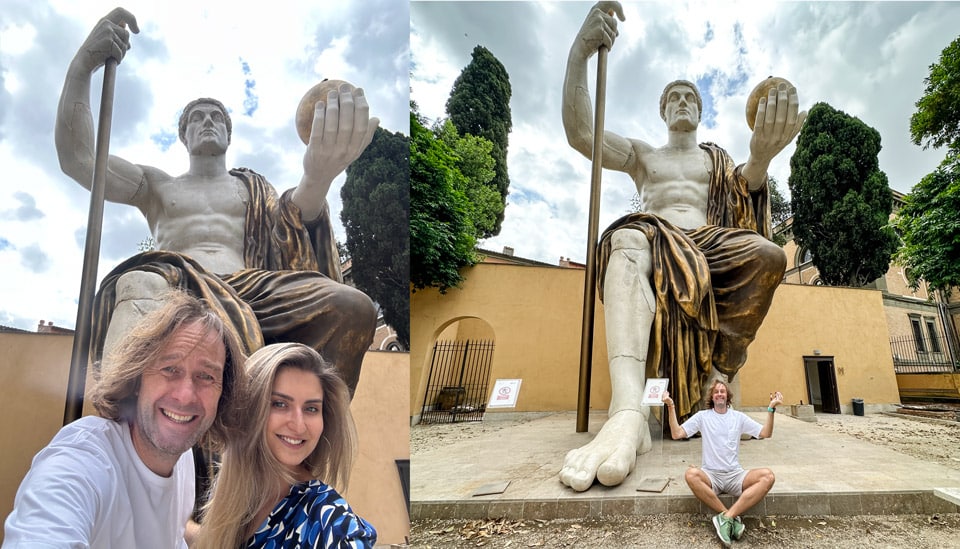
View both displays if possible. The modern reconstruction explains the original composition, while the surviving fragments show what actually remains from the fourth-century monument.
RomeItaly.guide © 2026. Created with love by Roman experts and guides.