
989840 travellers read
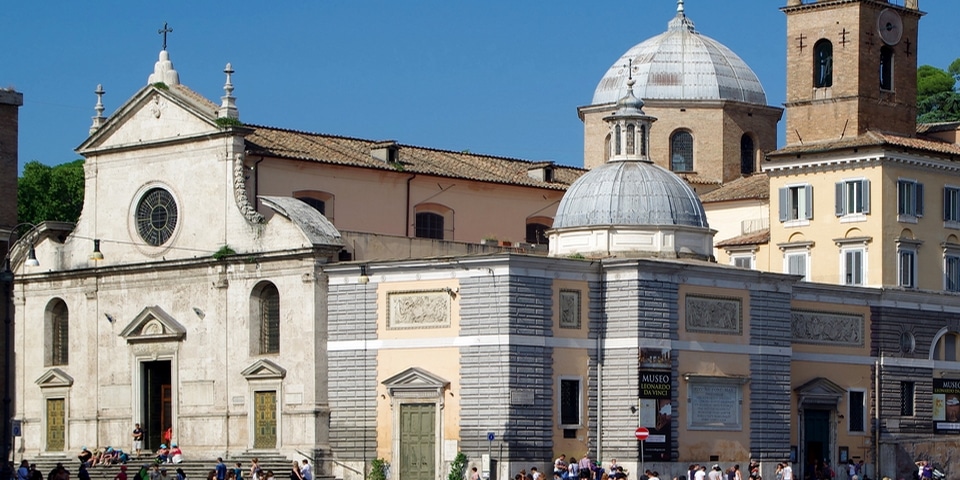
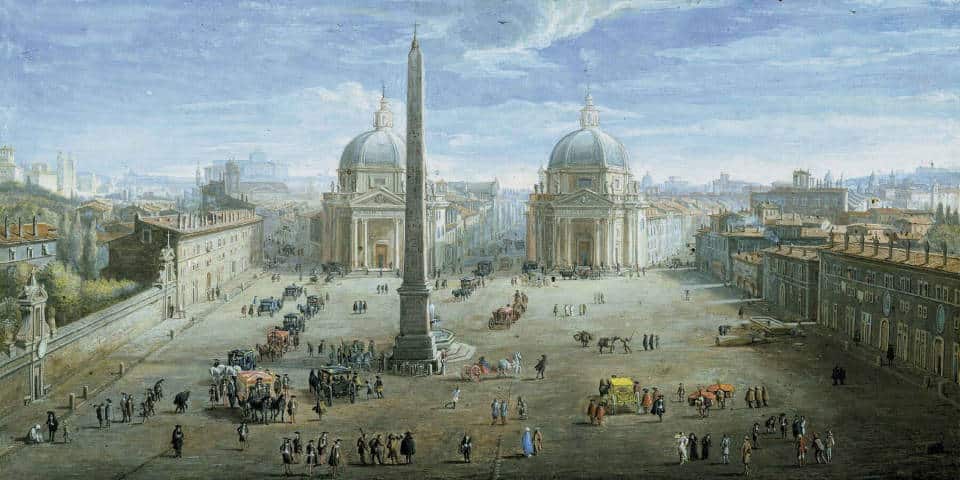
The Parish Basilica of Santa Maria del Popolo (Basilica Parrocchiale Santa Maria del Popolo) is a titular church administered by the Augustinian Order. It is located on the north side of Piazza del Popolo, one of Rome’s must-see squares.
The church houses artworks by renowned artists such as Raphael, Gian Lorenzo Bernini, Caravaggio, Alessandro Algardi, Pinturicchio, Andrea Bregno, Guillaume de Marcillat and Donato Bramante.
The history of the basilica’s creation is linked to the memory of Emperor Nero and Pope Paschal II. After Nero’s suicide, he was buried in the mausoleum of his paternal family, the Domitii Ahenobarbi, at the foot of Pincian Hill.
The tomb was later buried under a landslide and, on its ruins, a huge walnut tree grew that “was so tall and sublime that no other plant exceeded it in any way.” The tree soon became the haunt of a large number of horrendous demons, harassing the inhabitants of the area and also travellers arriving in the city from the north through Porta Flaminia.
As the devils endangered an important access road to the city and also disturbed the whole populace, the newly elected pontiff, Paschal II, was deeply concerned. So the Pope fasted and prayed for three days, and at the end of that period, exhausted, he dreamt of the Blessed Virgin Mary, who gave him detailed instructions on how to free the city from the demonic scourge.
On the Thursday after the Third Sunday of Lent in 1099, the Pope assembled the clergy and people of Rome in an impressive procession that, with the crucifix at its head, went along the urban stretch of the Via Flaminia until it reached the infested spot. There, Paschal II performed the rite of exorcism and then struck the walnut tree with a decisive blow to its root, causing the evil spirits to burst forth, shouting madly. When the tree was removed, the remains of Nero were found among the ruins; the Pope ordered that these be thrown into the Tiber.
When the Pope freed Rome from the demons, he devoted that corner to Christian worship. Paschal II, to the sound of hymns, laid the first stone of an altar on the former site of the walnut tree. Within three days, a simple chapel was built on this spot and dedicated to the Virgin Mary.
The early history of the basilica is largely unknown because its archives were lost during the Napoleonic era. However, several documents from before 1500 survived, with the earliest archival sources dating to the 13th century.
The name “del Popolo” (“of the people”) is derived from Populus, meaning a large rural parish in medieval Latin. Thus, the name is linked to the suburban settlement around Via Flaminia that was created after the chapel had been built. Moreover, the name S. Maria ad Flaminiam appears in some 15th-century documents.
The church was entrusted to the Order of Saint Augustine in the middle of the 13th century. The Augustinians were a new mendicant order established under the guidance of Cardinal Riccardo Annibaldi, one of the most influential members of the Roman Curia at the time.
Later, a community of friars was established by the church and the Franciscans were compensated for their loss with the monastery of Ara Coeli (1250-1251).
The strong connection between the Annibaldi family and the church was confirmed by an engraving that mentioned two noblewomen of the family, Caritia and Gulitia, who set up marble monuments within the basilica in 1263.
On the orders of Pope Sixtus IV, the basilica was rebuilt between 1472 and 1477. This Pope presented himself as the Urbis Restaurator of Rome and embarked on an ambitious renovation programme. The medieval church was completely demolished. A new three-aisled, Latin cross-shaped basilica was built with four identical chapels on each side, an octagonal dome above the crossing, and a tall bell tower at the end of the right transept. This reconstruction became an example of early Italian Renaissance architecture in Rome.
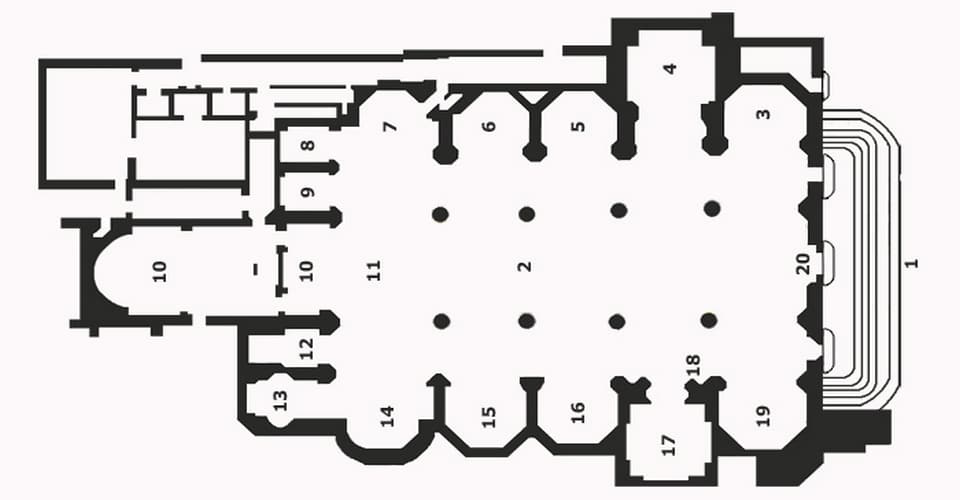
Despite many later changes to the basilica, it still largely retains its Sistine form today.
The reconstruction also carried a symbolic message: Nero’s evil walnut tree was supplanted by the beneficent oak of the Della Rovere. The papal coats of arms were placed on the façade. Another key aspect of the Sistine rebuilding was that it made the basilica – the first church for travellers arriving in Rome from the north – a dynastic monument to the Della Rovere family. This was reinforced by relatives of the Pope and other members of his court, who bought chapels and commissioned funerary monuments.
With the election of Julius II Della Rovere in 1503, the Basilica of Santa Maria del Popolo became the Pope’s favourite church. Julius was devoted to the icon of Madonna del Popolo. He altered his uncle’s work and built a spacious new choir between 1505 and 1510 behind the main altar. Donato Bramante, the Pope’s favoured architect, worked on this project.
The choir was built in the High Renaissance style and decorated with Pinturicchio’s frescoes on the sail vault and Guillaume de Marcillat’s stained-glass windows. Later, it was also used as a mausoleum, where Andrea Sansovino created two monumental tombs for Cardinal Girolamo Basso della Rovere and Cardinal Ascanio Sforza.
One of the most important commissions was for Raphael, who painted the Madonna of the Veil, a portrayal of the Holy Family (1508), and the Portrait of Pope Julius II (1511).
However, in 1591, both paintings were removed from the church by Paolo Emilio Sfonrati and later sold.
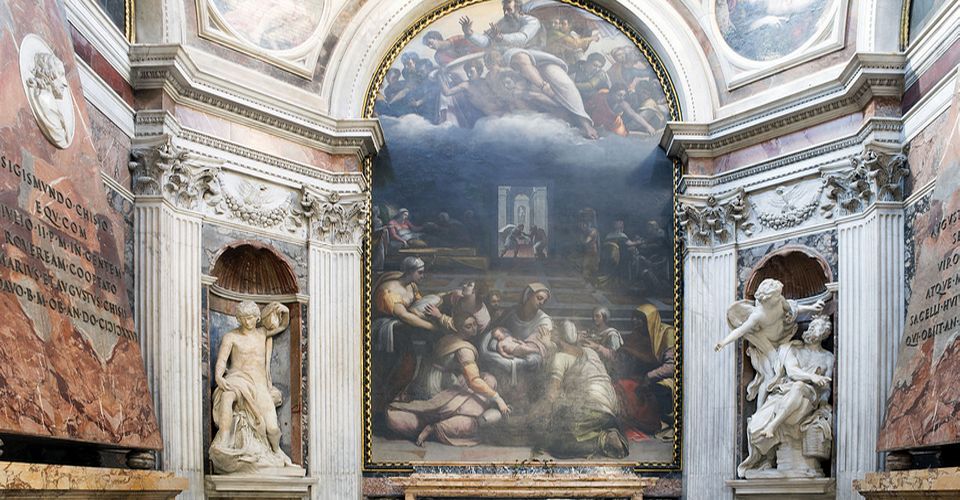
Sienese banker Agostino Chigi, adopted into the Della Rovere family, built a mausoleum to replace the second chapel on the church’s left-hand side in 1507. The chapel was dedicated to the Virgin of Loreto, whose cult was promoted by the Della Rovere popes. Raphael designed the Chigi Chapel, which was largely completed in 1516 but remained unfinished for many years.
After the Della Rovere era, the basilica lost its role as a papal church but was still one of Rome’s most important pilgrimage churches. In 1561, Pope Pius IV led a solemn procession from St. Peter’s to the Basilica of Santa Maria del Popolo on the occasion of the reopening of the Council of Trent.
The last important Renaissance addition was the Theodoli Chapel, built between 1555 and 1575 by Giulio Mazzoni.
The basilica became a parish church when Pope Pius IV created the Parish of St. Andrew “outside Porta Flaminia” and united it in perpetuity with the Augustinian priory. The friars and Pope Pius V oversaw the care of the new parish. Moreover, the parish still exists today and encompasses a vast area, including the southern part of the Flaminio district, the Pincian Hill, and part of the historic centre around Piazza del Popolo.
In 1594, Pope Clement VIII ordered the removal of the tomb of Vannozza dei Cattanei, the mistress of Alexander VI, from the basilica to make the memory of the Borgias less visible, as far as possible.
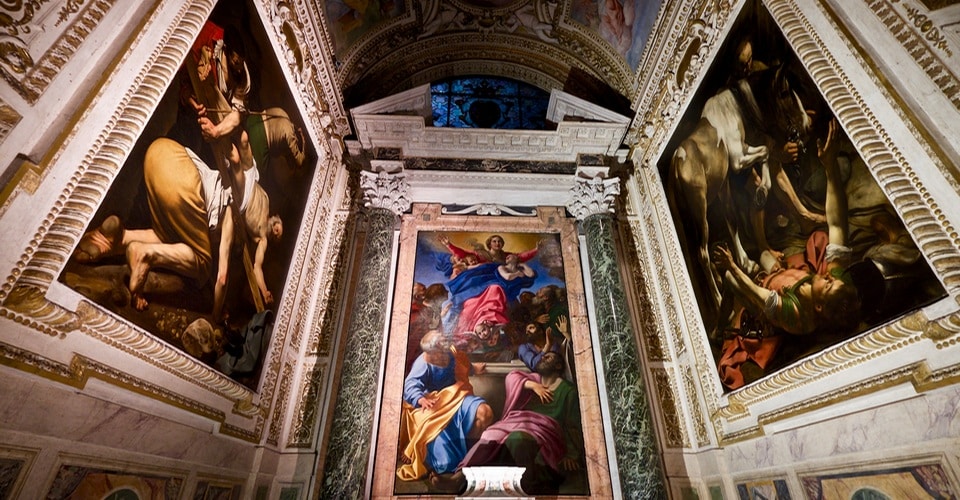
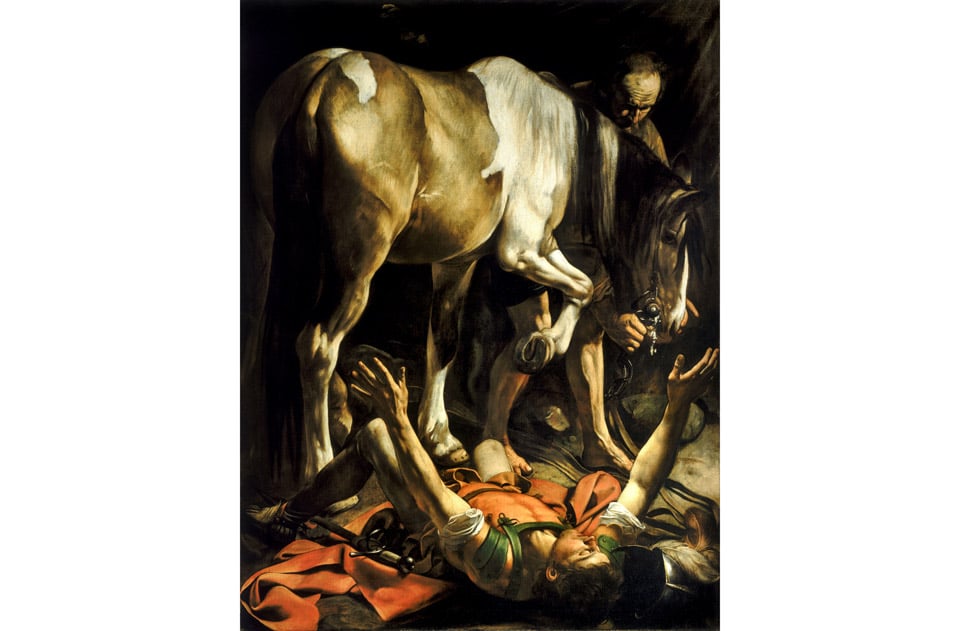
The Cerasi Chapel in Santa Maria del Popolo contains two paintings by Caravaggio. These paintings are: “The Conversion on the Way to Damascus” and the famous “Crucifixion of Saint Peter.”
“Crucifixion of Saint Peter” (Crocifissione di san Pietro, 1601) depicts the martyrdom of St Peter by crucifixion—Peter asked for his cross to be turned so as not to imitate his God, Jesus Christ. He is therefore portrayed upside down. 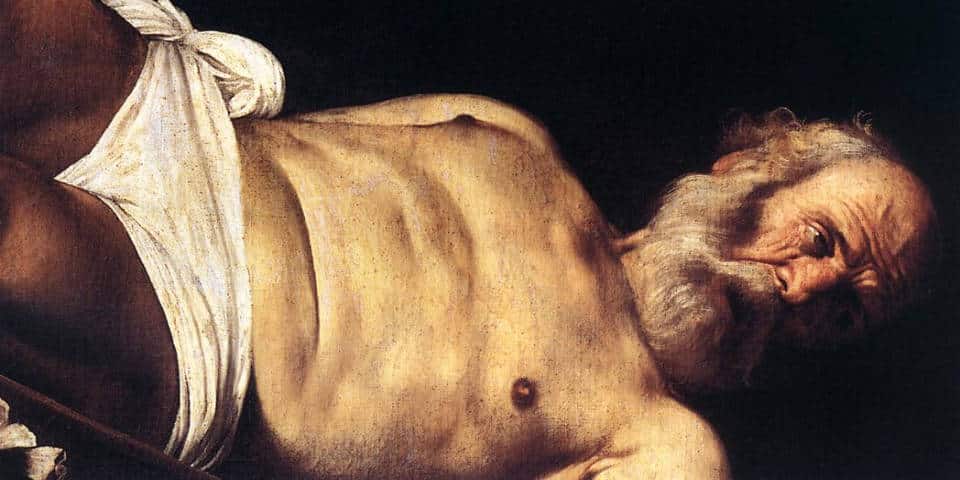
“The Conversion on the Way to Damascus” (Conversione di San Paolo, 1601) portrays the moment described in Chapter 9 of Acts of the Apostles when Saul, soon to become the apostle Paul, set out for Damascus. Instead, he heard the Lord say, “I am Jesus, whom you persecute, arise and go into the city.” The Golden Legend, a collection of medieval retellings of biblical events, may have shaped the context for Caravaggio. This scene captures the exact moment Paul is overwhelmed by the spirit of Jesus Christ and is thrown from his horse.
See a guide to all Caravaggio’s works in Rome.
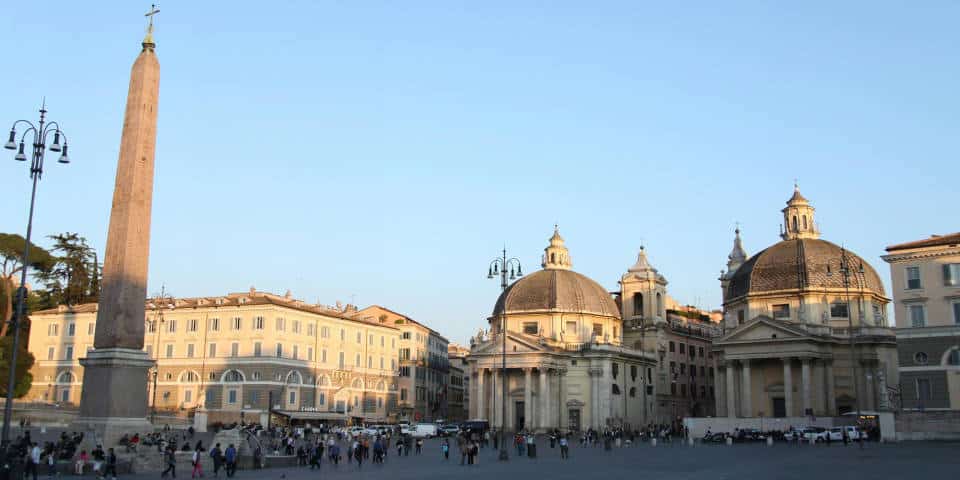
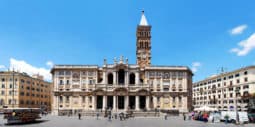
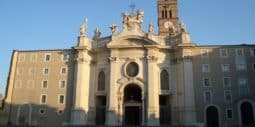
The basilica’s façade was built in the early Renaissance style in the 1470s during the renovation under Pope Sixtus IV. Moreover, it was later reworked by Gian Lorenzo Bernini in the 17th century to preserve its original form. Initially, there were panels in the windows and spokes in the central rose window. In addition, the earlier church was free-standing, with a clear view of the bell tower.
Andrea Bregno is often credited with the design, although there is no explicit confirmation. The architect aimed for perfect proportions in his project and managed to create masterful details. The high façade was built of Roman travertine, like many other buildings in Rome of that period. Although the architecture is simple, there are many details. It is adorned with four pilasters on the lower level and two pilasters flanking the upper part, with the rose window in the middle.
If you are a fan of the famous Angels and Demons book/film by Dan Brown, you should visit the basilica. The scene where, after racing across the city, Langdon and Vittoria reach Santa Maria del Popolo was actually filmed in the basilica. They enter and find Raphael’s Chigi Chapel with “earthly” connotations. There they find the cover stone depicting Mors, the Roman god of Death, with a ladder descending.
Langdon enters the tomb where he finds the first Cardinal, buried to the waist, dead from choking on earth stuffed down his throat. His chest is branded with a symbol of EARTH, reminding Langdon of the brand on Leonardo Vetra.
RomeItaly.guide © 2026. Created with love by Roman experts and guides.